


 Chinese
 Spanish
 Russian
 Portuguese
 French
 German
 Indonesian
 Thai
 Vietnamese
 Arabic
 Italian
 Turkish
 Polish
 Japanese

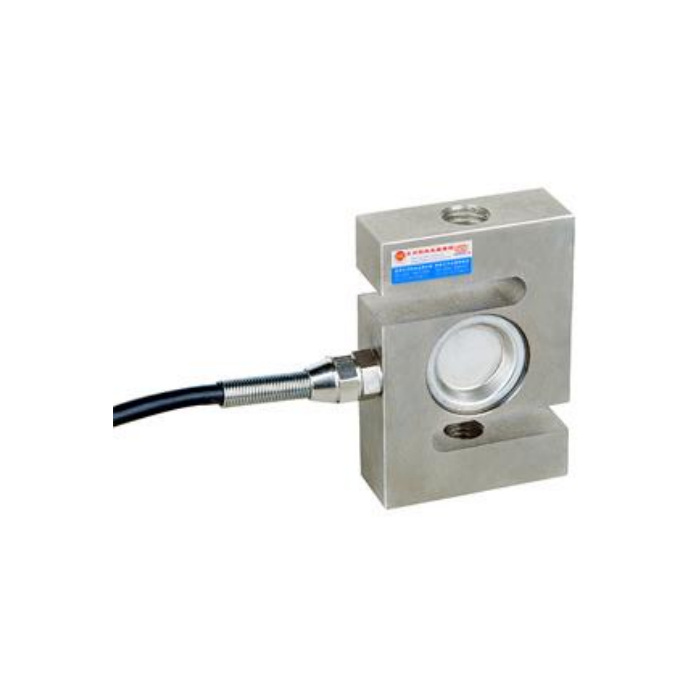

METRAVON MV-LC0093 is an S-type load cell with fine-pitch end threads for tensile and compressive force fixtures. It is documented over a 50-5000 kg family. Capacity changes do not always produce an obvious change in the front outline: different versions can share height and width but require another thread or side clearance. Identify the exact dimensional row before retaining the old couplings.
Check the S-type load cell thread even when the body looks unchanged
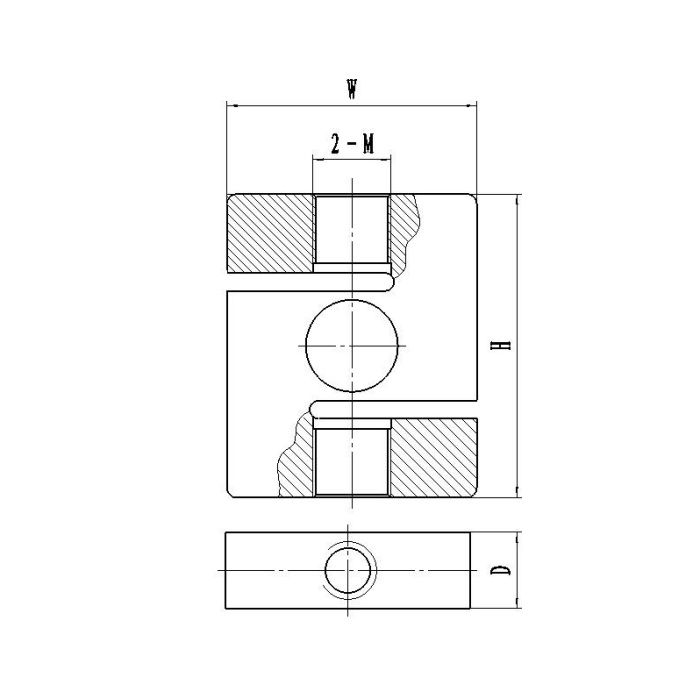
The 300 kg and 500 kg rows both show 77 mm height H, 50.8 mm width W and 24.4 mm thickness D. The end designation changes from M10 x 1 to M12 x 1. At 1000 kg the M12 x 1 thread and front outline remain, but thickness increases to 36 mm. Check the complete pitch and both mating fittings rather than assuming a matching nominal bolt size. Do not force a standard-pitch fitting into a fine-pitch measuring connection.
| Item | Value | Selection notes |
|---|---|---|
| 50 / 100 / 200 kg H / W / D | 77 / 50.8 / 18.5 mm | Both measuring ends are designated M10 x 1. |
| 300 kg H / W / D | 77 / 50.8 / 24.4 mm | The M10 x 1 designation remains. |
| 500 kg H / W / D | 77 / 50.8 / 24.4 mm | The thread changes to M12 x 1 despite the same outline. |
| 1000 kg H / W / D | 77 / 50.8 / 36 mm | The M12 x 1 version needs more side clearance. |
| 2000 / 3000 kg threads | M16 x 1.5 / M18 x 1.5 | Check each larger body row and its coupling dimensions. |
| 5000 kg H / W / D | 130 / 92 / 58 mm | The end designation is M20 x 2. |
| Working temperature | -40 to +85 deg C | Assess the fittings, cable and reader for their actual exposure. |
Allow the thicker versions to move clear of the fixture
For 50, 100 and 200 kg, the H and W references are again 77 and 50.8 mm, while D is 18.5 mm. The 2000 kg version changes to H86, W70 and D45 mm; 3000 kg uses H100, W80 and D50 mm. Include the side cable exit, coupling adjustment and any moving clevis in the clearance review. A bracket that accommodates the front silhouette may still touch a thicker body during loading or reversal.
Set up the millivolt bridge before judging a replacement by its zero
The electrical specification calls for 10-12 V DC excitation and 2.0 +/-0.015 mV/V rated output. Input resistance is 380 +/-5 ohms and output resistance 350 +/-2 ohms. Obtain the delivered wiring identification because the reference colour legend and circuit sketch disagree on signal-pair polarity. Verify the force sign and actual span with a suitable reference; an apparently stable unloaded display is not evidence that the old settings match the new unit.
Accept the assembled axial force path
Specify the tensile and compressive working points, any preload and how the end fittings articulate. Compare the required references during loading, unloading and reversal, then inspect empty return. The listed precision entry is 0.05% FS under the applicable sensor conditions. It does not remove coupling strain or establish the complete test-machine error. Confirm the IP67 or IP68 version and relevant termination conditions on the offer, rather than treating the two entries as a blanket immersion claim.
For another 500 kg layout with M12 x 1 ends, compare MV-LC0094: its height and front width differ, so the shared thread is not a replacement approval.
Fine-pitch fittings and side clearance
Q1. Can the 500 kg unit use a coupling from the 300 kg version?
The two bodies share the listed outer dimensions, but the thread changes from M10 x 1 to M12 x 1. Compare both fittings and the complete axial assembly. A photograph or matching body height cannot resolve that difference.
Q2. Will a 1000 kg version fit between the same side guides?
Thickness increases from 24.4 mm at 500 kg to 36 mm at 1000 kg. Check guide clearance throughout movement and allow for the cable exit. Recalibrate after the mechanical arrangement is approved.
Q3. Does the 200% safe-load figure rate the attached lifting hardware?
It is a sensor load-limit entry, not a working-load approval for the couplings or a complete lifting assembly. Assess the full connection and required application evidence separately. Do not use that percentage as the normal operating range.
