


 Chinese
 Spanish
 Russian
 Portuguese
 French
 German
 Indonesian
 Thai
 Vietnamese
 Arabic
 Italian
 Turkish
 Polish
 Japanese



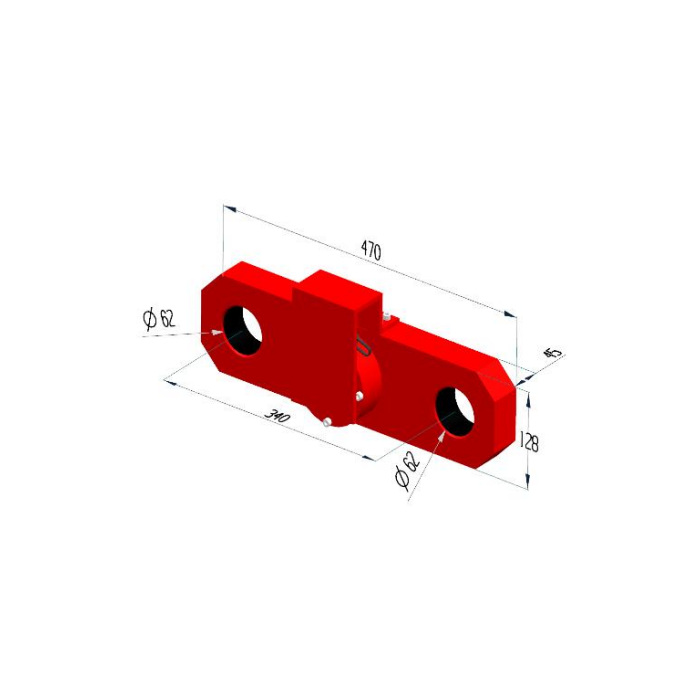
METRAVON MV-LC0090 is a tension load cell for measuring force through an in-line connection. Its two end connections must carry the tensile load along the intended measurement axis. Before specifying it for a pulling rig or suspended load, establish the maximum force at that connection and obtain the rated-capacity drawing. A sensor selected for a platform support is not necessarily suitable for the same numerical load in a tension assembly.
Specify the tension connection before choosing capacity
Send a sketch showing the sensor, mating pins or shackles, and the direction of pull. The connection must allow axial loading without forcing the body to bend. Check pin diameter, bearing contact, clearance around the centre housing and the available length between attachment points. Dimensions shown for one version must not be used to fabricate a connection for another capacity.
The rated capacity of MV-LC0090 requires confirmation for the proposed assembly. Do not use a broad product-family range as an order specification. The quotation should identify one rated load, its matching mechanical drawing and the supplied electrical configuration. Include start-up tension, braking, slack take-up and other transient loads in the application description; static suspended weight alone may not describe the highest force.
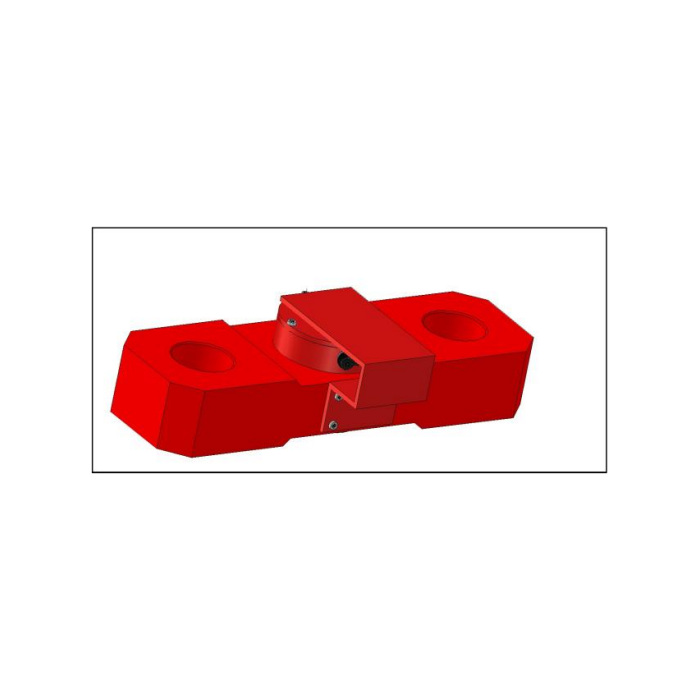
Analog tension load cell specifications
| Parameter | Analog configuration |
|---|---|
| Rated capacity | Confirm the selected rating and corresponding drawing before ordering. |
| Rated sensitivity | 2.0 ±0.015 mV/V |
| Excitation | 10-12 V DC |
| Input / output resistance | 380 ±5 / 350 ±2 ohm |
| Specified accuracy | 0.3% FS |
| Operating temperature | -40 to +85 °C |
| Safe overload | 200% FS |
| Protection | Confirm IP67 or IP68 for the offered assembly and connector. |
These electrical values describe the bridge-output configuration. They do not establish a CAN, wireless or 4-20 mA interface. A control system needing one of those signals requires a separately specified conversion arrangement. Check the excitation and millivolt input of the weighing instrument before wiring; an amplifier supply connection is not interchangeable with bridge excitation.
What to record during commissioning
Record the installed zero with the intended fittings in place, then compare readings at known forces within the approved test range. Repeat loading and unloading to examine zero return and repeatability. If force readings change when the connection angle changes, investigate the fixtures before adjusting the instrument span. Retain the calibration record with the sensor serial number and connection drawing.
The 200% FS safe-overload figure is not a normal operating allowance, a fatigue rating or permission to proof-test a lifting assembly. Pins, shackles, supporting structures and the sensor must each be assessed for their own loading conditions. Where a reading triggers an overload stop, the controller, fault response and complete protection function need separate validation.
Questions about the proposed assembly
Q1. Can a quotation be issued from the maximum suspended weight alone?
It is a starting point, but the load path may include angled connections or transient tension. Supply the connection sketch, operating sequence and expected peak force so the rated capacity and fittings can be assessed together.
Q2. Does the displayed force equal the lifted mass?
Only when the mechanical arrangement and instrument scaling justify that conversion. A force measured in one link is not automatically the total lifted load. Specify the required displayed quantity and verify it against the actual rigging geometry.
Request an MV-LC0090 configuration review with the required force range, connection dimensions, load cycle, exposure conditions and receiving instrument. Ask for the rated-load drawing and wiring identification with the quotation.
