


 Chinese
 Spanish
 Russian
 Portuguese
 French
 German
 Indonesian
 Thai
 Vietnamese
 Arabic
 Italian
 Turkish
 Polish
 Japanese


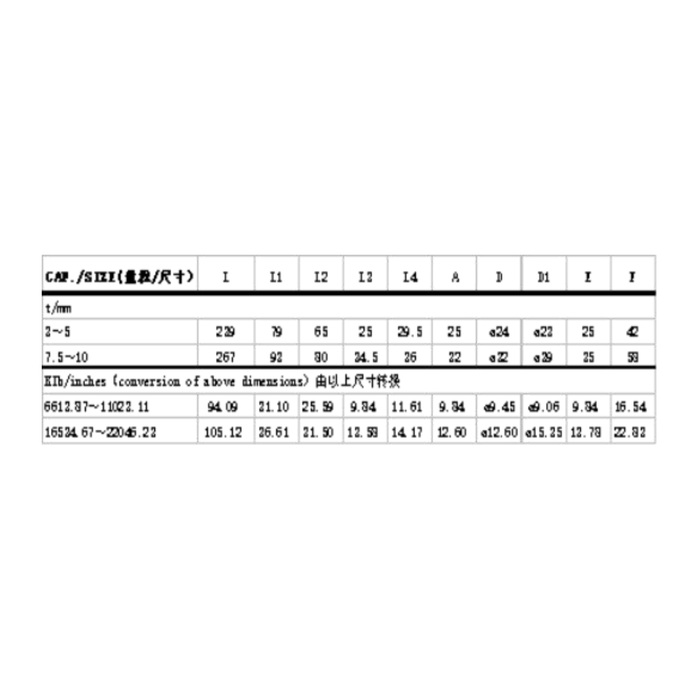
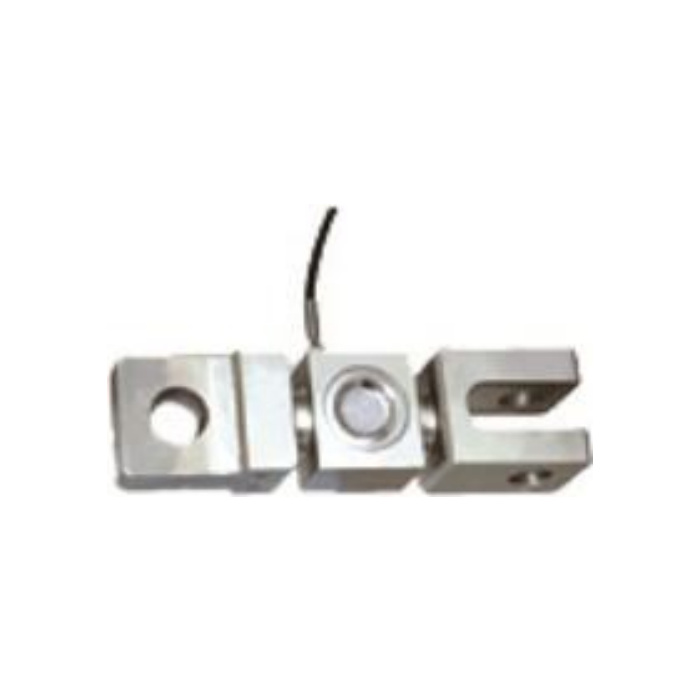
METRAVON MV-LC0088 is a tension load cell with a model-specific capacity range of 2-10 t and a nominal 2 mV/V analog output. It is used to sense tensile force in a designed load path. Select the connection hardware and rated capacity together; a sensor rating alone does not approve the complete lifting or force-measurement assembly.
Specify the analog sensor configuration
| Model parameter | Published specification |
|---|---|
| Capacity range | 2-10 t |
| Analog output | 2.0 +/-0.015 mV/V |
| Excitation supply | 10-12 V DC |
| Input resistance | 380 +/-5 ohm |
| Output resistance | 350 +/-2 ohm |
| Specified accuracy figure | 0.3% of full scale |
| Operating temperature | -40 to +85 deg C |
| Protection options listed | IP67/IP68; obtain the selected version's confirmed rating and conditions. |
| Safe overload limit | 200% of full scale |
The 0.3% figure is referenced to full scale, not to every measured value. Include the sensor, conditioning electronics and mechanical installation in the project's error assessment. Confirm the test basis and required calibration documentation when a defined force tolerance is part of acceptance.
Review the complete tensile connection
Provide a drawing showing how force enters and leaves the sensor. Check the connection dimensions, alignment and freedom of movement against the intended load direction. An offset attachment can introduce bending or side loading that is not represented by an axial tension rating.
Include acceleration, impact and other relevant transient forces in the capacity assessment. Do not interpret the safe overload figure as a second working range, a fatigue-life rating or a permitted proof-test load for the assembly. Any load test must follow the approved procedure for the actual equipment and connections.
Plan signal conditioning before ordering the cable
The configuration specified here produces a bridge-level millivolt signal. It requires suitable excitation and a compatible measuring input. A requirement for 4-20 mA, CAN or wireless transmission must be reviewed as an additional configuration or system requirement; those interfaces are not established for this analog version.
Identify the instrument, cable distance and connector arrangement, then request the terminal assignments for the supplied sensor. Keep the strain relief and cable routing clear of moving or loaded hardware. If the project includes a separate weighing instrument, verify its excitation and signal range against this model instead of assuming all bridge inputs are equivalent.
Tension-measurement questions
Q1. Can this page be used to specify a 25 t version?
No. The model-specific parameter table supports the 2-10 t range stated here. A higher-capacity requirement needs a separately confirmed model and drawing. Do not extend an individual model's rating from a broader product-family description.
Q2. Can one calibration cover different attachment arrangements?
Only if their equivalence has been demonstrated within the required measurement tolerance. Changed hardware can alter alignment, restraint or preload. Validate the measurement with the actual approved attachment arrangement and retain the configuration with the calibration record.
Q3. Is a stainless steel body included automatically?
The material specification lists alloy steel or stainless steel. State the required material and exposure in the enquiry and check the offered version. Neither the model name nor a protection-rating option identifies the exact supplied alloy or its suitability for a particular chemical environment.
Request an MV-LC0088 tension-sensing quotation with the peak design force, connection drawing, duty cycle, measurement tolerance and receiving instrument. Ask for the capacity, material, protection configuration and calibration scope to be stated together in the offer.
