


 Chinese
 Spanish
 Russian
 Portuguese
 French
 German
 Indonesian
 Thai
 Vietnamese
 Arabic
 Italian
 Turkish
 Polish
 Japanese


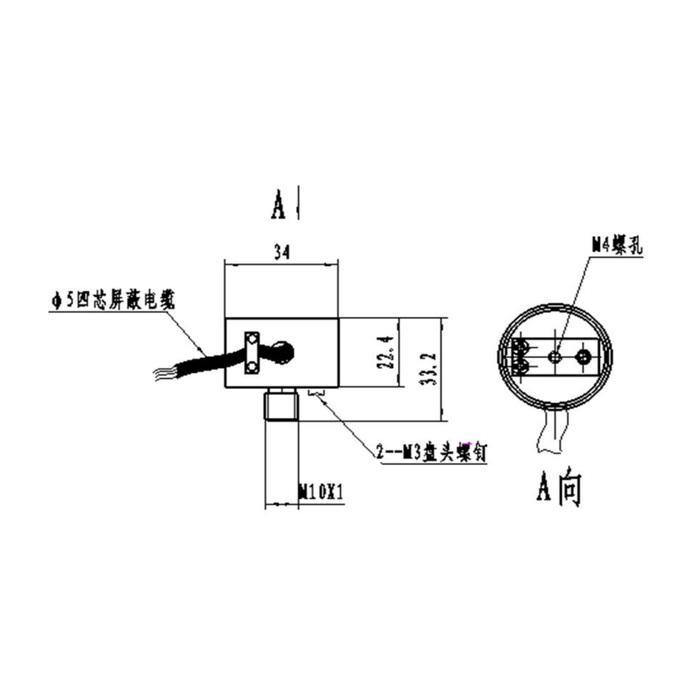
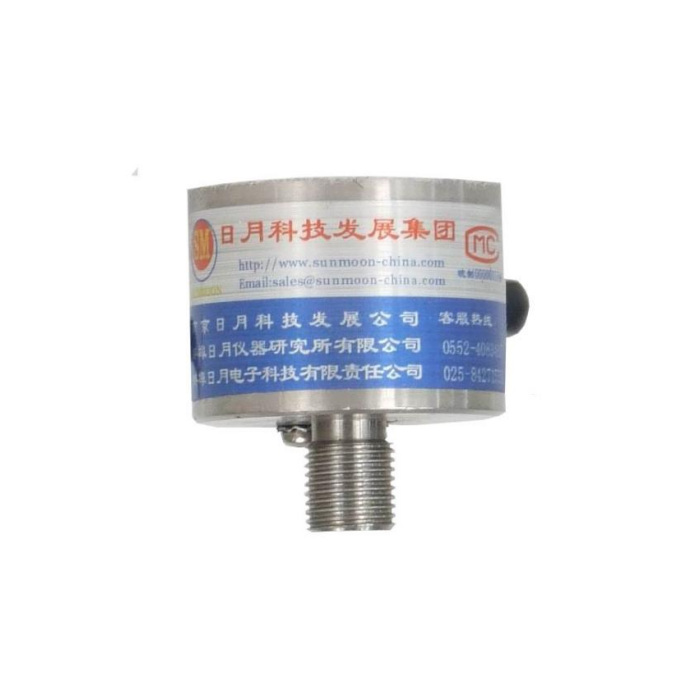
METRAVON MV-LC0067 is a miniature compression load cell for force measurement in compact fixtures, button-testing equipment and other space-limited assemblies. The listed capacity range is 0.5-100 kg. Its low-profile diaphragm construction is intended for compressive loading; the mounting thread does not establish a tension-measurement capability.
Make the fixture load the sensing element correctly
A small enclosure does not make alignment unimportant. The fixture must deliver the force through the intended contact without transmitting side load or an unintended moment. Check whether guide friction, a parallel support or a surrounding stop allows part of the force to bypass the sensor.
The catalogue drawing shows a 34 mm diameter body and an M10 x 1 mounting thread. Confirm the full installation drawing, engagement and contact arrangement for the ordered capacity. Reserve room for the cable exit and its movement; clamping the cable tightly against the fixture can complicate servicing and strain the termination.
Specifications for the force-measurement chain
| Sensor characteristic | Listed specification |
|---|---|
| Capacity range | 0.5-100 kg |
| Measurement direction | Compression |
| Rated analog output | 2.0 +/-0.015 mV/V |
| Excitation voltage | 10-12 V DC |
| Input / output resistance | 380 +/-5 / 350 +/-2 ohm |
| Published accuracy | 0.05% of full scale |
| Temperature limits | -40 to +85 deg C |
| Protection | IP65 |
| Safe load limit | 200% of full scale |
Specify the exact capacity and ordered material, alloy steel or stainless steel. The published accuracy is referenced to full scale, so increasing capacity can change the significance of that error relative to a small test force. Assess the sensor and amplifier together against the required force resolution and uncertainty.
Separate peak-force measurement from static calibration
For a press or button test, state the duration of the force event and what must be recorded: a settled value, a peak or a complete force trace. This listing does not establish a dynamic bandwidth. Check the sensor response, amplifier filtering and acquisition rate for the actual cycle before promising that a short peak will be captured.
Calibrate the assembled fixture with appropriate reference forces and inspect its unloaded return after repeated cycles. Evaluate any mechanical stop under the fixture designer's procedure. The overload figure does not mean the cell should act as the routine end stop of a moving press.
Compact-fixture questions
Q1. Does the 0.5 kg figure mean smaller forces cannot be measured?
It is the lower end of the listed capacity range, not a stated minimum detectable force. The usable lower measurement limit depends on the selected rating, electrical noise, amplifier resolution and fixture behaviour. Define the smallest required force change and verify it on the assembled measurement chain.
Q2. Can the millivolt signal go directly to a PLC analog input?
Only an input designed for the specified bridge signal and excitation is suitable. Otherwise, select a compatible conditioning device before the PLC or data-acquisition unit. Check the weighing instrument options against the required excitation and dynamic response rather than choosing by connector shape.
Request MV-LC0067 for your fixture with a section drawing, nominal and peak force, cycle timing, required resolution and available mounting space. Include temperature exposure and the intended amplifier so the mechanical fit and measurement performance can be assessed together.
