


 Chinese
 Spanish
 Russian
 Portuguese
 French
 German
 Indonesian
 Thai
 Vietnamese
 Arabic
 Italian
 Turkish
 Polish
 Japanese


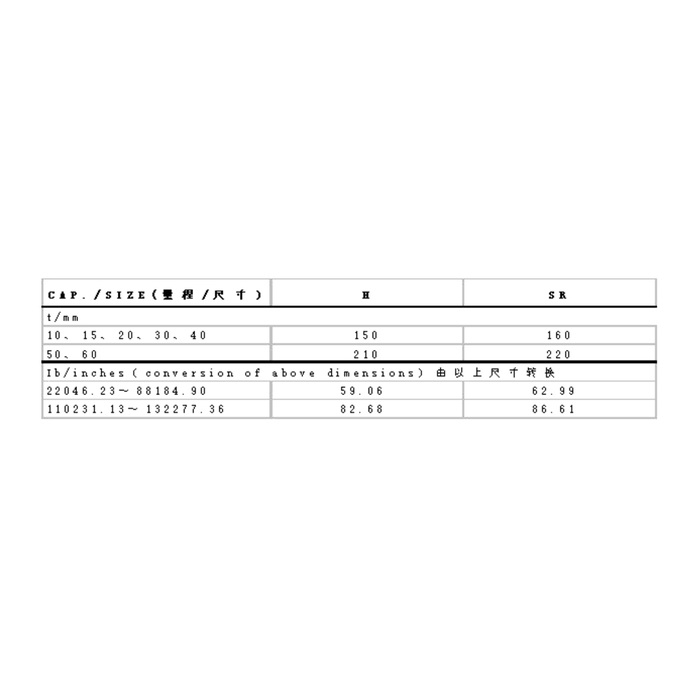
METRAVON MV-LC0038 is a column load cell for heavy platform, vehicle-scale and vessel weighing projects that use compression between two end seats. Its nominal range is 10-60 t. The most important replacement distinction is the capacity-dependent height: the reference changes from 150 mm to 210 mm at the 50 and 60 t ratings. A higher rating therefore cannot be selected as a simple electrical upgrade while retaining an unchanged support gap.
Match column load cell height and end curvature as a pair
The metric table lists 10, 15, 20, 30 and 40 t with H = 150 mm and SR = 160 mm; 50 and 60 t use H = 210 mm and SR = 220 mm. H is the overall vertical reference. SR identifies the curved-end profile and is not another height. The outline marks a 76.1 mm main-body diameter and a 44 mm end diameter. Use the complete drawing to compare both seating contacts and the remaining clearance. A seat that fits the end diameter may still have an unsuitable curvature.
| Item | Value | Selection notes |
|---|---|---|
| 10 / 15 / 20 / 30 / 40 t | H 150 mm / SR 160 mm | Height and curved-end profile must both match the chosen seats. |
| 50 / 60 t | H 210 mm / SR 220 mm | The additional height changes the required support gap. |
| Main body / end diameter | 76.1 / 44 mm | Diameter matching alone does not verify the curved contact. |
| Input / output resistance | 780 +/-20 / 700 +/-5 ohms | Check the complete indicator excitation load. |
| Rated bridge sensitivity | 2.0 +/-0.015 mV/V | Use a compatible weighing input or separate conditioner. |
| Ingress-protection entry | IP67 | Do not carry IP68 over from a neighbouring model. |
Inspect old seats before deciding to retain them
If a scale has unstable unloaded readings or poor return after traffic passes, inspect both seats, surrounding guides and the support foundation before changing the bridge. Look for displaced contacts, debris and restraint that prevents the intended movement. The reference describes self-adjustment and return, but does not give a universal permissible tilt, travel or restoring force. Reusing a damaged seat or tightly capturing the column can defeat the intended contact arrangement even when the replacement has the correct nominal rating.
Check the excitation burden of the complete scale
This model has 780 +/-20 ohms input resistance and 700 +/-5 ohms output resistance, with 2.0 +/-0.015 mV/V output at 10-12 V DC excitation. When several cells share an indicator, check the combined excitation demand and the indicator input arrangement rather than comparing sensitivity alone. A replacement with a different bridge resistance can change loading of that channel. Resolve terminal functions from the supplied wiring schedule and a controlled compression-sign check; the reference legend and circuit do not agree on signal-colour polarity.
Set the performance test for the vehicle or vessel installation
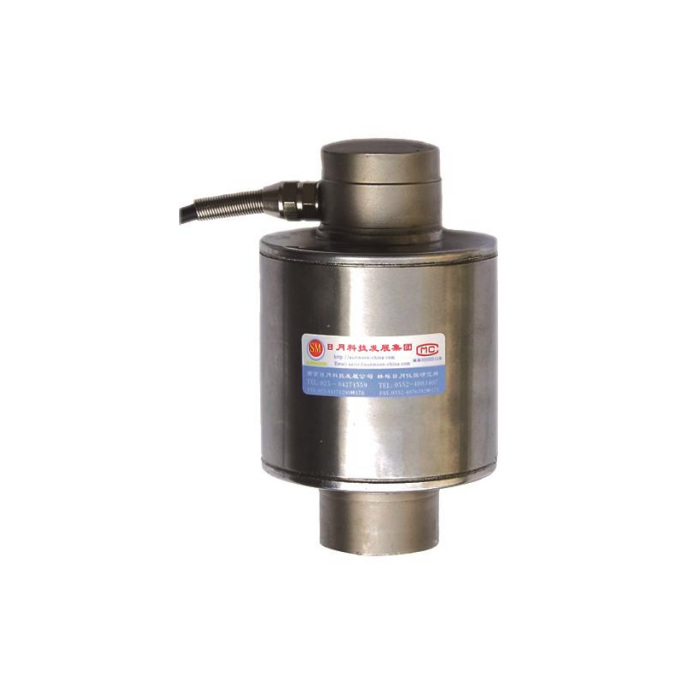
Reference precision is 0.05% FS, while the project result also depends on seats, load distribution, calibration and the reader. Provide the largest sensor reaction, including the intended loading positions, rather than assuming equal reactions at every support. For a platform, agree the positions and repeated passes relevant to use. For a vessel, account for empty weight and external pipe or restraint forces. An application reference to rail weighing does not establish a tested dynamic measurement class or an approved speed for a particular installation.
Keep IP67 and overload figures in their stated roles
The specified enclosure rating is IP67, not the IP68 entry found on some adjacent column models. Describe standing water, cable termination and cleaning conditions in the enquiry. Material options are alloy steel or stainless steel, with operation listed from -40 to +85 deg C and a temperature effect of 0.05% FS per 10 deg C. The 200% FS safe-load figure concerns the sensor reference; it is not permission to proof-load the full scale, foundation or retained seats to that value.
For a reference that shows a separate upper and lower seat set, compare the MV-LC0039 seated section. Its height references, range and bridge resistances differ; it is not established as a direct replacement.
Rating changes, end seats and reader compatibility
Q1. Can a 40 t support be upgraded to 50 t without changing the seats?
The reference height changes from 150 to 210 mm and the SR entry changes from 160 to 220 mm. Review the support gap and both contact profiles first. An unchanged mounting arrangement cannot be accepted from the capacity increase alone.
Q2. What does the SR value tell the installer?
It refers to the curved end shown in the outline. Read it together with the end diameter and mating seat section, not as body height or an allowable rocking distance. Request contact tolerances if the existing seats are to be retained.
Q3. Why check resistance if both old and new cells are 2 mV/V?
Sensitivity describes rated signal relative to excitation; it does not describe excitation current or every indicator constraint. Compare input resistance, the number of connected bridges and the reader specification, then calibrate and test the completed installation.
