Chinese
 Spanish
 Russian
 Portuguese
 French
 German
 Indonesian
 Thai
Thai Vietnamese
 Arabic
 Italian
 Turkish
 Polish
 Japanese
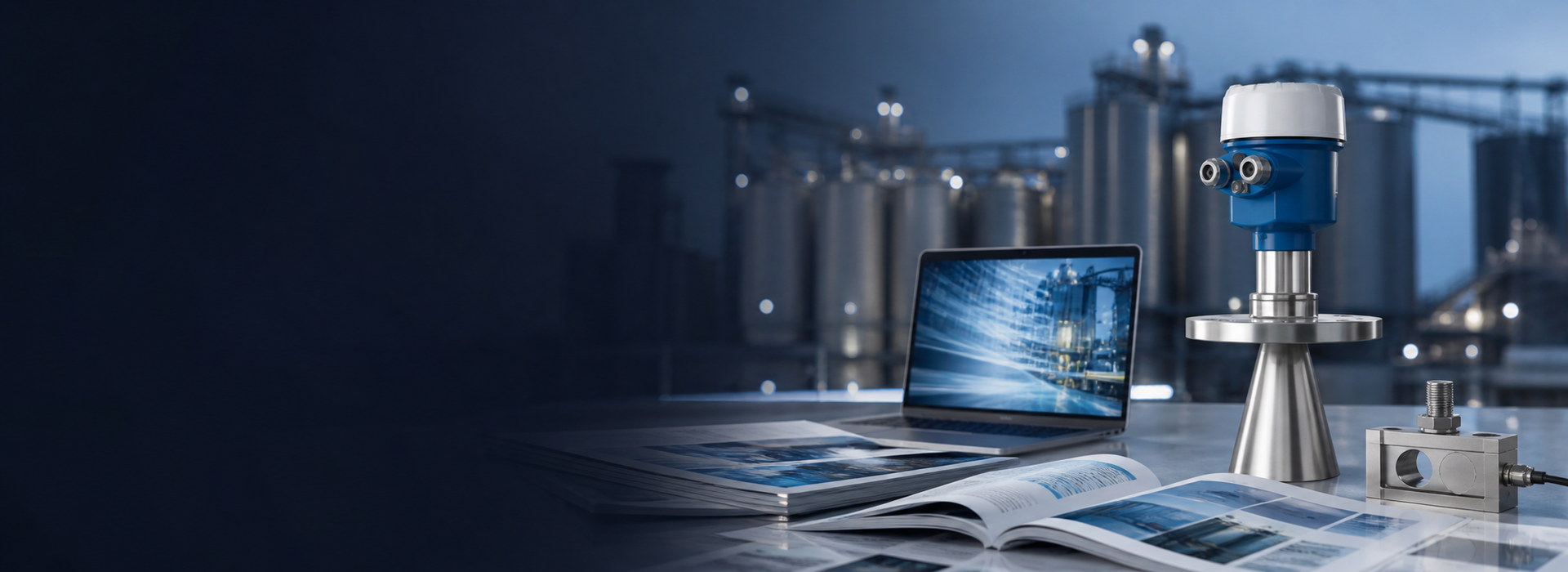
Level transmitter types differ in what they physically measure. Non-contact radar measures microwave travel time; guided-wave radar guides the signal along a probe; ultrasonic instruments use acoustic travel time; hydrostatic and differential-pressure transmitters infer level from pressure; capacitance devices respond to electrical properties. Floats and displacers respond to buoyancy, while weighing systems infer inventory from supported mass. Selection should begin with the measurand and process: liquid surface, interface, bulk solid, water depth or mass. Record range, pressure, temperature, dielectric behaviour, density, vapour, foam, dust, agitation, coating, vessel geometry and maintenance access. Then compare failure behaviour, diagnostics, proof-test method and lifecycle cost. No single technology is universally best.
Radar and guided-wave radar
Non-contact radar suits many liquids and solids when the antenna has a clear beam and sufficient reflection. Check nozzle, internals, dielectric response, condensation and echo quality.
Guided-wave radar can handle difficult vapour and interface duties, but probe coating, clearance, tensile load, anchoring and nozzle geometry require review.
Ultrasonic measurement
Ultrasonic sensors can be economical in vented tanks and open channels with a stable gas space and clear acoustic path. Maximum level must remain outside the dead zone.
Steam, temperature gradients, gas composition, dense foam and condensation may attenuate or delay sound. Review the echo trace across operating conditions.
Hydrostatic and differential pressure
Pressure-based measurement works in wells, sumps and pressurized vessels when density and pressure references are known. Temperature or composition changes become level error through density.
Vented probes need a dry atmospheric reference; DP systems require correct wet or dry legs, impulse-line management and elevation calculation.
Capacitance, float and displacer
Capacitance can provide point or continuous measurement when dielectric properties and grounding are stable. Coating and composition changes must be included in the evaluation.
Floats and displacers provide direct buoyancy-based response but need suitable density, free movement and mechanical access. They can be effective for independent point alarms.
Bulk solids and inventory
For powders and granules, compare radar, guided-wave, capacitance, vibrating or rotating point switches against dust, angle of repose, bridging and impact.
If mass inventory is required and bulk density varies, silo load cells may be more representative than a surface-level measurement converted to volume.
Commission with common acceptance criteria
Use one datum and verify low, middle and high conditions where practical. Confirm raw measurement, scaling, damping, alarms and fault output through the PLC.
Retain echo curves, pressure readings, capacitance values or support signals as baseline diagnostics. Reassess selection after process, vessel or material changes.
Engineering checklist
- Define the actual measurand.
- Record all process extremes.
- Review vessel geometry and access.
- Specify fault and lost-signal behaviour.
- Compare proof-test methods.
- Verify the complete installed loop.
Frequently asked questions
Which type is best for every tank?
None. The correct choice depends on process, geometry, risk and maintenance.
Why can pressure level drift?
Density, reference pressure, temperature or impulse-line condition may change.
When is weighing preferable?
When mass inventory is needed and surface shape or bulk density makes level-to-volume conversion unreliable.
Need a project-specific review? Send process data, drawings, photographs and acceptance criteria through our contact page.
Technology selection should also consider what operators can diagnose during an upset. A numerical level value without signal-quality, echo, pressure or probe-status information may be difficult to trust. Define how invalid measurement is identified in the PLC and historian, how long a previous value may be held and which alarm remains independent. For critical service, evaluate common-cause failures such as one blocked nozzle, shared impulse lines, one power supply or identical buildup on two probes. The chosen architecture should support safe maintenance, isolation and functional testing without requiring personnel to enter a confined space.