Chinese
 Spanish
 Russian
 Portuguese
 French
 German
 Indonesian
 Thai
Thai Vietnamese
 Arabic
 Italian
 Turkish
 Polish
 Japanese
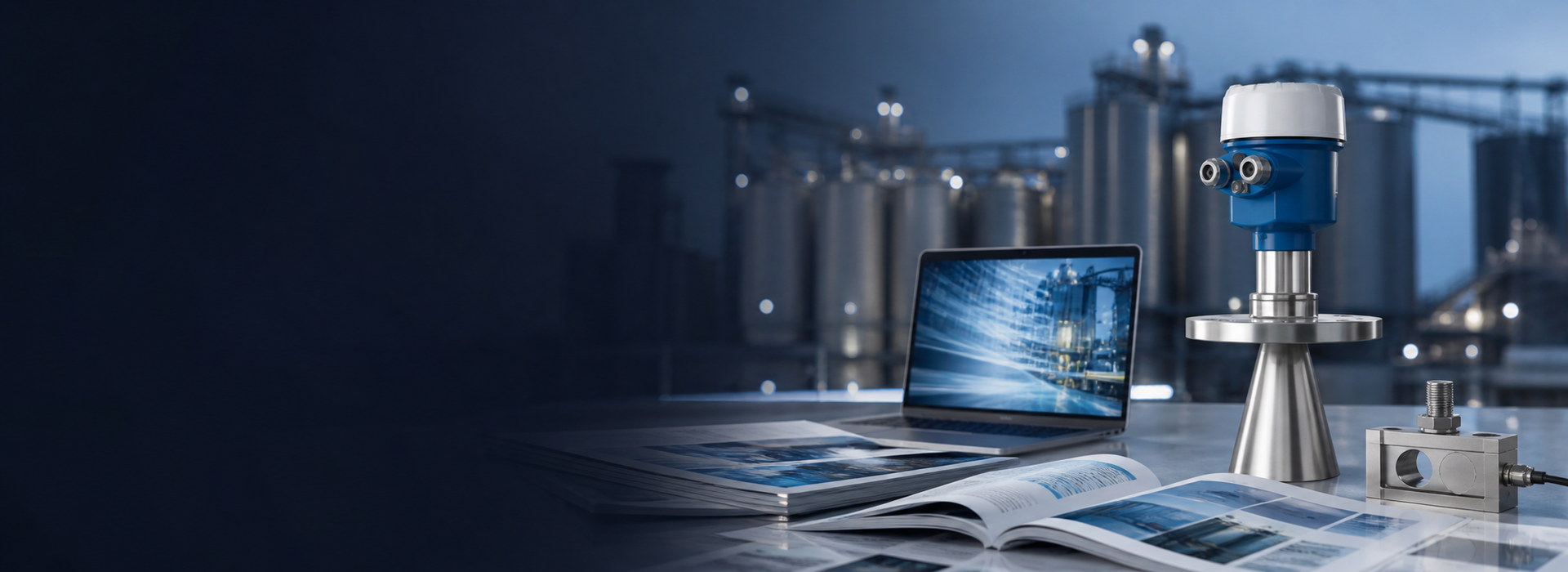
Powder level sensor selection must account for the behaviour of bulk solids, not only vessel height. A powder can create dust clouds during filling, form an angle of repose, bridge above the outlet, adhere to probes or generate static electricity. Its bulk density, particle size, moisture and dielectric properties may vary between batches. Continuous radar measures the surface distance and can work well when beam angle, nozzle and echo quality are suitable. Guided-wave radar, capacitance and RF-admittance devices interact with a probe and therefore require buildup and tensile-load review. Rotating paddle, vibrating rod and capacitance switches are common point-level options, each with different sensitivity to coating and material force. For inventory mass, silo weighing may be preferable because a surface measurement cannot by itself resolve variable density or material in transit.
Define material behaviour
Provide product name, particle size, bulk-density range, moisture, dielectric information, flowability, abrasiveness and temperature. Include aeration and pneumatic filling conditions.
Describe ratholing, bridging, caking and wall buildup from operating experience. A clean sample in a bucket does not reproduce the silo environment.
Map the vessel and filling pattern
Draw diameter, height, roof, nozzle, outlet, internals and maximum pile. Mark fill streams and likely angle of repose at different operating states.
Avoid aiming a sensor into direct impact. Check whether the measurement represents the highest pile, average inventory or a local point near the outlet.
Choose continuous technology
Radar requires a clear beam and usable dielectric reflection. Review false echoes from roof structure and retain echo curves at empty, filling and full conditions.
Guided-wave and capacitance probes need mechanical clearance and must withstand pull from moving or collapsing material. Anchoring can transfer large forces and should be engineered.
Choose point-level protection
Rotating paddles provide simple mechanical detection but need suitable torque and protection from impact. Vibrating rods need enough material interaction and freedom from heavy coating.
Capacitance and RF-admittance switches can detect many powders when sensitivity, grounding and buildup compensation are correctly established. Provide a safe proof-test method.
Handle dust and hazardous areas
Identify combustible-dust classification, temperature limits and required equipment marking. Dust-tight construction alone does not establish explosion protection.
Control static grounding, cable glands and enclosure maintenance. Verify the certificate for the exact model and installation, including special conditions of use.
Commission and reconcile
Verify empty reference, blocking distance, alarm elevation and PLC action. Capture diagnostic values during representative filling and discharge rather than only in an empty vessel.
For inventory, reconcile level-derived volume with receipts and withdrawals while considering bulk density and material in transit. Do not force calibration to match an uncertain stock estimate.
Engineering checklist
- Provide powder and vessel data.
- Map fill stream and pile geometry.
- Check probe tensile and impact loads.
- Verify dust-area certification.
- Capture baseline diagnostics.
- Separate level from mass inventory.
Frequently asked questions
Can one sensor measure every powder?
No. Dielectric response, dust, buildup, force and flow pattern vary widely.
Why does level disagree with tonnes?
Surface shape, bulk density, voids and material in transit affect conversion from distance to mass.
Where should a high-level switch be mounted?
At a representative location outside direct fill impact, with enough access for inspection and proof testing.
Need a project-specific review? Send process data, drawings, photographs and acceptance criteria through our contact page.
Changes in supplier, grade or moisture can alter powder behaviour even when the product name is unchanged. Establish a management-of-change trigger for persistent false echoes, new coating, slower discharge, denser dust or unexplained inventory error. Maintenance should compare current diagnostics with baseline records before increasing sensitivity or suppressing echoes. If a point switch is used for overfill protection, the proof test must demonstrate actual sensing response; an electronic test that only toggles the output may not reveal a seized paddle, coated rod or damaged probe. Keep access platforms and isolation arrangements in the original mechanical design.