


 Chinese
 Spanish
 Russian
 Portuguese
 French
 German
 Indonesian
 Thai
 Vietnamese
 Arabic
 Italian
 Turkish
 Polish
 Japanese

Leachate basin level measurement must remain meaningful when rainfall increases inflow or treatment capacity is restricted. The level signal cannot solve a storage shortage, but it can show how much operating margin remains if the basin geometry, pump limits and data quality are known. Specify those relationships before selecting alarm elevations.
Define usable storage under the limiting pump case
Survey the basin datum, overflow elevation and minimum pump operating level. Include sediment and any volume that cannot be pumped. Review continued rainfall, a failed duty pump and restricted discharge to the treatment plant. The available margin is the usable storage under those conditions, not simply the nominal basin capacity.
Assign each alarm a response and a responsible operator. A message acknowledging high level is not the same as restoring discharge capacity. Keep critical local pumping and any independently required overflow protection separate from remote visibility.
Select leachate basin level measurement for changing exposure
The METRAVON MV-RD12T provides non-contact atmospheric water-level measurement with a 42 mm PVDF lens assembly. For leachate, review the credible chemistry, temperature, vapour and cleaning conditions rather than approving the installation from one sample or the lens material alone.
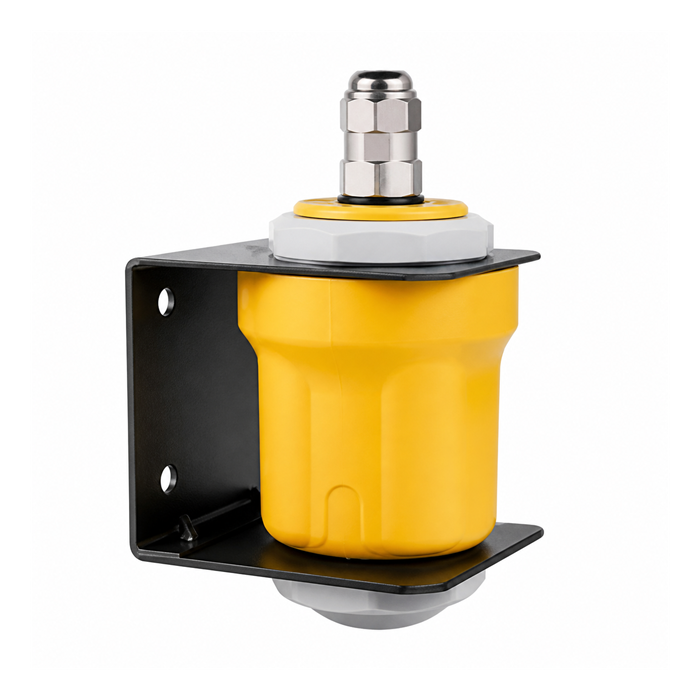
Place the beam away from the incoming cascade, aeration and floating equipment. State whether the required reading is liquid level or the top of a foam or floating layer. A stable reflection from that layer may still be unsuitable for determining pump submergence.
| Change | Inspect | Control implication |
|---|---|---|
| Heavy rain | Rise rate and available storage | Alarm response must remain timely with the accepted filtering. |
| Foam layer | Which surface the radar follows | The displayed height may not represent the liquid needed for pump control. |
| Deposits | Lens, recesses and local echoes | Investigate fouling before changing the level datum. |
| Pump fault | Run status and actual level trend | A start command alone does not prove water is being removed. |
Retain records that explain a rising basin
Log level with acquisition time, validity and pump status. Where available, keep rainfall and treatment-flow records on compatible timestamps. These records help distinguish sustained inflow from an unavailable pump or an instrument that has stopped updating.
The MV-RD12T has several power and output versions. Identify the ordered supply and interface before specifying the RTU. A held analog value or repeatedly uploaded old digital value must not appear as a new observation; test the receiving system's stale-data and signal-failure handling.
Questions about environmental monitoring
Q1. Can a falling level prove that the liner is leaking?
No. Pumping, inflow changes and measurement faults can also affect the trend. Liner integrity and leak detection need their own inspection or monitoring arrangements; the process-level signal cannot identify a leakage path by itself.
Q2. Does a sealed housing remove the need for inspection?
No. Deposits, corrosion of external hardware and bracket movement remain possible. Inspect after significant storms and maintenance, then set subsequent intervals from the observed condition and signal history.
Q3. What should happen after the sensor has been flooded?
Follow the supplied assembly's recovery requirements and check the lens, cable seals and mounting datum. Verify a known level before returning the signal to automatic duty. IP68 does not promise normal measurement with the antenna underwater.
Summary
Send basin elevations, chemistry ranges, pump cases and intended remote reporting with a leachate monitoring enquiry. The proposed sensor and control response should be assessed against the remaining storage under adverse operation, not only a calm-day level reading.
