


 Chinese
 Spanish
 Russian
 Portuguese
 French
 German
 Indonesian
 Thai
 Vietnamese
 Arabic
 Italian
 Turkish
 Polish
 Japanese


Hazardous-waste tank level measurement cannot be specified from the label on the tank alone. The permitted waste composition, vapour, temperature and transfer conditions determine whether a proposed assembly is suitable. If those conditions are undefined, the first procurement task is to establish the accepted waste range, not to choose a transmitter model.
Define What May Enter the Tank
Provide known constituents and concentration ranges, solids, temperature, pressure and cleaning exposures. Identify which incoming loads require a separate review. Compatibility with one previously stored liquid does not establish compatibility with a future mixture.
Include vapour exposure and the site's area classification. The lens may normally remain above the liquid yet still encounter condensate or splash. Review the seal, connection and exposed metal as well as the antenna material. A compatible coating does not protect an incompatible gasket elsewhere in the assembly.
Hazardous-Waste Tank Level Measurement Is One Function
| Function | Purpose | Boundary |
|---|---|---|
| Level | Observe occupied height and support normal transfer control. | A valid surface target must be established for the accepted waste. |
| Overfill | Stop or prevent an unsafe receiving condition. | Required independence and testing come from the approved protection design. |
| Leak alarm | Detect the specified containment failure or accumulation. | It is not provided merely by having a high-level alarm. |
| Route check | Confirm the intended source, destination and permitted transfer. | A rising level does not prove the waste is chemically acceptable. |
Keep these functions distinct in the cause-and-effect and operator display. An alarm should identify the actual condition and required response. Two alarms calculated from one radar do not create independent sensors, and a falling level does not establish a leak without considering withdrawals and measurement validity.
Assess the Offered Radar Against the Waste Range
The METRAVON MV-RD12 is a liquid-level radar with a PTFE lens and configuration-dependent process connections. It can be considered for a defined measurement duty, but its published description is not a blanket compatibility statement for hazardous waste or evidence of suitability as an independent protective device.
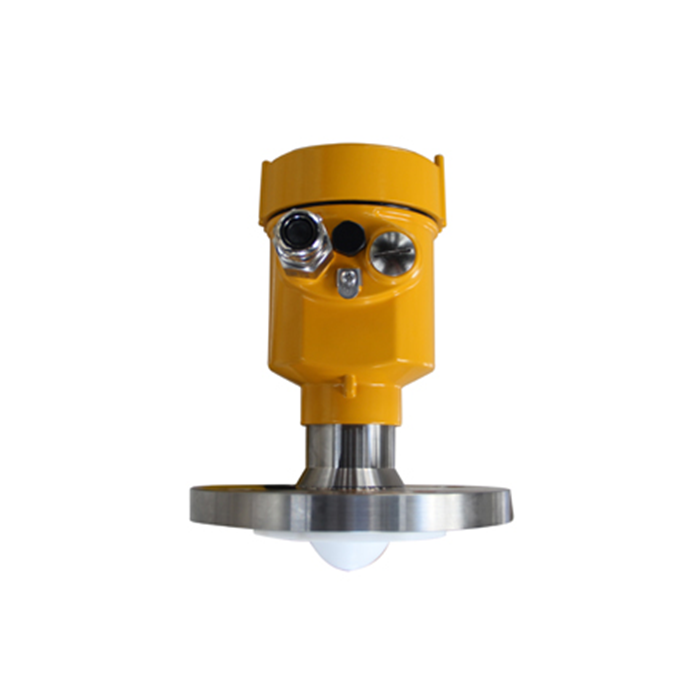
Ask for the exact seal, connection, allowable operating combination and required area documents. If a mandatory condition cannot be substantiated, do not approve that configuration. Define a review process for composition changes instead of assuming that an initially accepted model remains suitable indefinitely.
On the tank section, show the inlet, mixers, coils, floating layers and maximum permitted surface. Foam or a floating layer can change the target. A trial with water alone may verify wiring and scale without proving the intended waste measurement.
Verify Available Space and Stopping Response
Before a transfer, establish the destination and available receiving space using valid measurements and the approved procedure. Account for material arriving during detection, control action and valve or pump response, including relevant line contents. Do not choose a high-level threshold solely because it is a familiar percentage.
Test normal transfer logic, invalid measurement, required protective functions and containment alarms through their own approved procedures. Keep the tests distinguishable in the record. No test should depend on deliberately approaching an uncontrolled overflow or releasing hazardous material.
After changes to waste composition, seals, piping or control logic, assess whether the earlier acceptance evidence still applies. Retain the original parameter file and the reason for the change so a later reading can be interpreted against its actual configuration.
Waste-Handling Questions
Q1. Is pH enough to select the antenna and seal?
No. Chemical identity, concentration, temperature and mixtures affect compatibility. Supply the available composition and exposure information, including cleaning conditions. Where uncertainty remains, obtain the plant's materials assessment rather than treating a single pH value as a complete specification.
Q2. Can radar also detect a leak in the tank wall?
It can show a level trend, but that trend does not uniquely identify leakage. Transfers, surface changes and invalid echoes can produce changes too. Use the separately designed leak or containment monitoring function for the required detection duty.
Q3. What should happen when a waste load falls outside the accepted range?
Follow the site's review and transfer-authorisation procedure before receipt. The instrument configuration should not be presumed suitable for an unassessed chemical or temperature. Update the relevant compatibility and measurement evidence before extending its approved duty.
Summary
Define the waste range and preserve the separation between level, overfill, leak detection and transfer authorisation. Submit the accepted waste specification and tank arrangement for a configuration review. An unresolved materials or approval requirement is a procurement hold point, not a reason to broaden the product claim.
