


 Chinese
 Spanish
 Russian
 Portuguese
 French
 German
 Indonesian
 Thai
 Vietnamese
 Arabic
 Italian
 Turkish
 Polish
 Japanese


A hydrostatic level transmitter does not measure level directly. It measures the pressure at the tank bottom and infers level from a fixed liquid density, so when that density shifts with temperature or product change the inferred level and the derived tank volume drift together. This article works through the size of that drift, shows where a sealed-vessel differential-pressure arrangement removes the gas-pressure term, and sets the point at which a radar gauge that measures distance directly becomes the safer choice.
What a hydrostatic level transmitter actually measures
A hydrostatic or differential-pressure transmitter mounted at the tank base reads the weight of the liquid column above it and delivers a linear output between zero pressure and full-scale pressure, most often as a 4–20 mA signal. Over several hundred metres of cable the current is preserved, but the loop voltage must still be checked against the transmitter's minimum terminal voltage, which is why this method stays common on large storage tanks. The instrument reports pressure; level is a calculation the user performs with an assumed density and a known tank height. For a vented tank a gauge transmitter with a vented cable, or a differential-pressure transmitter with a reference leg open to air, both isolate the liquid head from the atmosphere. The vent path must be protected against moisture, typically with a desiccant filter, whenever the liquid and ambient temperatures differ strongly. These transmitters are chosen for low installed cost and a simple, field-proven pressure element that needs little routine attention.
How density enters the level calculation
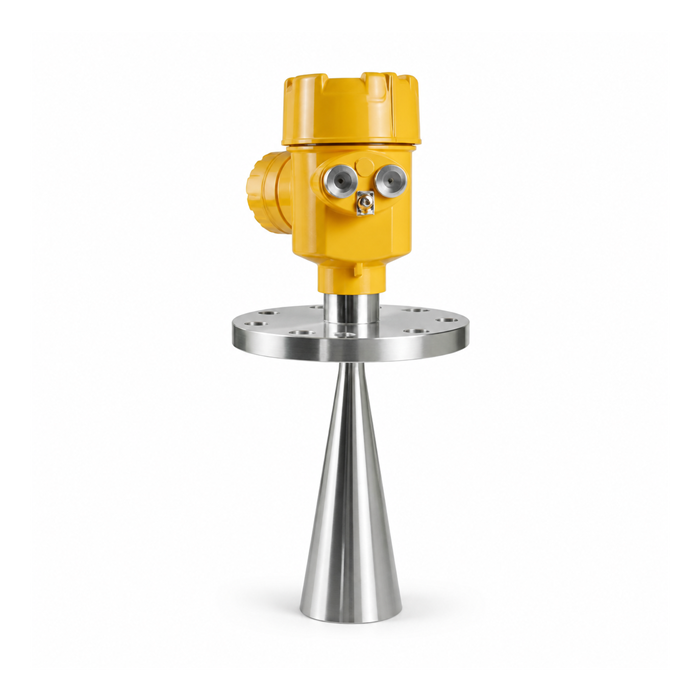
The inferred level follows the relation h = p / (ρ · g), where p is the measured gauge pressure, ρ is the assumed liquid density and g is the local gravity constant near 9.81 m/s². Every unit of reported level therefore carries the density assumption as a hidden multiplier. The span is scaled in pressure units, with the density assumption baked into the LRV and URV, so the conversion holds only while ρ stays at the value used during scaling. In a vented water tank near 20 °C the density is about 998 kg/m³, but in a blended product, a sugar solution or a tank that cools overnight the density can move by several percent without any change in real level. The transmitter cannot detect that move; it simply reports the pressure it sees. The user must decide how tightly the density must be known for the level to remain inside tolerance, because no re-calibration of the pressure element changes the assumption that sits in the scaling.
Worked density-shift example: level and volume error
The table below sets assumed site values for a vertical tank and converts a real density change into a level error and a volume error. This is an illustrative calculation based on assumed site values, not a METRAVON field record, and the numbers should be confirmed against the current data sheet and nameplate before any engineering decision.
| Quantity | Assumed site value | Condition |
|---|---|---|
| Nominal density ρ0 | 1000 kg/m³ | water-like, used for scaling |
| Actual density ρ1 | 1030 kg/m³ | blend change, or a 25–40 °C swing on a light hydrocarbon |
| Tank height H | 12.0 m | vertical cylinder |
| Internal diameter D | 4.0 m | flat bottom |
| True level h_true | 6.0 m | 50 % fill |
Input and conversion: the bottom pressure actually present is p = ρ1 · g · h = 1030 · 9.81 · 6.0 = 60,626 Pa, or about 60.6 kPa. The transmitter scaled to ρ0 reports h_rep = p / (ρ0 · g) = 60626 / (1000 · 9.81) = 6.18 m. Level error = 6.18 − 6.00 = +0.18 m, equal to +3.0 % of the true level. The cross-section is A = π · (2.0)² = 12.57 m², so the true volume is 75.4 m³ while the reported volume is 77.7 m³, a volume error of +2.3 m³ (+3.0 %). Boundary condition: the error scales with level, reaching +0.36 m at the full 12.0 m height, and it reverses sign if the actual density is lower than the scaled value.
When the hydrostatic method stops being trustworthy
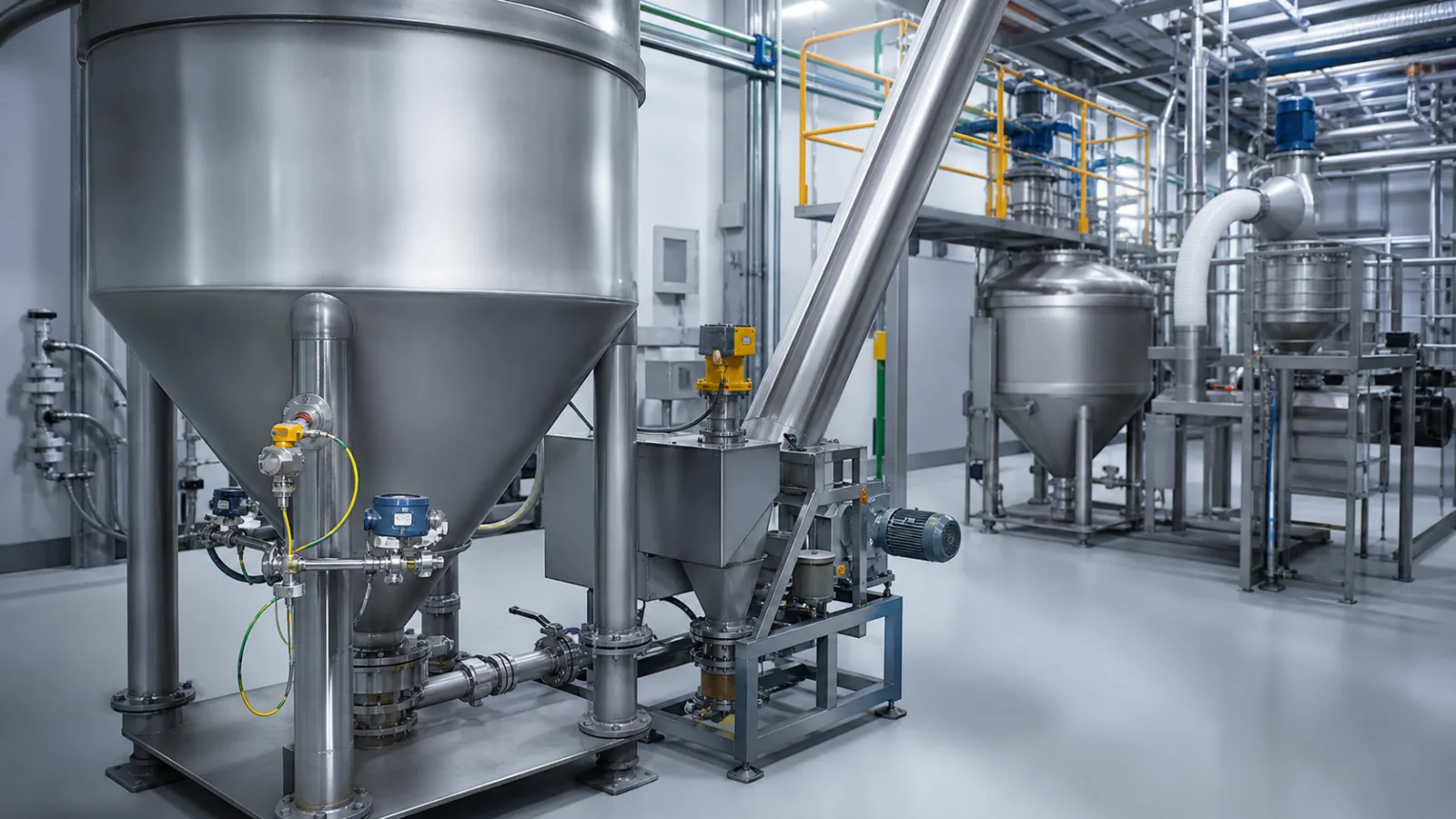
A hydrostatic transmitter should be set aside when the liquid density is not stable or not known at the point of measurement. In a tank that receives alternating products, or that heats and cools through the day, the density term moves while the real level stays fixed, and no amount of transmitter re-calibration removes the bias because the instrument is reporting pressure correctly. Foaming, stratification and suspended solids also break the single-density assumption that the scaling relies on. For transfer accounting, custody-style stocktaking or any duty where the level error must stay under roughly 1 % of the tank height, the uncompensated hydrostatic method will fail the acceptance check. At 6 m fill, 1 % of height is 60 mm, which allows only ±1 % density uncertainty — narrower than most product specifications. In those cases a radar gauge that measures the distance to the surface directly removes the density term entirely, or a density-corrected mass measurement is required so the calculation no longer depends on a guessed density.
Sealed-vessel measurement and gas-pressure compensation

In a sealed tank the gas above the liquid carries its own pressure, so a single bottom tap cannot separate the liquid head from the gas pressure. A differential-pressure transmitter solves this by placing the high side at the tank bottom and the low side on a connection at the upper end of the tank. The measured difference is ρ · g · h regardless of the gas pressure, so a rising gas pressure no longer adds a false level. The differential falls because the liquid head h falls, whatever the gas pressure does. A blanketing regulator may hold the gas pressure constant, but it never enters the differential. A remote seal with a capillary fills the impulse line so the process never contacts the transmitter, which matters for toxic, hot or vacuum services where an open leg is impractical. The trade is that the capillary oil has its own density and that density changes with temperature, which becomes the dominant error term for this arrangement and must be carried through the same density discipline used for the liquid.
Remote-seal capillary drift and the acceptance checklist
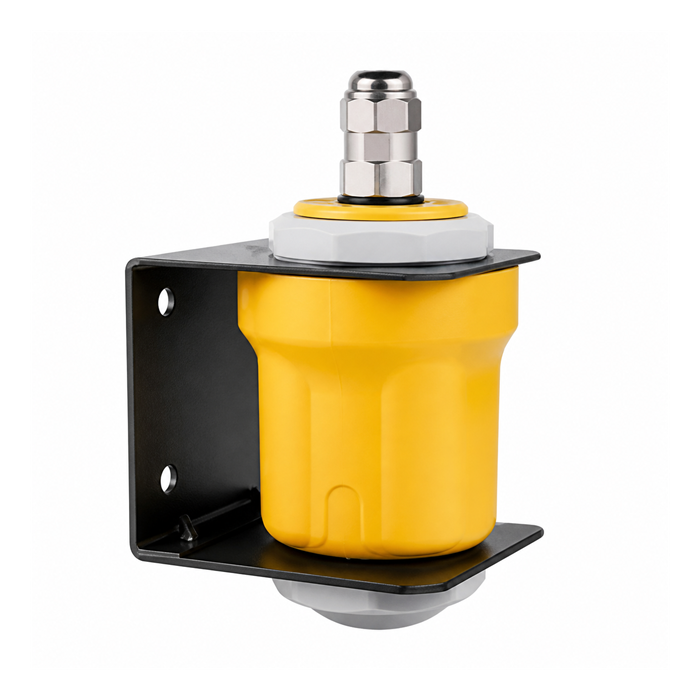
A remote-seal capillary filled with silicone or a similar oil adds an elevation correction equal to the oil density multiplied by the height difference between the two seals. When the oil warms by 30 °C its density can fall by 2–3 %, so the lighter oil in the seal leg presses less on the diaphragm. On a 6 m seal elevation this is a 120–180 mm zero shift — enough to fail a ±1 % band on a 12 m tank; the zero moves up as the oil warms. The acceptance checklist therefore asks the installer to confirm the seal oil type and its temperature coefficient from the data sheet, measure the installed elevation difference on site, verify the zero with a closed and equalised leg before commissioning, and record the expected drift across the site temperature range of typically −10 °C to +50 °C. If the temperature swing is wide, a radar gauge or a tank-gauging servo that has no capillary term avoids the problem and keeps the zero stable.
FAQ
Q1. Does a hydrostatic level transmitter measure level directly?
No. It measures bottom pressure and infers level from an assumed density and the tank height. If the density used for scaling differs from the actual liquid density, the reported level is biased even when the pressure reading is correct. Always confirm the density term against the product data sheet and keep it documented with the tank record for later audits.
Q2. How much level error does a density change cause?
A density change of +3 % causes a level error of about +3 % of the true level, because level is inversely proportional to density. In the worked example a move from 1000 to 1030 kg/m³ at half fill gave +0.18 m on a 12.0 m tank, and the error grows with level height and with the density shift.
Q3. Can I recalibrate the transmitter to fix density drift?
Recalibration will not remove a density error, because the instrument is reporting pressure correctly. Re-scaling only changes the assumed density, which is valid only while that density holds. For a tank with a changing product or temperature, enter the actual density into the calculation or use a sensor that does not depend on density for its level value.
Q4. Why use a differential-pressure transmitter on a sealed tank?
A sealed tank has gas pressure above the liquid that a single bottom tap cannot separate from the liquid head. A differential-pressure transmitter compares bottom pressure with top pressure, leaving ρ · g · h as the measured value. This keeps the reading correct as gas pressure changes during filling and emptying without any extra compensation step.
Q5. What goes wrong with a remote-seal capillary?
The capillary oil has a density that falls as it warms, shifting the zero by a fraction of the elevation head. A 30 °C rise can move the zero by 120–180 mm on a 6.0 m elevation. Verify the oil temperature coefficient, the installed elevation and the closed-leg zero before commissioning, and record the expected drift across the site temperature range.
Q6. When should I choose radar instead of hydrostatic measurement?
Choose radar when the liquid density is unstable or unknown, when the duty demands level error under about 1 % of height, or when a wide temperature swing makes a capillary seal drift unacceptable. Radar measures distance to the surface directly and removes the density term from the level calculation entirely, which is why it is preferred for accounting duties.
SUMMARY
Hydrostatic level measurement infers level from bottom pressure using an assumed density, so a +3 % density shift at half fill produced a +0.18 m level error and a +2.3 m³ volume error in the worked example. Next, send us the tank height, diameter, liquid density range and whether the vessel is vented or sealed, and our engineers will confirm whether a hydrostatic, differential-pressure or radar arrangement meets your tolerance.
Talk to a METRAVON engineer about this application
If you are planning a level upgrade on a tank with a changing product or temperature, send us the tank drawing, the liquid density range and the acceptable level tolerance. Our application engineers will check the density sensitivity of a hydrostatic arrangement against a radar alternative and return a written recommendation.
