


 Chinese
 Spanish
 Russian
 Portuguese
 French
 German
 Indonesian
 Thai
 Vietnamese
 Arabic
 Italian
 Turkish
 Polish
 Japanese


Diesel day-tank level control must preserve usable fuel while leaving space for transfer from bulk storage. Total tank capacity is not usable reserve: the suction position, unpumpable heel, return flow and permitted operating band determine what the generator can actually draw.
Diesel Day-Tank Level Control: Establish the Operating Band
Mark the suction connection, normal start and stop levels, low-reserve indication and highest permitted level on a tank section. Include incoming line contents and any return from the engine. A level percentage becomes a useful reserve figure only after the tank geometry and unusable region have been accounted for.
If the HMI displays remaining runtime, identify the consumption rate and load condition used. A value calculated from a nominal rate must not imply the same endurance at every generator load. Show the calculation basis and treat an invalid level as an invalid runtime estimate.
| Setting | Basis | Verify |
|---|---|---|
| Pump start | Usable reserve and the time to restore supply. | Transfer begins soon enough under the accepted operating demand. |
| Pump stop | Free space and fuel arriving after the stop signal. | Valve travel and line drain-down do not consume the remaining margin. |
| Low reserve | Operator response and the consequence of supply loss. | The alarm reaches the responsible operator with an actionable condition. |
| High-high | The approved overfill-protection design. | Its separate response is proven without relying only on the normal stop setting. |
Check the Small Tank's Beam Path
The METRAVON MV-RD11S is a compact liquid radar with a 21 mm PTFE lens and a published 0.1-10 m measuring interval. Its beam angle is 14 degrees: the small fitting does not imply a narrow footprint inside the tank. Nearby walls, braces and return pipes must be included in the mounting review.
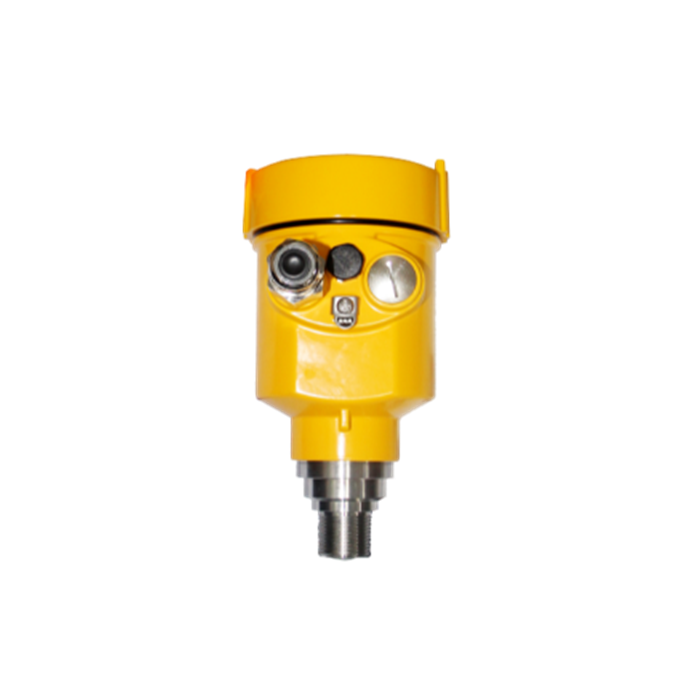
Keep the measurement path away from a splashing return and confirm the shortest air gap at maximum permitted fill. Review the exact fuel, temperature, seals and site's area requirements. The standard product description is not proof of hazardous-area approval for a particular installation.
If the path is unsuitable for the compact model, assess a different antenna or mounting position. The MV-RD12 has a different lens and beam, but its larger connection also needs a drawing review. Do not select between them solely by nominal range.
Test Transfer Faults as Well as Normal Start and Stop
Use the approved test procedure to check the field value, receiver scaling, pump request and actual transfer response. Include an unavailable transfer pump, an invalid level signal and power recovery. Record what requires manual acknowledgement rather than assuming that automatic restart is acceptable.
A held value after lost echo must not silently continue to operate the transfer sequence. Likewise, a low-low condition must not automatically stop essential generation without the consequence having been assessed in the operating design. Instrument selection cannot decide that policy.
Trend level with transfer-pump state, engine load and return conditions. An unexpected level movement may result from transfer, return flow or an instrumentation issue; it is not sufficient evidence of a leak by itself. Investigate with the designated containment and equipment checks.
Generator-Supply Questions
Q1. Is a wide pump deadband always better?
It can reduce cycling, but it also changes reserve at the start point and available space at the stop point. Choose the band from pump constraints, demand and tank geometry, then verify both ends. A copied percentage band may be unsuitable for another tank or transfer rate.
Q2. Can one radar provide two independent high-level protections?
No. Two settings using the same sensor share that sensor's failure path. Meet the plant's independent-protection requirement with the separately assessed arrangement, while keeping the continuous measurement useful for normal operation.
Q3. What information is needed to quote the level instrument?
Provide the tank section, suction and return positions, permitted level band, fuel details and PLC input. Add required approvals and whether the scope includes control integration. This identifies both the usable measuring span and the work outside the transmitter supply.
Summary
Base day-tank control on usable reserve, delayed inflow and an explicit fault policy. Send the tank and transfer arrangement for a compact-radar review. Confirm the control response and required documentation before using the reading to support generator availability.
