


 Chinese
 Spanish
 Russian
 Portuguese
 French
 German
 Indonesian
 Thai
 Vietnamese
 Arabic
 Italian
 Turkish
 Polish
 Japanese


Asphalt tank level measurement must remain useful while the product heats, circulates and leaves deposits around the roof connection. A radar that reads a cool, stationary surface correctly may still lose its target during a transfer. Choose the installation from the temperature cycle and the required stopping margin, not from maximum range alone.
Specify the temperatures at the instrument, not just in the tank
Record the normal product temperature and the highest credible temperature during heating, cleaning and an upset. Add the temperature around the electronics, including radiant heat from pipework. The liquid, flange and housing do not necessarily experience the same conditions.
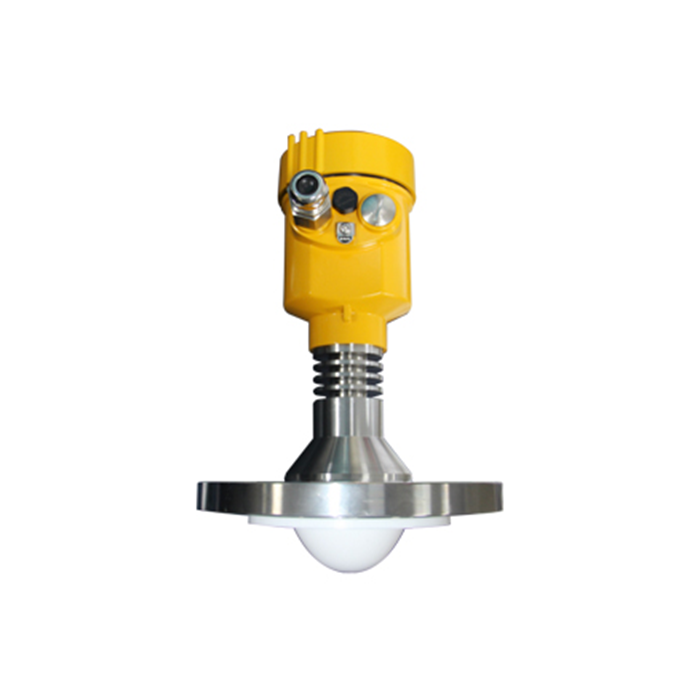
The METRAVON MV-RD15G is a liquid-level model with a 76 mm PTFE lens and a published upper process-temperature reference of 200 deg C. This is a candidate for a heated-tank review, not automatic approval for every asphalt grade. The offered seal, pressure-temperature combination and electronics environment must also be acceptable.
Do not solve an excessive temperature requirement by assuming that a short excursion is harmless. If the duty exceeds the approved assembly, a different construction or measuring arrangement is needed. Wrapping insulation around a cooling section does not increase its rating and can worsen housing exposure.
Test asphalt tank level measurement through the operating cycle
| State | Likely change | Evidence to retain |
|---|---|---|
| Heat-up | Thermal gradients and condensation develop near the roof. | Echo trace, local distance and temperatures at the process connection and enclosure. |
| Transfer | Incoming flow and recirculation disturb the reflecting surface. | Distance trend and alarm response with the actual filling route operating. |
| Storage | Deposits accumulate or harden while the surface looks stable. | As-found lens and nozzle condition before an approved cleaning operation. |
| Shutdown | Residual line contents may continue entering after the stop command. | Observed run-on and the remaining headspace under the agreed transfer procedure. |
Resolve the nozzle before ordering the flange
Supply a section drawing showing bore, length, mounting face and nearby internals. A recessed lens can see the nozzle or collect condensed material rather than the intended surface. The MV-RD15G reference uses a DN80-or-larger flange arrangement, but flange size alone does not establish a usable nozzle.
Keep the measurement path away from the inlet and inspect the full low-level path past coils and supports. A bracket or protective plate added after commissioning can introduce a new reflection. Any cleaning or purge accessory needs its own material, pressure and operating review; it is not assumed to be included with the instrument.
Keep transfer protection separate from inventory calculations
For stopping a transfer, allow for detection, configured damping, controller processing, valve movement and material still in the line. Obtain those times from the actual system rather than applying an arbitrary percentage below full. Independent overfill protection, where required, needs its own risk-based design and test.
For inventory, first verify level against a safe reference, then validate tank geometry and temperature-dependent conversion. Radar does not measure asphalt mass directly. A discrepancy in calculated tonnes may come from density or tank conversion even when the distance measurement is correct.
The output configuration also matters. A specified 4-20 mA/HART loop and a separately ordered RS485/Modbus arrangement require different wiring and receiving inputs. Prove that lost-target status is recognised by the PLC; a held last value must not silently be treated as a fresh measurement.
Questions before a heated-tank purchase
Q1. Is a higher temperature rating enough to justify a different model?
No. Review the entire process-facing assembly, aperture and environment. A higher-rated lens material may have different chemical limits, and the offered connection must still fit the vessel. Request a written configuration against each operating case rather than selecting the largest number in a catalogue.
Q2. Can a successful cold test close commissioning?
It can close the checks performed at that condition, such as scaling and basic geometry. Hot operation, circulation and deposit formation remain separate checks. Record any untested condition as an outstanding acceptance item rather than treating it as proven.
Summary
For an asphalt application, the useful quotation includes the process assembly, mounting review, signal interface and agreed hot-operation tests. Send the asphalt grade, temperature-pressure cases and nozzle drawing, together with the transfer duty and cleaning method, so selection addresses the actual tank.
