


 Chinese
 Spanish
 Russian
 Portuguese
 French
 German
 Indonesian
 Thai
 Vietnamese
 Arabic
 Italian
 Turkish
 Polish
 Japanese


Dosing tank level measurement should give the operator time to replenish chemical before suction becomes unreliable. The lowest readable liquid level is not necessarily the lowest usable level for the metering pump. Establish the pump's operating requirement and the remaining chemical demand before setting the low alarm.
Turn pump demand into a useful reserve
Use the tank's actual shape to determine the volume available above the agreed minimum suction level. Compare that reserve with the expected consumption during detection, notification and replenishment. A curved bottom or internal suction pipe can make a height percentage a poor estimate of remaining dosing time.
A low-level action must follow the pump and treatment-process requirements. Stopping a pump may protect the pump while interrupting essential chemical treatment, so specify the plant response as well as the instrument alarm. Keep a separate record of how an invalid measurement is handled.
Check dosing tank level measurement in the available headspace
The METRAVON MV-RD11S has a 21 mm PTFE lens and a published 0.1-10 m liquid measuring interval. Its nominal 14-degree beam must fit the tank through the complete working range. A small threaded connection does not ensure clearance from the wall, mixer or fill pipe.
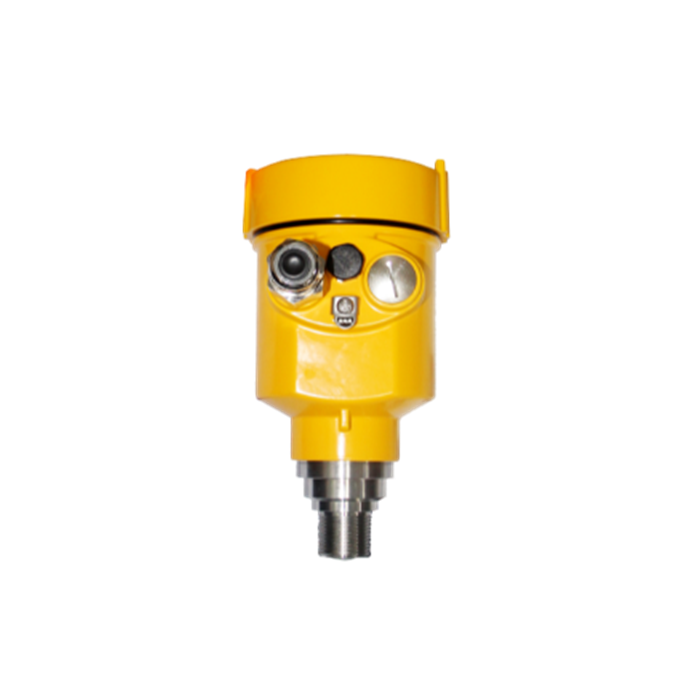
Measure the closest liquid distance at maximum fill, including any nozzle extension. Adding a standpipe to gain headspace can introduce a strong nearby reflection. Review its bore and length rather than treating extra height as an automatic remedy.
| State | Check | Required outcome |
|---|---|---|
| Normal dosing | Level trend versus pump operation | The usable reserve is visible before replenishment is needed. |
| Rapid refill | Jet, foam and stopping delay | The high limit leaves space for liquid still entering after stop. |
| Low reserve | Reference level and intended plant response | The alarm and action occur before the agreed suction limit. |
| Lost signal | Local fault and controller indication | Stale level is identified and the approved fallback is invoked. |
Identify the chemical, not just the treatment process
Hypochlorite, coagulant, acid, alkali and polymer solutions present different material and surface conditions. Provide composition, concentration and temperature, including dilution and cleaning. Approve the process seal and connection as well as the PTFE lens; corrosive vapour can reach parts above the normal liquid surface.
Observe foam and deposits during actual refill and dosing. If the process requires the liquid beneath foam, acceptance must show that the usable signal represents that quantity. A clean-water check can establish wiring and scaling without qualifying the chemical service.
Questions about replenishment
Q1. Can a high alarm be set just below the tank lid?
Not without checking refill rate, response time and liquid remaining in the delivery line. The usable high limit must also stay outside the instrument's near zone. Containment and any independent overflow protection remain separate requirements.
Q2. What should the PLC receive?
Specify the ordered 4-20 mA or RS485/Modbus RTU electronics to match the input. Agree on engineering units, scaling and fault handling. A digital register value without a freshness or validity check is insufficient for unattended replenishment decisions.
Summary
A dosing-tank selection review needs the chemical duty, tank section, suction arrangement, consumption and refill sequence. Use those details to evaluate MV-RD11S and establish useful low and high limits rather than copying alarm percentages from another vessel.
