


 Chinese
 Spanish
 Russian
 Portuguese
 French
 German
 Indonesian
 Thai
 Vietnamese
 Arabic
 Italian
 Turkish
 Polish
 Japanese


METRAVON Radar Level Measurement for Ammonia Solution Tanks in Acid Regeneration Systems
Acid regeneration systems used in steel pickling and related chemical processes may include fresh-acid, regenerated-acid, spent-acid, neutralization and alkaline-chemical tanks. Ammonia solution may be used in some treatment or neutralization arrangements, depending on the plant design.
These tanks should not be treated as one common chemical service. Fresh acid, regenerated acid and ammonia solution have very different material-compatibility requirements and should be selected separately.
What Makes Ammonia Solution Tanks Challenging?
Higher temperature and process conditions can increase ammonia release into the vapor space.
Copper, brass, zinc and some other materials require particular caution in ammonia service.
Temperature differences can create condensation; acid-gas cross-contamination can also lead to salt deposits.
Toxicity, ventilation, vapor handling and site classification must be addressed by the overall process design.
Material compatibility depends on the actual ammonia service
Compatibility depends on ammonia concentration, temperature, impurities, alloy grade, stress condition, contact duration and whether exposure is in the liquid or vapor phase.
Copper, brass, zinc and some related alloys are well-known concerns in ammonia environments. Stainless steels, PTFE, PFA and other materials must still be checked against the exact service conditions and the project's material standard.
Why Non-Contact Radar Is Often Considered First
Free-space radar does not require a probe to remain immersed in the ammonia solution. This can reduce direct product exposure, probe coating and some mechanical maintenance.
The process-side lens or antenna, gasket, flange and isolation surface may still be exposed to vapor, splash and condensate, so complete material compatibility remains essential.
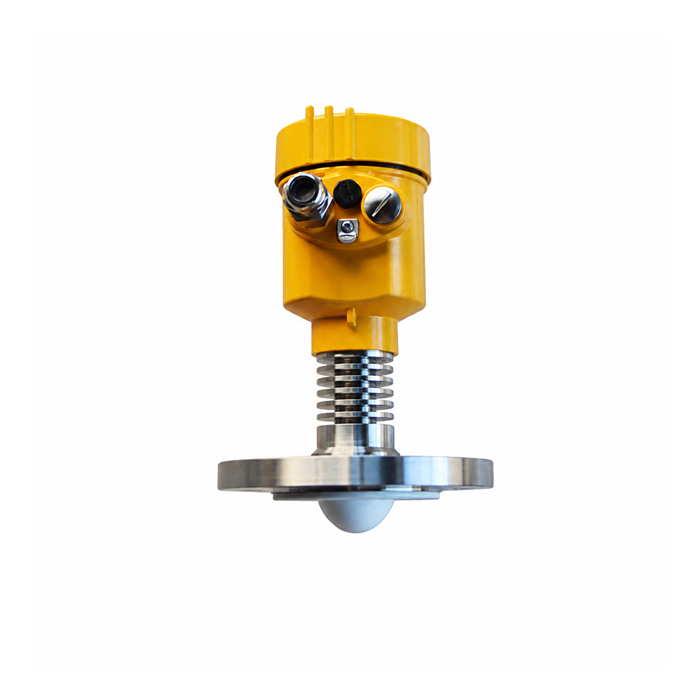
What Does 80GHz Add?
80GHz radar can provide a compact antenna and narrow beam, which is useful in small tanks or vessels containing internal pipework, supports or coils. It can also improve separation from nearby fixed structures.
A focused beam can help separate the surface from nearby structures. Suitability in ammonia vapor and installed accuracy still depend on the selected antenna, operating conditions, deposits and the verified target; frequency alone establishes neither.
Does Ammonia Vapor Itself Cause Radar Loss of Echo?
Do not attribute echo loss to ammonia vapor from the symptom alone. Compare pressure, temperature, antenna condition and selected target with the event. Condensation, film, deposits and fixed reflections are possible causes; the actual process and instrument limits determine what needs testing.
Why White Deposits at the Tank Top Need Chemical Investigation
Ammonia vapor does not simply condense into “ammonia crystals” under ordinary tank conditions. If white crystalline deposits repeatedly appear around the tank top or instrument, investigate acid-gas cross-contamination, vent-system interaction and the actual deposit chemistry.
Where ammonia meets acidic vapor such as HCl-containing mist, ammonium-salt formation can become a realistic mechanism for deposits.
When to Consider PTFE-Covered Guided Wave Radar
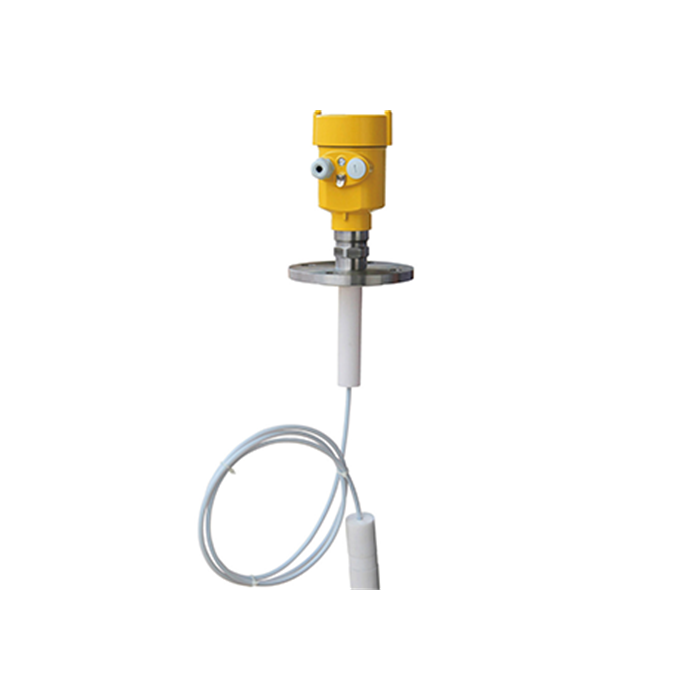
Guided wave radar sends the electromagnetic signal along a rod, cable or coaxial probe. In some small or medium ammonia-solution tanks, a chemically suitable guided probe can be a practical alternative if contact with the liquid is acceptable.
Check the complete probe assembly, process connection, seals, fixing hardware, temperature and pressure rating. A PTFE covering does not automatically make the entire instrument chemically compatible.
Guided Wave Radar Is Not Immune to Foam and Deposits
A guided signal path can reduce some free-space effects, but foam, probe coating, deposits and dielectric behavior can still change the echo response. Compare free-space radar and GWR using the actual application rather than assuming one technology is always more stable.
Free-Space Radar vs Guided Wave Radar
| Comparison | Free-Space Radar | Guided Wave Radar |
|---|---|---|
| Immersed measuring element | No | Yes |
| Deposit concern | Mainly antenna/process surface | Entire probe can be exposed |
| Internal structures | Narrow beam can help avoid them | Probe must remain clear of them |
| Material review | Process isolation, connection and seals | Full probe and connection assembly |
Installation Position
Keep the measuring point away from the direct filling jet, severe surface disturbance, major internal structures and locations where condensate may continuously drip onto the process surface of the instrument.
For GWR, also ensure the probe cannot contact the tank wall, supports or internal piping and is not exposed to damaging filling impact.
Process Connection and Seal Selection
Do not specify one universal material such as PTFE/PFA or titanium for every ammonia-solution application. Select the process isolation, flange, gasket and hardware from the actual concentration, temperature, pressure and site material standard.
Fresh-acid and regenerated-acid tanks require their own separate material assessment.
Cable Glands and Drip Loops
In outdoor or humid chemical areas, cable routing should prevent rainwater or condensate from running directly into the gland. Use the correct gland size, tighten it properly, seal unused entries and keep the enclosure sealing system intact.
Maintenance Should Be Condition-Based
There is no universal cleaning interval for ammonia tanks. Base inspection frequency on condensation, deposit rate, echo changes, temperature, nearby acid mist and historical maintenance data.
Use echo and maintenance trends to decide whether inspection is needed. Plan any process-side inspection or dismantling under the site isolation and exposure-control procedure; a weakening signal does not authorize opening an operating ammonia tank.
Purging Must Be Engineered, Not Improvised
Compressed air, nitrogen or water purging should only be used when the instrument design supports it and the process safety review allows that purge medium. On ammonia tanks, an improvised purge can affect vapor release, tank pressure and the vent system.
Does the Radar Need Periodic Recalibration?
Set calibration and verification intervals from the selected manual and the project measurement requirements. Routine checks may include reference height, configured range, independent level comparison, PLC scaling and echo trends. Do not repeatedly change empty/full parameters as a substitute for diagnosing an unstable target.
If a displayed level suddenly falls from 60% to 10%, do not assume the internal calibration has drifted. Confirm the real level, compare the local display and PLC value, inspect the echo curve, and check for deposits or configuration changes first.
Why “Recalibration Fixed It” Does Not Prove Calibration Drift
Changing empty/full parameters can alter both output scaling and the target-search region. If the fault-state echo curve and original parameters were not saved, the real root cause may no longer be identifiable.
Save fault-state data and the original parameters before changing configuration. A recovered display alone does not identify the failed part of the measurement chain.
Electrical Inspection
Verify terminal voltage under load, loop current, barrier or isolator drop, cable condition, communication, grounding and surge protection against the selected instrument and approved loop drawing. One operating-voltage range cannot be applied to every radar model.
Hazardous-Area Certification Is Site-Specific
Ammonia is toxic and can be flammable under certain conditions, but hazardous-area classification depends on concentration, temperature, ventilation, venting and the site's formal area study.
If the location is classified, use a specifically certified model. IP65/IP67/IP68 enclosure ratings do not replace Ex certification.
Level Measurement Is Only One Part of Ammonia-Tank Safety
A radar level transmitter does not replace ammonia gas detection, ventilation, tank-pressure management, emergency systems or independent overfill protection where these are required by the process safety design.
Quick Diagnostic Table
| Symptom | Check First |
|---|---|
| Sudden level jump | Actual level, filling disturbance, echo curve, deposits |
| Constant offset | Reference height, empty/full settings, PLC scaling |
| Intermittent loss of echo | Condensation, deposits, unwanted echoes, true echo strength |
| White deposit near instrument | Acid-gas cross-contamination, vent system, deposit chemistry |
| PLC wrong, local display correct | 4-20 mA loop, communication, PLC scaling |
Data Required for Selection
- Ammonia solution concentration and impurities;
- Tank height, diameter and internal structures;
- Maximum and minimum level;
- Normal and design temperature and pressure;
- Mounting nozzle and filling arrangement;
- Nearby acid mist, condensation and ventilation conditions;
- Power, output and communication requirements;
- Hazardous-area classification and required certification.
Questions before specifying an ammonia-tank instrument
Q1. Does a non-contact radar avoid the ammonia material review?
No. Its lens or antenna, process isolation, seal and connection can still encounter vapor, splash or condensate. Provide concentration, temperature, impurities and exposure conditions for the complete assembly. An acceptable housing material or probe covering does not establish compatibility of every process-exposed part.
Q2. Should white deposits be removed by adding a purge?
Identify the deposits and the conditions that produce them before choosing a cleaning or purge arrangement. Acid-gas contamination is one possibility, not a diagnosis from color alone. A purge must be supported by the instrument and approved for its effect on tank pressure, vapor release and vent handling.
Q3. When is a guided probe worth comparing with free-space radar?
Consider it when the vessel geometry or surface return makes free-space tracking difficult and product contact is acceptable. Check the probe, seals, coating risk, clearances and transition zones for the actual medium. MV-RD702 is a model entry for review, not evidence that every configuration suits an ammonia tank.
Q4. What evidence should accompany an unstable-level enquiry?
Send the actual level reference, local and PLC values, fault-state echo trace, reference height and original settings. Add recent filling, temperature or deposit changes. Preserve those records before changing span or suppression, otherwise a recovered display may hide the original cause.
Application Summary
Ammonia-solution level measurement is not simply a corrosion-resistant housing choice. Review vapor exposure, all process-exposed materials, condensation or deposits, vessel geometry and maintenance conditions together.
Free-space radar minimizes long-term immersion of the measuring element, while guided wave radar can be useful in selected tanks where a contact probe is acceptable. Fresh-acid, regenerated-acid and ammonia-solution tanks should always be treated as separate material-selection problems.
For a model review, include ammonia concentration, exposure conditions, nozzle dimensions and any deposit evidence. Send ammonia-tank details
