Chinese
 Spanish
 Russian
 Portuguese
 French
 German
 Indonesian
 Thai
Thai Vietnamese
 Arabic
 Italian
 Turkish
 Polish
 Japanese
Engineering Summary
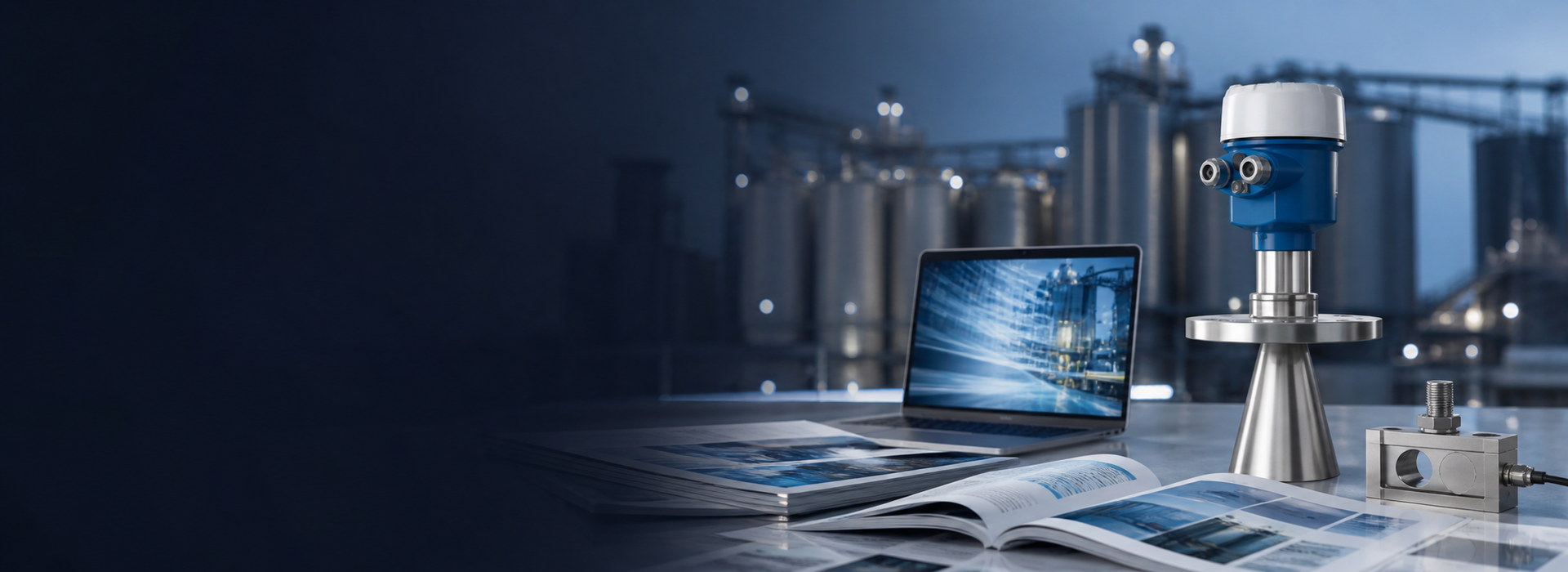
Radar level transmitters are non-contact continuous level instruments used on tanks, reactors, silos, and bulk-material processes. Engineering selection should distinguish measurement principle, operating frequency, accuracy class, antenna type, measured medium, and process conditions. Different radar types vary in beam angle, range, blocking distance, buildup sensitivity, and ability to work around internal structures.
Table of Contents
What Is a Radar Level Transmitter?
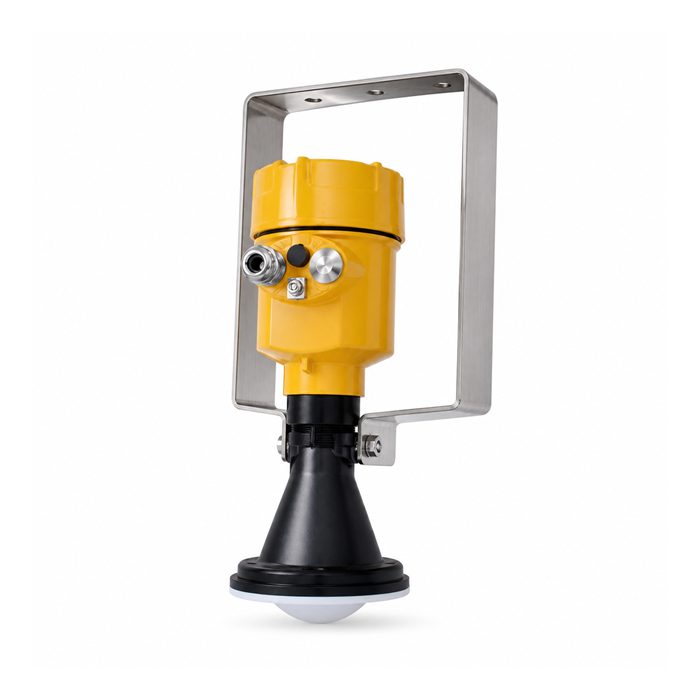
A radar level transmitter, or radar level instrument, uses microwave electromagnetic energy to measure liquid level or bulk solids level. Free-space radar is normally mounted above the product surface and does not require the measuring antenna to remain immersed in the process medium.
Typical applications include storage tanks, chemical process vessels, reactors, water basins, silos, powders, granules, and difficult industrial processes.
How Does Radar Level Measurement Work?
Microwave Transmission → Product Surface Reflection → Echo Reception → Signal Processing → Distance Calculation → Level Conversion
For pulse time-of-flight radar:
d = c × t / 2
If E is the empty reference distance, the product level can be expressed as:
H = E − d
Radar first measures distance. The instrument then converts distance into level, percentage, or volume according to vessel configuration.
Main Characteristics of Radar Level Transmitters
1. Non-Contact Measurement
Free-space radar reduces direct process contact, mechanical wear, corrosion exposure, contamination, and maintenance associated with some contact-type technologies.
2. No Mechanical Measuring Movement
Unlike floats or mechanical plumb-bob systems, radar usually has no continuously moving mechanical measuring assembly.
3. Suitable for Many Difficult Process Conditions
Radar can be applied in environments involving vapor, dust, temperature changes, pressure changes, agitation, and irregular solids surfaces. However, extreme temperature, pressure, thick foam, severe condensation, and dense dust still require model-specific evaluation.
4. Applicable to Liquids and Bulk Solids
Depending on frequency, antenna, and signal processing, radar can be used for water, industrial liquids, oils, chemicals, slurry, powders, pellets, mineral products, cement, and grain.
How Are Radar Level Transmitters Classified?
By measurement principle
By operating frequency
By accuracy class
By antenna type
By measured medium
By industrial application
1. Classification by Measurement Principle
Pulse Radar
Pulse radar transmits short microwave pulses and determines distance from propagation time.
FMCW Radar
FMCW stands for Frequency Modulated Continuous Wave . The radar continuously changes transmit frequency and calculates target distance from the frequency difference between the current transmit signal and the delayed return signal.
Operating frequency and measurement principle are different concepts. “26 GHz” alone does not indicate whether a particular instrument is pulse radar or FMCW radar.
2. Classification by Operating Frequency
26 GHz Radar
26 GHz radar is a mature technology widely used for water tanks, wastewater basins, chemical storage, oil tanks, and many conventional bulk solids silos.
80 GHz Radar
80 GHz millimeter-wave radar can form a narrow beam with suitable antenna design, making it attractive for small-diameter vessels, reactors, narrow installation spaces, and complex solids silos.
120 GHz and Other Higher-Frequency Radar
Higher-frequency millimeter-wave radar can provide smaller antennas and narrower beams, but actual performance still depends on antenna design, FMCW bandwidth, medium reflectivity, signal processing, and installation conditions.
Higher frequency does not automatically mean that every performance parameter is better.
3. Classification by Accuracy Class
Process-Grade Radar
Process radar focuses on stable continuous measurement for alarms, pump control, process operation, and inventory trends.
High-Accuracy or Custody-Oriented Radar
Higher-accuracy radar may be used where repeatability and measurement uncertainty are more demanding, such as inventory control or certain tank gauging applications. Formal custody-transfer use depends on certifications and applicable regulations.
4. Classification by Antenna Type
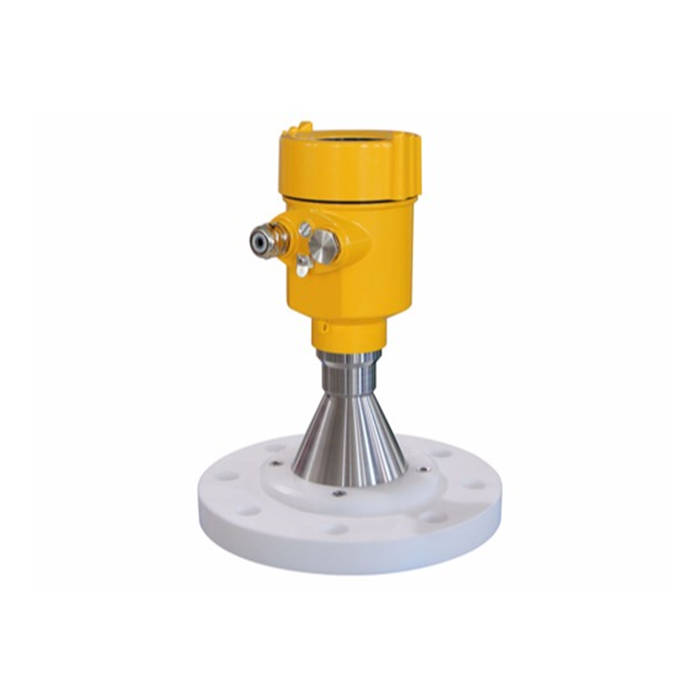
Horn Antenna
Horn antennas are mature designs with good directionality. At the same frequency, increasing antenna aperture generally produces a narrower beam. Typical applications include conventional tanks and some large silos. High-buildup or sticky products require special attention.
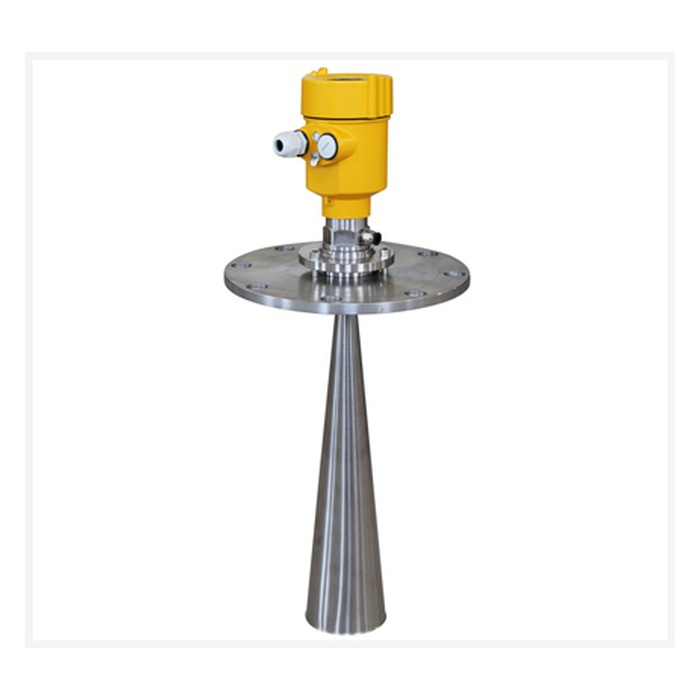
Parabolic Antenna
Parabolic antennas provide strong directionality and concentrated energy, which can benefit long-range or difficult solids applications. Their larger physical size and potential for buildup must be considered.
Array Antenna
Array antennas use multiple radiating elements to control the beam. They are common in modern millimeter-wave radar where compact size and narrow-beam performance are desirable.
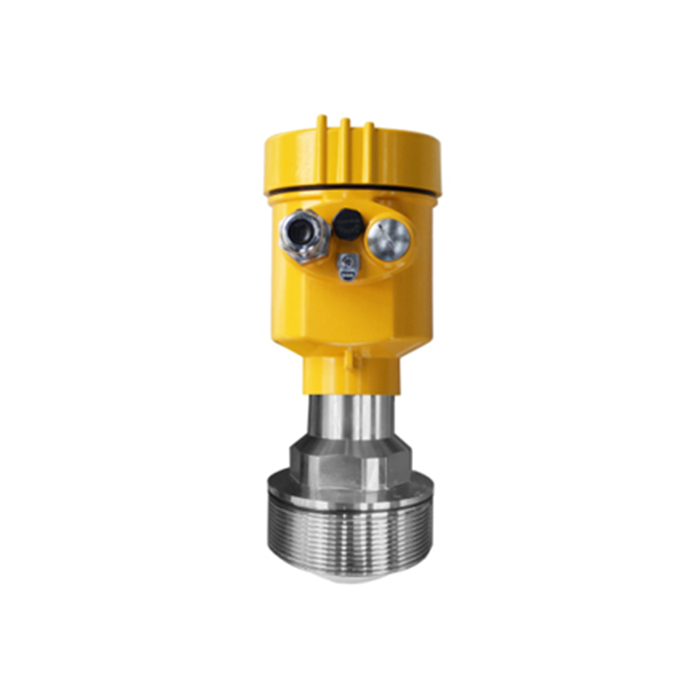
Lens or Planar Antenna
Lens or planar designs are common in 80 GHz and higher-frequency radar. They support compact process connections, narrow beams, and small mechanical envelopes. Material compatibility must be confirmed for the process medium.
How Should Different Antennas Be Compared?
| Antenna Type | Main Characteristics | Typical Applications | Key Considerations |
|---|---|---|---|
| Horn | Mature, good directionality | Conventional tanks, large vessels | Installation space, buildup |
| Parabolic | High gain and strong directionality | Long range, some solids silos | Large size, deposits |
| Array | Good beam control | Millimeter-wave radar, complex vessels | Model-specific design |
| Lens / Planar | Compact, small connection, narrow beam | 80 GHz and higher-frequency radar | Material compatibility |
5. Classification by Measured Medium
Liquid Radar Level Measurement
Typical media include water, industrial liquids, oil, chemicals, wastewater, and slurry. Important factors include dielectric behavior, foam, vapor, agitation, temperature, and pressure.
Bulk Solids Radar Level Measurement
Typical products include cement, mineral powder, coal, ash, grain, and plastic pellets. Solids introduce angle of repose, conical piles, funnel surfaces, dust, wall buildup, and changing reflection geometry.
How to Compare Different Radar Types
| Item | 26 GHz Radar | 80 GHz Radar | Higher-Frequency Millimeter-Wave Radar |
|---|---|---|---|
| Technology Maturity | Mature | Mature and widely adopted | Increasing adoption |
| Typical Beam | Relatively wider | Narrower | Can be narrower still |
| Antenna Size | Relatively larger | Smaller | Potentially smaller |
| Small Vessels | Evaluate carefully | Often advantageous | Model dependent |
| Complex Internals | Installation position is critical | Narrow beam is advantageous | Depends on product design |
| Large Simple Tanks | Suitable | Suitable | Evaluate cost and process needs |
| Complex Solids Silos | Applicable | Often worth prioritizing | Evaluate by application |
Typical Industrial Applications
1. Cement and Mining Silos
Site Challenge: Heavy dust, irregular surfaces, large silo height, buildup, and filling impact.
Radar Level Transmitter → RS485 Modbus RTU / 4–20 mA → PLC
2. Chemical Tanks and Reactors
Site Challenge: Corrosive media, vapor, temperature, pressure, agitation, and internal structures.
Radar Level Transmitter → 4–20 mA/HART → PLC / DCS
3. Grain and Bulk Raw-Material Silos
Selection should focus on beam angle, silo height, dust, filling location, and material surface geometry.
4. Oil and Industrial Liquid Storage Tanks
Select according to vessel size, process temperature, pressure, medium properties, and accuracy requirements.
5. Multi-Silo Remote Monitoring
Multiple Radar Level Transmitters → RS485 / RTU → Industrial Gateway → 4G / Ethernet → SCADA / IoT
Radar Level Selection Guide
| Item | What to Confirm |
|---|---|
| Measured Product | Liquid, slurry, powder, or granules |
| Product Name | Used to assess dielectric behavior and material compatibility |
| Measurement Distance | Maximum distance to the lowest level |
| Vessel Geometry | Height, diameter, shape |
| Internals | Beams, coils, ladders, agitators, filling pipes |
| Process Temperature | Normal and maximum |
| Process Pressure | Normal and maximum |
| Process Conditions | Foam, dust, vapor, condensation, agitation |
| Process Connection | Thread, flange, size |
| Output | 4–20 mA, HART, RS485 Modbus RTU |
| System Integration | PLC, DCS, RTU, SCADA, industrial gateway |
| Hazardous Area | Required explosion-protection certification |
Installation Considerations
Avoid the Filling Stream
Filling streams can create strong dynamic echoes.
Avoid Internal Obstacles
Pipes, ladders, agitators, and beams can create fixed reflections.
Use Beam Angle to Determine Mounting Position
Do not apply one fixed tank-wall distance to every radar. Use the actual beam angle and measurement distance.
Check Nozzle Geometry
Long narrow nozzles can create additional reflections. Follow the installation requirements for the specific product.
Commission False-Echo Suppression
Use false-echo mapping, damping, and application-mode settings as required.
FAQ
Q1: What is the difference between a radar level transmitter and a radar level gauge?
“Radar level transmitter” is commonly used for industrial instruments that output a process signal, while “radar level gauge” is a broader term. In practice, terminology varies by industry.
Q2: Is radar completely unaffected by temperature and pressure?
No. Radar propagation is relatively insensitive to many gas-phase changes, but the process connection, seals, antenna, and electronics still have temperature and pressure limits.
Q3: Is 80 GHz always better than 26 GHz?
No. 80 GHz often provides a narrower beam and smaller process connection, while 26 GHz remains suitable for many conventional tanks and industrial processes.
Q4: Which is better, a horn antenna or an array antenna?
Neither is universally better. The choice depends on operating frequency, range, vessel geometry, process connection, and buildup risk.
Q5: Can radar measure cement and mineral powder?
Yes, but selection should consider dust, angle of repose, silo height, dielectric properties, and buildup.
Q6: Can radar measure in agitated tanks?
Yes, if the installation position avoids strong obstacles and the instrument is configured with appropriate echo suppression and damping.
Q7: What is the difference between process-grade and high-accuracy radar?
Process radar prioritizes stable continuous measurement. Higher-accuracy radar places greater emphasis on repeatability and measurement uncertainty.
Q8: Can a radar level transmitter connect directly to a PLC?
Yes, depending on the available 4–20 mA, HART, or RS485 Modbus RTU interface.
Q9: Which radar should be prioritized for complex solids silos?
Narrow-beam high-frequency radar is often worth evaluating first, but final selection still depends on the product and installation.
Q10: What is the single most important radar selection parameter?
There is no single parameter. Medium, range, beam angle, temperature, pressure, antenna, installation position, and communication interface must be considered together.
Conclusion
Radar level measurement is a mature non-contact technology for tanks, reactors, silos, and bulk-material processes. Correct selection requires matching measurement principle, operating frequency, accuracy class, antenna structure, process conditions, and system interface to the application.
METRAVON Radar Level Measurement Selection
For project evaluation, provide medium name, liquid or solid state, maximum range, vessel dimensions, temperature, pressure, dust, foam, vapor, condensation conditions, internals, process connection, communication requirements, and site photos or vessel drawings.