Chinese
 Spanish
 Russian
 Portuguese
 French
 German
 Indonesian
 Thai
Thai Vietnamese
 Arabic
 Italian
 Turkish
 Polish
 Japanese
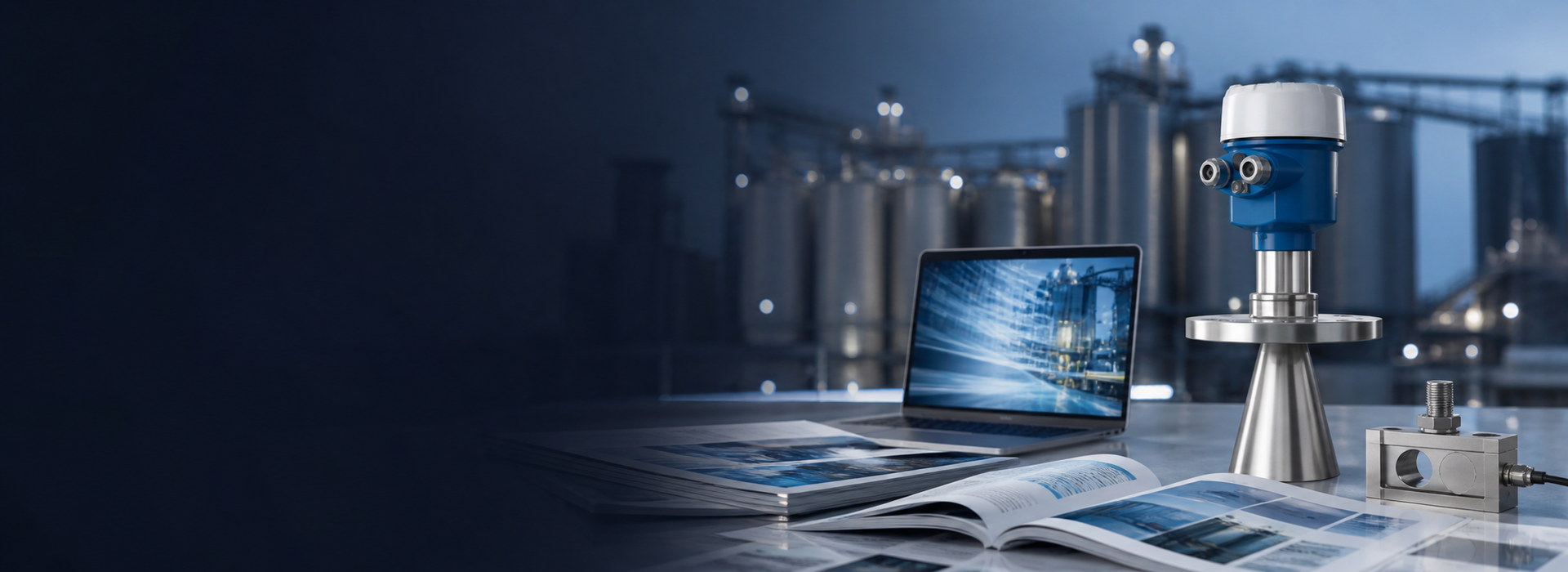
Ultrasonic level sensors determine the distance to a liquid or material surface by measuring the round-trip travel time of an acoustic pulse. They are widely used for non-contact level measurement in water tanks, open basins, wastewater systems, wet wells, and selected atmospheric process vessels. However, because ultrasonic waves require a gas medium for propagation, temperature, vapor, foam, dust, and surface conditions can significantly influence measurement performance.
1. How Does an Ultrasonic Level Sensor Work?
Measurement Process
Sensor transmits an ultrasonic pulse → The pulse reaches the product surface → An echo is reflected → The sensor receives the echo.
Distance Calculation
D = c × t / 2, where D is the distance to the surface, c is the speed of sound, and t is the round-trip travel time.
The transmitter converts the measured distance into level using the configured empty distance or tank height. Because the speed of sound in air changes with temperature, industrial ultrasonic instruments normally include automatic temperature compensation.
2. Main Advantages of Ultrasonic Level Sensors
Non-Contact Measurement
The sensor does not need to be immersed in the liquid, reducing direct corrosion, contamination, scaling, and mechanical wear.
Simple Installation
Threaded, flange, or bracket mounting can be used, particularly for open basins, tanks, and wastewater wells.
Low Maintenance
There are no floats, guide rods, or immersed moving components. Routine maintenance mainly involves checking the sensor face and installation.
Competitive Cost
For atmospheric water and general process level measurement, ultrasonic technology can provide a cost-effective solution.
Not Directly Affected by Liquid Density
The instrument measures distance to the surface rather than hydrostatic pressure.
Broad Application Range
Suitable for water, wastewater, selected chemicals, and some granular or coarse solid materials.
3. Main Limitations of Ultrasonic Level Measurement
Temperature Effects
Air temperature changes the speed of sound. Temperature compensation reduces the effect, but strong gradients can still introduce additional error.
Foam
Thick or loose foam may absorb or scatter acoustic energy and weaken the actual liquid-surface echo.
Vapor and Volatile Gases
Changes in gas composition can alter acoustic propagation conditions and cannot always be corrected by normal temperature compensation.
Dust
Heavy airborne dust may attenuate or scatter sound, making radar worth evaluating for difficult solids applications.
Surface Turbulence
Agitation, vortexing, waterfalls, or high inlet flow can redirect the echo away from the sensor.
Vacuum
Ultrasonic waves require a gas medium, so standard ultrasonic level sensors are not suitable for near-vacuum vessels.
4. What Is the Blocking Distance?
After transmitting an ultrasonic pulse, the transducer continues vibrating for a short period and cannot reliably receive a very close echo. The area near the sensor where measurement is not reliable is known as the blocking distance, dead zone, or near-field blanking zone.
Selection Rule:Blocking distance varies significantly between sensor models. The maximum liquid level must remain outside the specified blocking distance with an appropriate safety margin. A larger maximum range does not automatically mean a better sensor for every application.
5. Why Does Temperature Affect Ultrasonic Measurement?
Ultrasonic level instruments calculate distance from sound velocity and travel time, while the speed of sound in air changes with temperature. Industrial sensors therefore normally use an integrated temperature sensor to compensate the calculation.
In tall tanks, outdoor basins, or installations with strong thermal stratification, the average temperature along the complete sound path may differ from the temperature measured near the transducer. Additional error can therefore remain even when temperature compensation is active.
6. How Do Foam, Vapor and Volatile Media Affect Measurement?
| Condition | Effect on Ultrasonic Measurement |
|---|---|
| Thin, wet foam | Measurement may still be possible depending on actual echo strength. |
| Thick, loose foam | Can strongly absorb acoustic energy and reduce the liquid-surface echo. |
| Heavy vapor | May change propagation velocity and attenuate the signal. |
| Volatile solvents | Changes in gas composition may affect sound velocity and measurement stability. |
| Heavy airborne dust | May cause acoustic attenuation and scattering; radar should also be evaluated. |
7. Can Ultrasonic Level Sensors Measure Solids?
Ultrasonic sensors can be used for selected granular and coarse materials such as grain, plastic pellets, coal, and some mineral products. However, solids often form sloped surfaces, so the reflected acoustic signal may not return directly to the sensor.
For cement, fly ash, mineral powder, and other dusty materials, airborne dust may further attenuate the signal. Radar level measurement should therefore also be considered for large or difficult bulk solids applications.
8. Ultrasonic vs. Radar Level Measurement
| Application | Ultrasonic | Radar |
|---|---|---|
| Atmospheric clean-water tank | Suitable | Suitable |
| Wastewater basin | Suitable; check foam and aeration | Suitable |
| Open-water basin | Commonly used | Suitable |
| Heavy foam | Requires careful evaluation | Also depends on foam properties |
| Heavy vapor | Usually not preferred | Generally more suitable |
| Vacuum vessel | Standard ultrasonic not suitable | Suitable models available |
| Heavy-dust silo | Use with caution | Generally more suitable |
| High temperature / pressure | Usually not preferred | Specialized models available |
9. Typical Applications
Water Tanks and Basins
Atmospheric tanks with relatively stable environmental conditions are typical ultrasonic applications.
Wastewater and Wet Wells
The sensor does not remain submerged in wastewater, reducing direct contamination and maintenance.
Hydrology
Suitable for selected channels, reservoirs, and other open-water monitoring applications.
Selected Bulk Solids
Can be used for some coarse or granular solids where dust and surface slope remain manageable.
10. Installation Guidelines
Aim at the Surface
The sensor should be aligned as perpendicular to the liquid surface as practical.
Avoid Inlet Flow
High-velocity inflow, waterfalls, and falling material can interfere with the actual surface echo.
Avoid Obstructions
Ladders, pipes, beams, agitators, and vessel structures may generate false echoes.
Keep the Sensor Face Clean
Condensation, dirt, sludge, frost, or spider webs may interfere with transmission and reception.
11. Does an Ultrasonic Level Sensor Require Calibration?
Ultrasonic instruments normally do not require frequent liquid-standard calibration in the way analytical sensors such as pH or dissolved oxygen probes do. However, correct configuration and field verification are still required after installation.
Empty distance
Full-scale range
4–20 mA scaling
Blocking distance
Response time
False-echo suppression
It is therefore more accurate to say that ultrasonic level sensors normally do not require frequent recalibration, but they do require correct setup and field verification.
12. Information Required Before Selection
Measurement
Medium name
Maximum measuring distance
Maximum level
Surface turbulence
Process Conditions
Temperature
Pressure
Foam
Vapor
Dust
Installation
Tank or basin dimensions
Mounting position
Thread/flange/bracket
Site photos
Electrical
Power supply
4–20 mA
RS485 Modbus
Relay
IP/Ex requirements
FAQ
1. What is the main advantage of an ultrasonic level sensor?
The main advantage is non-contact measurement. The sensor does not need to remain immersed in the process liquid, reducing corrosion, contamination, and buildup.
2. What is the main disadvantage?
Ultrasonic measurement depends on acoustic propagation through the gas space, so temperature, vapor, foam, dust, and gas composition can affect performance.
3. How far can an ultrasonic level sensor measure?
It depends on the specific sensor. Industrial products are available in multiple range classes, while actual usable distance is also affected by foam, vapor, dust, turbulence, and mounting conditions.
4. Can ultrasonic level sensors measure wastewater?
Yes. Wastewater basins and wet wells are common applications, but heavy foam, aeration, or strong turbulence should be evaluated before final selection.
5. Can ultrasonic level sensors measure oil?
Some oils can be measured, but volatile vapors in the gas space may change acoustic propagation and should be considered.
6. Why is temperature compensation required?
Because the speed of sound in air changes with temperature. Without proper compensation, temperature changes can become distance errors.
7. Can ultrasonic sensors be used in vacuum vessels?
Standard ultrasonic instruments are generally unsuitable because sound requires a gas medium for propagation.
8. Do ultrasonic level sensors have a dead zone?
Yes. The actual blocking distance depends on the sensor design and measuring range. Maximum level must remain outside the specified near-field area.
9. Does foam always prevent ultrasonic measurement?
No. Thin, wet foam may still provide a usable echo, while thick, loose, or continuously changing foam is much more likely to attenuate the acoustic signal.
10. What information does METRAVON need for selection?
Please provide the medium, maximum measuring distance, maximum level, temperature, pressure, foam, vapor, agitation conditions, mounting method, output signal, and site photos.
Conclusion
The main advantages of ultrasonic level sensors are non-contact measurement, simple construction, easy installation, relatively low maintenance, and competitive overall cost. They are particularly suitable for water tanks, basins, wastewater systems, wet wells, open channels, and selected atmospheric process applications.
Their main limitations are related to the acoustic propagation environment. Temperature gradients, foam, vapor, volatile gases, dust, vacuum, and severe surface turbulence can all affect measurement stability. Selection should therefore consider more than maximum range alone.
METRAVON can compare ultrasonic and radar level measurement according to the process medium, measuring range, temperature, pressure, vessel structure, installation conditions, and required output interface.