


 Chinese
 Spanish
 Russian
 Portuguese
 French
 German
 Indonesian
 Thai
 Vietnamese
 Arabic
 Italian
 Turkish
 Polish
 Japanese


After a liquid level sensor replacement, a trend may jump even though nothing entered or left the tank. The new instrument may use a different reference plane, output span or measured variable. Before reusing the historical tag, establish that a value recorded after the change means the same thing as a value recorded before it.
Keep a before-and-after measurement definition
Export the old configuration while it is still available. Record the tag at the transmitter, PLC and historian, because those three locations may apply different conversions. A tag labelled "tank level" could contain metres, a percentage or a calculated volume.
| Field | Record for both instruments | Why the comparison matters |
|---|---|---|
| Quantity | Distance, level, volume, mass or a defined percentage | The same numeric value can describe different physical quantities. |
| Reference | Sensor reference plane, physical zero and tank drawing revision | A mounting change can introduce an offset without a distance-measurement fault. |
| Scaling | Units, signal endpoints and each conversion in the receiving chain | A conversion may be applied twice or retained from the removed sensor. |
| Time | Observation timestamp, polling interval and filtering | A delayed or held reading may look like a change in tank behaviour. |
| Validity | How missing, invalid, held and simulated values are identified | A stored number is not necessarily a valid process observation. |
Liquid level sensor replacement: a reference-plane example
For a top-mounted radar, level above a defined datum can be calculated as reference height minus measured distance. Suppose the old reference height was 8.00 m and a stationary surface was 2.00 m below it: the level was 6.00 m. Raising the new reference plane by 0.20 m changes the reference height to 8.20 m and the measured distance to 2.20 m. The calculated level is still 6.00 m.
If the receiver retains the old 8.00 m reference height, it will calculate 5.80 m instead. This is an illustrative geometry calculation, not a METRAVON accuracy test. It shows why copying an old offset can create a trend discontinuity even when the replacement measures distance correctly. Use the reference plane on the supplied assembly drawing, not an approximate housing position.
Assign each calculation to one place
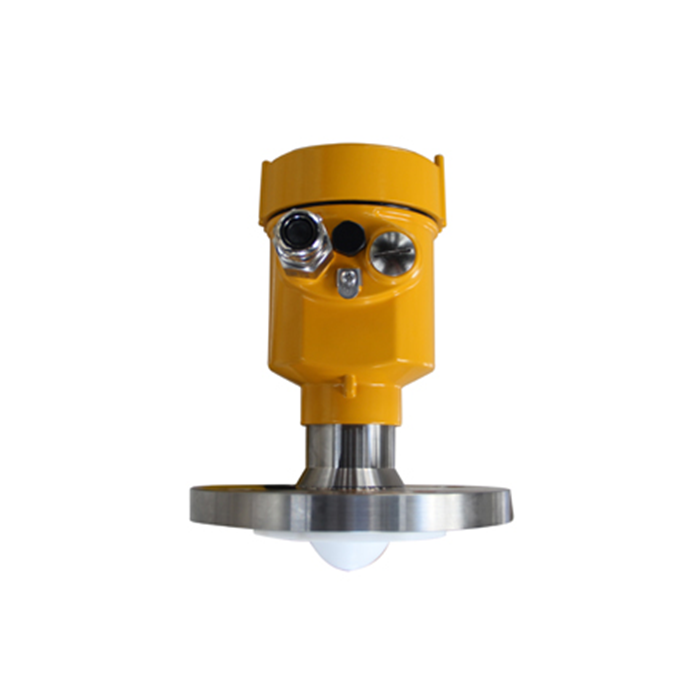
The METRAVON MV-RD12 is a liquid radar with separately selected electrical configurations. Confirm the actual variable and output of the ordered version. Do not assume that matching a 4-20 mA connection preserves the old engineering span or that every unit provides the same digital variables.
Write down the complete data path: instrument output, PLC interpretation, any tank calculation, and the value archived by the historian. Where volume is required, identify the owner and revision of the geometry or tank table. The level-to-volume calculation guide explains why the tank shape matters. Applying a volume conversion to a value that has already been converted is not corrected by adjusting the sensor zero.
For RS485/Modbus RTU, confirm the available register, units, data format and invalid-value handling from the selected electronics documentation. For an analogue loop, identify the values assigned to both endpoints and how the receiving input treats an invalid signal. These checks belong to the supplied version; they cannot be inferred from the model family alone.
Prove the handover before joining the trend
Agree acceptance limits and an independent reference before the shutdown. Where practical, compare the old and new instruments during an authorised overlap period. Agreement with the old sensor is useful evidence, but it does not make that sensor a calibration standard.
| Test | Evidence to retain | Discrepancy to investigate |
|---|---|---|
| Stable level | Reference level, raw distance, local indication and received value at the same time | Separate reference geometry from scaling before changing calibration. |
| A second operating level | The same values at another safely available level | A changing discrepancy may indicate span, units or geometry rather than a constant offset. |
| Filling or discharge | Timestamped values, filtering settings and process state | Different update rates or damping can make otherwise consistent instruments appear to disagree. |
| Invalid input or communication loss | An approved test of status, retained values and historian quality flags | A held last value must not be mistaken for a fresh valid measurement. |
A simulated signal can verify scaling and alarm logic downstream of the injection point. It cannot prove that the installed radar tracks the intended surface. Keep simulation periods separate from actual level observations, and remove overrides through the site's release procedure.
Keep the changeover visible
Record removal, installation, testing and return-to-service times. Preserve the original historical readings and mark the change in measurement definition. If an authorised correction is needed, keep a separate corrected series with its method, applicable period and reason. Do not shift years of old data by a constant amount merely to make the chart look continuous.
Data handover questions
Q1. Can the existing alarm values be copied?
Only after confirming that they represent the same physical conditions with the new variable, units and datum. Check the receiving logic, delay and reset behaviour as well as the number. Use an approved test to verify the alarm path without creating an unsafe tank condition.
Q2. What if the old sensor cannot run alongside the new one?
Keep its final readings, configuration and fault history, then commission the replacement against an appropriate independent reference. State the gap and remaining uncertainty in the change record. A missing overlap should not be replaced with an invented correction or an assumption that the last old reading was accurate.
Q3. Should a genuine discontinuity be removed from reports?
Explain it rather than concealing it. Distinguish a process movement from a revised measurement reference and from an unverified interval. Reports comparing periods across the change should identify which definition applies; any derived inventory or consumption calculation may need its own review.
Summary
Accept the replacement only when the physical reference, receiving value and archived record agree with the documented measurement definition. Send the old tag specification, tank drawing, conversion settings and intended output with an MV-RD12 integration enquiry. Include the required handover evidence so the quotation and commissioning scope address more than the transmitter connection.
