


 Chinese
 Spanish
 Russian
 Portuguese
 French
 German
 Indonesian
 Thai
 Vietnamese
 Arabic
 Italian
 Turkish
 Polish
 Japanese


Radar level to volume conversion requires a tank model and a defined datum. A transmitter can report the correct distance while the inventory display remains wrong because the receiver uses a linear percentage for a tank whose cross-section changes with height.
Choose Where the Conversion Will Be Performed
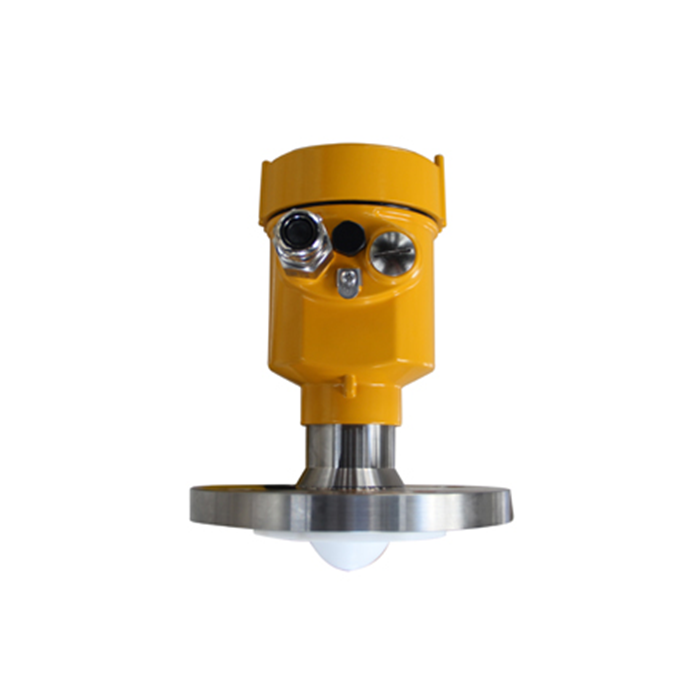
For a METRAVON MV-RD12 installation, specify the delivered output and its variable. Do not assume that every electronics option includes a programmable tank table. If the PLC or data logger performs the conversion, retain raw distance or level separately from calculated volume.
Measure the reference-plane position and establish the level zero used by the tank drawing. An empty-distance setting must refer to that same zero. An adapter or antenna replacement can shift the instrument reference without changing the tank, so copying the previous setting can introduce a systematic error.
Radar Level to Volume Conversion Depends on Shape
| Section | Conversion | Limit |
|---|---|---|
| Vertical cylinder | V = A h for a constant-area section. | Add volume below that section separately; account for displaced space. |
| Horizontal cylinder | The filled circular segment grows nonlinearly with liquid depth. | Half depth gives half volume only for the symmetric cylindrical body; do not generalise linear scaling. |
| Cone or irregular tank | Use the correct section geometry or an approved level-volume table. | Transitions, heads, tilt and internal displacement can invalidate a simple formula. |
A Checkable Formula for a Horizontal Cylindrical Body
For an ideal horizontal cylinder of radius r and straight-body length L, filled to depth h between zero and 2r, the body volume is L[r squared arccos((r-h)/r) - (r-h) sqrt(2rh-h squared)]. Evaluate arccos in radians and use one length unit throughout. This excludes dished heads, tilt and internal displacement.
Check the implementation at zero depth, half diameter and full diameter: the expected body volumes are zero, half of pi r squared L, and pi r squared L. Also test away from the midpoint, where an incorrect linear conversion becomes visible. Use the actual tank table instead when its calibrated geometry is the approved inventory basis.
Test the Table as Software and the Level as a Measurement
Record the table revision, level and volume units, interpolation method and permitted range. Test values at row boundaries and between rows. Below or above the validated range, flag the result rather than silently extrapolating or presenting a clamped endpoint as valid inventory.
Then compare actual liquid level with an independent reference and follow the value through transmitter output, PLC scaling and table lookup. A software test proves the calculation for its input; it does not prove that foam, a datum error or a wrong echo has not corrupted that input.
Volume-Calculation Questions
Q1. Can the volume be multiplied by density to obtain mass?
It can produce an estimate when density applies to the actual fluid and temperature. Document that basis and its uncertainty. It does not convert an ordinary level installation into an approved weighing or commercial quantity system.
Q2. Why does agreement at half full not validate the whole tank?
Some incorrect conversions happen to agree at a symmetry point. Use low, intermediate and high test points, including every change in tank section, to expose the shape-dependent error.
Summary
Validate the datum, tank model and receiving calculation independently. Send the tank drawing or table and required output for a conversion review, identifying where the volume calculation will run.
