


 Chinese
 Spanish
 Russian
 Portuguese
 French
 German
 Indonesian
 Thai
 Vietnamese
 Arabic
 Italian
 Turkish
 Polish
 Japanese


Bulk-solids radar selection has to answer both whether the material produces a usable return and whether the observed part of the pile serves the process decision. Dielectric behaviour influences reflection; pile geometry determines what that reflected distance means.
Describe the Material in Its Operating State
Supply the material name, grade, particle-size distribution, moisture variation and conveying method. Include dielectric information if available, with its test conditions. A nominal material label does not describe a dry aerated powder and the same product after storage or moisture exposure equally well.
Do not substitute bulk density for dielectric information. Density is relevant to inventory conversion and can correlate with material state, but it is not an electrical reflection specification. Where the echo behaviour is uncertain, ask for an application assessment and representative trial rather than inventing a minimum dielectric constant for the model.
Bulk-Solids Radar Selection: Four Distinct Questions
| Question | Provide | Decision |
|---|---|---|
| Reflection | Material state, moisture and available dielectric information. | Assess whether a useful return can be expected at the required distance. |
| Pile shape | Inlets, outlets, fill sequence and observed slopes. | Choose the region to observe for the intended level or inventory duty. |
| Obstructions | Roof steelwork, ladders, filters and the complete beam path. | Locate the antenna without relying on software to hide every conflict. |
| Fouling | Dust loading, sticky deposits and inspection access. | Assess maintenance practicality and the difficult operating state. |
Apply MV-RD21 Specifications to the Actual Silo
The METRAVON MV-RD21 uses a 76 mm PTFE lens with a listed 3-degree beam. Its 0.1-30 m and 0.3-150 m range configurations are alternatives that must match the order. Neither maximum distance is a guarantee for every powder under dense filling dust.
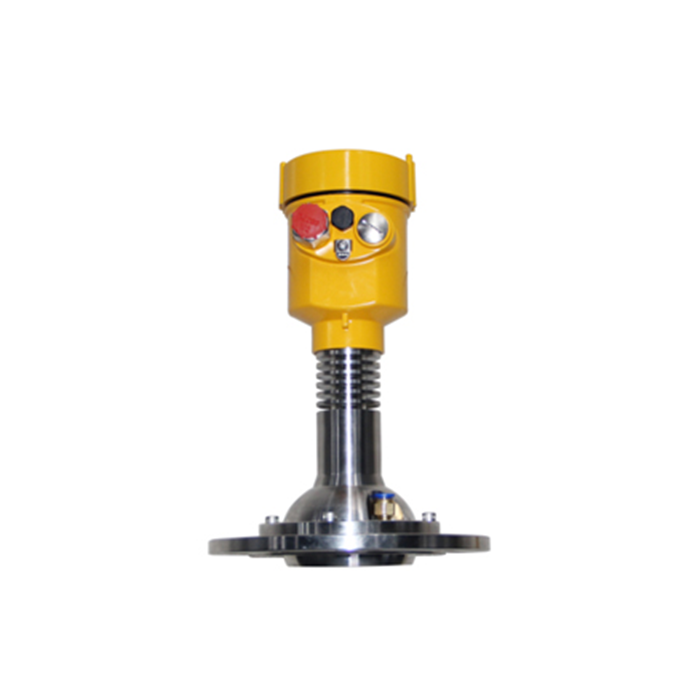
Plot the full footprint at the lowest expected surface and check where it lands after filling and discharge. A point away from the inlet may avoid impact but still follow a changing slope. There is no universally correct centre or off-centre position without the silo geometry.
Include Failure to Discharge in the Review
A bridge or rat hole can leave material visible above an outlet that is no longer flowing. A level reading therefore cannot prove successful discharge. If the process must detect blockage, consider feeder, flow or other independent evidence in the control design.
During a trial, capture selected distance and echo diagnostics at low level, during delivery and during withdrawal. Record the visible or otherwise known pile state and material code. Agree acceptable data availability and recovery behaviour before judging the trial from a settled reading alone.
Material-Selection Questions
Q1. Does a stronger return guarantee accurate tonnes?
No. It can support target detection, but inventory conversion still depends on pile representation, vessel geometry and density.
Q2. Is a narrow beam always more representative?
No. It can help avoid an obstruction while observing a very local peak or valley. Match the target region to the required decision and validate how it behaves as the pile moves.
Summary
Specify material behaviour and surface geometry as separate inputs. Send the silo layout and material-state information for MV-RD21 selection, including the operating event most likely to challenge the measurement.
