Chinese
 Spanish
 Russian
 Portuguese
 French
 German
 Indonesian
 Thai
Thai Vietnamese
 Arabic
 Italian
 Turkish
 Polish
 Japanese
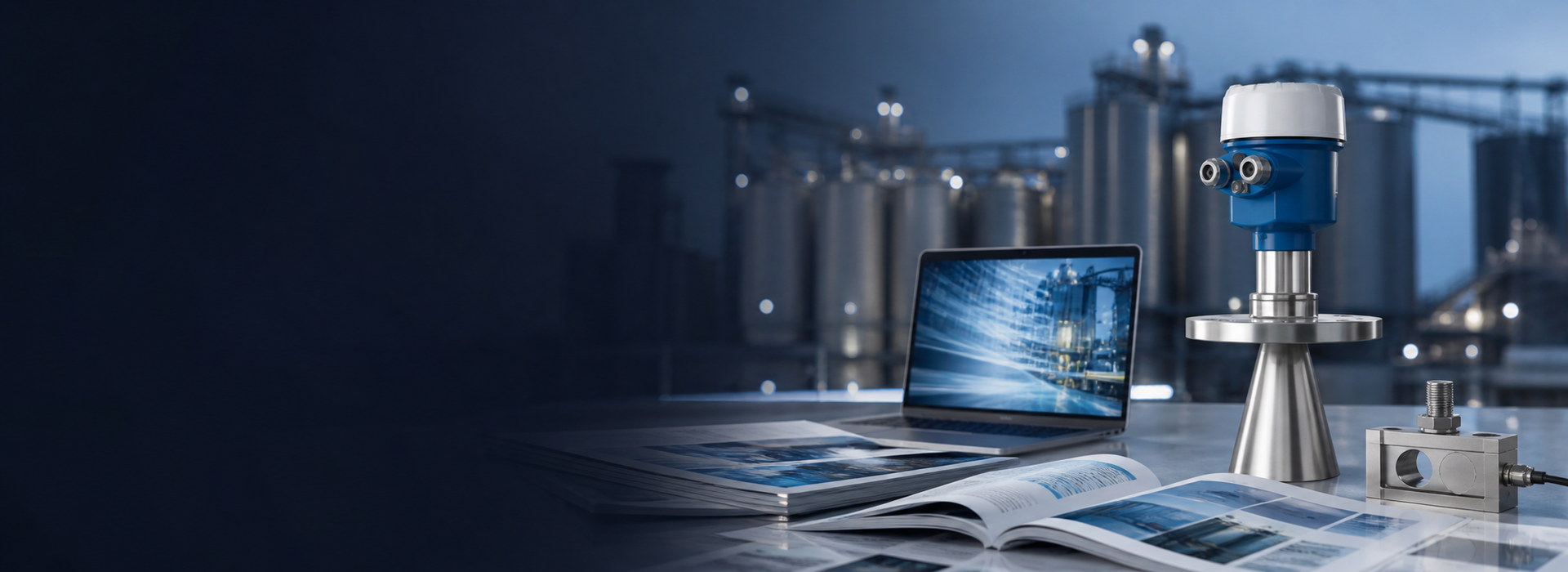
1. What Is the Difference Between High-Frequency and Low-Frequency Radar Level Meters?
A radar level meter uses electromagnetic waves for non-contact level measurement.
The instrument transmits microwave signals toward the surface of the measured medium through an antenna. When the signals reach the surface of a liquid, slurry, granular material, or powder, they are reflected. The instrument receives the echo signals and calculates the distance from the sensor to the medium surface according to changes in time, frequency, or phase between the transmitted and returned signals.
The actual liquid or material level can then be calculated using the height of the tank or silo.
Common operating frequencies used for industrial radar level measurement include 6GHz, 26GHz, and approximately 80GHz.
In terms of the basic principle:
The higher the frequency, the shorter the wavelength.
The lower the frequency, the longer the wavelength.
These differences further affect the antenna size, beam angle, directivity, and adaptability of the radar to different operating conditions.
Therefore, the distinction between high-frequency and low-frequency radar level meters is not simply about which is more advanced or more accurate. Each offers different technical advantages under different site conditions.
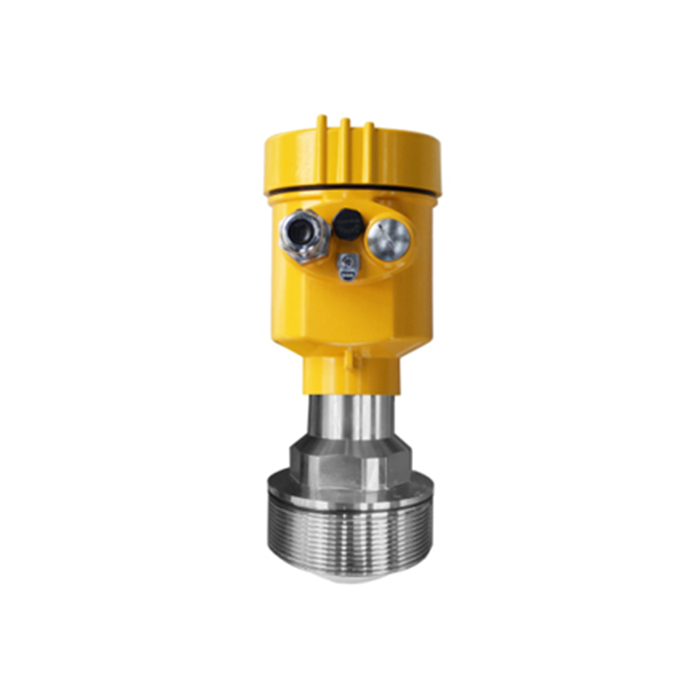
2. What Are the Advantages of High-Frequency Radar Level Meters?
High-frequency radar level meters currently used in industrial applications generally include 26GHz and 80GHz radar. In recent years, 80GHz radar has become increasingly common in both liquid-level and solid-level measurement.
The primary advantages of high-frequency radar include a narrow beam, good directivity, a small antenna, and strong resistance to interference in complex environments.
1. A Smaller Beam Angle
With a similar antenna size, a higher radar operating frequency generally makes it easier to produce a narrower transmission beam.
A narrow beam means that the radar energy is more concentrated.
In a tall storage tank, a large beam angle causes the radar beam to cover an increasingly large area as the measuring distance increases.
As a result, tank walls, ladders, filling pipes, agitators, support structures, heating coils, and other equipment may enter the radar beam and generate interfering echoes.
High-frequency radar, particularly 80GHz radar, can concentrate the measuring area within a smaller region, reducing interference signals generated by these internal structures.
High-frequency radar therefore generally offers clear advantages in tanks with complex internal structures.
2. More Suitable for Narrow Tanks
Many chemical tanks, chemical dosing tanks, additive tanks, and small process tanks have relatively small diameters.
If the radar beam is wide, the signal may easily strike the tank wall.
Strong reflections from tank walls, welds, pipes, or supports may interfere with the identification of the true liquid-level echo.
Because a high-frequency radar has a more concentrated beam, it is generally easier to install and commission in tall, narrow tanks.
This narrow-beam advantage becomes particularly important when the radar cannot be mounted in the center of the tank and must instead be installed close to the tank wall.
3. Smaller Antenna Size
Another important advantage of high-frequency radar is that the antenna can be made smaller.
A high-frequency radar generally does not require a large antenna to obtain a narrow beam.
This is particularly important for small tanks.
For example, some equipment has only a small threaded connection or small-diameter flange on the top. If the radar requires a large horn antenna, there may not be sufficient installation space.
An 80GHz radar can use a more compact antenna and process connection and is therefore highly suitable for:
Small storage tanks;
Chemical dosing tanks;
Chemical additive tanks;
Water-treatment tanks;
IBC containers;
Narrow silos;
Small hoppers inside mechanical equipment.
4. More Suitable for Tanks with Complex Internal Structures
Industrial tanks frequently contain various internal structures, including:
Agitator blades;
Coils;
Heaters;
Ladders;
Support beams;
Filling pipes;
Internal pipes;
Reinforcing ribs.
All of these structures can produce radar reflections to varying degrees.
If the beam coverage is large, the radar may simultaneously receive reflections from the liquid surface and several fixed obstacles.
Although modern radar instruments generally provide false-echo suppression and signal-processing functions, a suitable mounting position and narrower beam can still substantially reduce commissioning difficulty.
For tanks with complex internal structures, an 80GHz high-frequency radar is therefore often one of the preferred solutions.
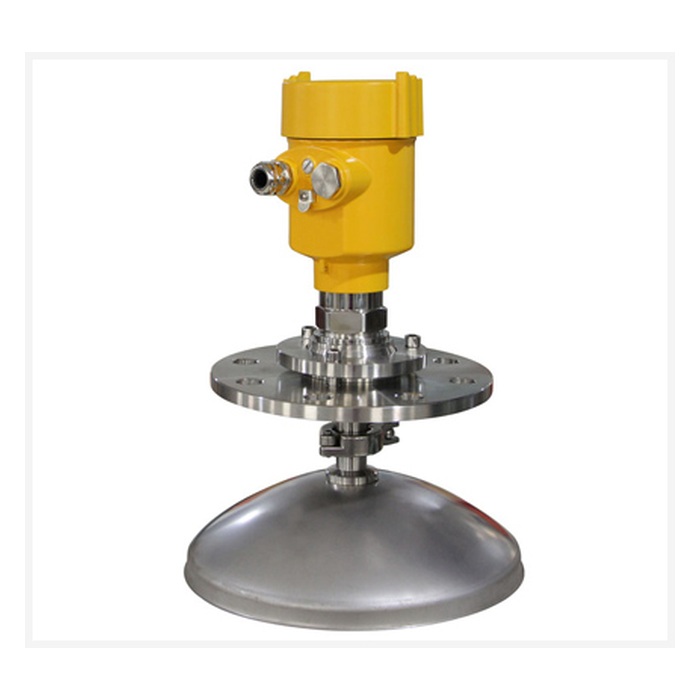
3. Why Is High-Frequency Radar Suitable for Solid-Level Measurement?
Solid-level measurement differs significantly from liquid-level measurement.
A stationary liquid surface is generally flat, whereas the surfaces of powders and granular materials are often irregular.
For example, cement, fly ash, grain, ore, sand, plastic pellets, and fertilizer stored in silos may form a pronounced angle of repose.
A central material pile may form during filling, while a funnel-shaped or conical material surface may develop during discharge.
Solid-level measurement is therefore generally more complicated than conventional liquid-level measurement.
An important advantage of high-frequency radar in these applications is its more concentrated beam.
A narrow beam can reduce interference from silo walls, supports, and other structures, allowing the radar to focus more effectively on the target material surface.
For this reason, 80GHz radar is widely used in:
Cement silos;
Fly ash silos;
Grain silos;
Feed silos;
Plastic pellet silos;
Ore silos;
Sand and aggregate silos;
Fertilizer silos;
Chemical powder silos;
Other powder and granular-material silos.
However, solid-level radar should not be selected according to frequency alone.
The maximum measuring distance, dielectric characteristics of the material, dust concentration, particle size, filling position, silo structure, and likelihood of material accumulating on the antenna must also be considered.
4. Is High-Frequency Radar Suitable for Dusty Environments?
Many solid materials generate large amounts of dust during filling or discharge.
For example, cement, fly ash, flour, mineral powder, and certain chemical powders may produce a noticeable dust cloud during rapid filling.
Radar uses electromagnetic waves for measurement, making its operating principle different from that of ultrasonic instruments, which depend on sound waves propagating through the air.
Ordinary dust generally does not affect radar measurement by directly changing the propagation conditions in the same way that it can affect ultrasonic measurement.
Radar level meters therefore generally adapt well to silos containing large amounts of dust.
However, if dust remains attached to the antenna surface for an extended period and forms a thick deposit, signal quality may be reduced.
For high-dust sites, attention should therefore be paid to the antenna structure, mounting position, and anti-buildup design.
5. Is High-Frequency Radar Suitable for High-Temperature and High-Pressure Environments?
Because radar level meters use non-contact measurement, they can be applied in many high-temperature, high-pressure, and vacuum conditions.
However, the following point must be noted:
The permissible temperature and pressure depend on the construction of the specific product, not simply on whether it operates at 80GHz, 26GHz, or 6GHz.
Different radar level meter models may use:
PTFE;
PEEK;
Stainless steel;
Ceramic;
Different sealing materials;
Different flanges and process connections.
When purchasing a high-temperature radar level meter, the following information must be specified:
Normal operating temperature;
Maximum process temperature;
Normal pressure;
Maximum process pressure;
Whether a vacuum is present;
Whether the medium is corrosive;
Whether explosion-proof certification is required.
An 80GHz radar should not automatically be considered suitable for every high-temperature or high-pressure application.
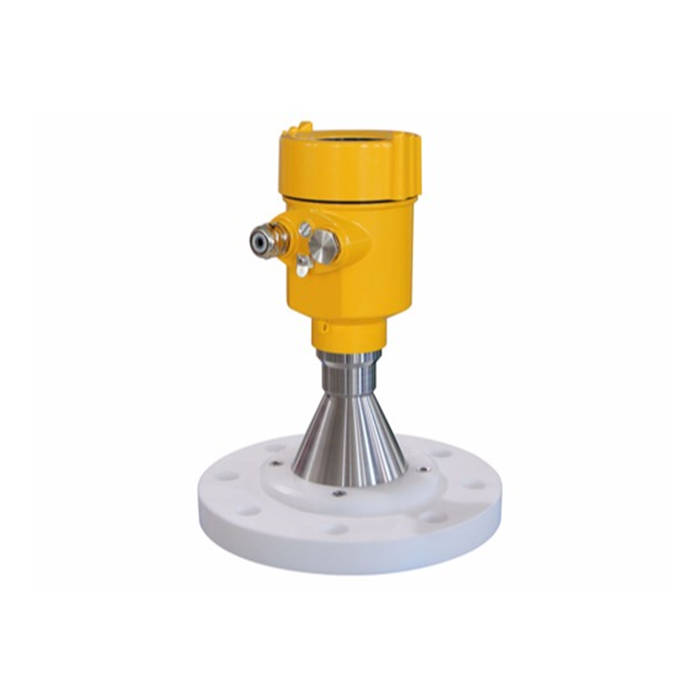
6. What Are the Advantages of Low-Frequency Radar Level Meters?
High-frequency radar offers clear advantages, but this does not mean that low-frequency radar has lost its application value.
Lower-frequency radar still performs very well under certain specialized liquid conditions.
1. Certain Advantages for Fluctuating Liquid Surfaces
Lower-frequency radar generally has a relatively wider beam.
In certain large tanks or applications with pronounced liquid-surface fluctuations, a wider beam can cover a larger surface area.
Examples include:
Large mixing tanks;
Tanks with rapid filling and discharge;
Tanks with continuously fluctuating liquid surfaces;
Certain chemical reactors.
Under these conditions, the liquid surface is not completely flat.
If the radar measures only a very small local area that happens to be affected by waves or agitation, the echo may change significantly.
A wider beam can cover a larger liquid-surface area and may therefore offer practical advantages under certain conditions involving severe fluctuations.
Modern 80GHz radar can also handle many fluctuating surfaces through advanced signal-processing algorithms, so the final decision should still be based on the performance of the specific instrument.
2. Advantages in Certain Heavy-Steam Environments
Large amounts of steam may be present in high-temperature water tanks, steam-condensation systems, reactors, and certain chemical storage tanks.
The presence of steam does not necessarily mean that radar measurement is impossible.
However, under extremely severe steam and condensation conditions, condensate may form on the radar antenna.
Severe condensation may affect radar-signal transmission and reception.
Certain lower-frequency radar products have extensive engineering experience in specialized environments involving heavy steam and condensation.
Therefore, an 80GHz radar should not be selected solely because of its higher frequency in the following applications:
High-temperature water;
Saturated-steam environments;
Severe condensation;
Reactors;
Evaporators;
Sealed tanks with high humidity.
These projects should be evaluated comprehensively according to the medium, temperature, pressure, and severity of the steam.
3. Foam Conditions Require Comprehensive Evaluation
Foam is a complex issue in liquid-level measurement.
Foam may absorb, reflect, or attenuate radar signals.
The actual effect depends on:
Foam thickness;
Foam density;
Bubble size;
Foam water content;
Dielectric characteristics of the liquid.
It is therefore incorrect to say that low-frequency radar can always penetrate foam or that 80GHz radar can always solve foam-related problems.
The first requirement to confirm during project design is:
Should the system measure the top of the foam or the actual liquid level beneath it?
These are two completely different measurement requirements.
If the foam is extremely thick or the operating conditions are particularly complex, guided wave radar or another liquid-level measurement technology may also be evaluated.
7. What Are the Clear Advantages of 80GHz Radar Level Meters?
Based on current developments in industrial level measurement, the main advantages of 80GHz radar are as follows.
First, the beam is highly concentrated.
This makes it particularly suitable for narrow tanks and complex silos.
Second, the antenna is small.
Smaller threaded or flanged connections can be used.
Third, it adapts better to internal obstacles.
It can reduce interference generated by tank walls, ladders, pipes, agitators, and other structures.
Fourth, it is suitable for solid-level measurement.
It is particularly suitable for powder and granular-material silos.
Fifth, the mounting position is more flexible.
When installation at the center of a tank is impossible, the narrow beam can be used to avoid internal structures as much as possible.
Sixth, it can reduce unnecessary false echoes.
Good beam focusing can reduce certain sources of interference directly instead of relying entirely on subsequent software-based signal processing.
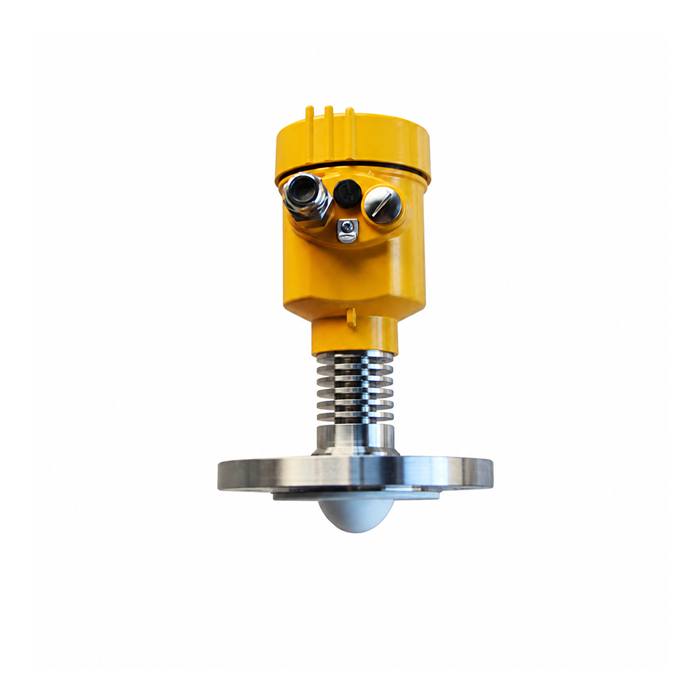
For these reasons, 80GHz radar is highly suitable for complex liquid-level and solid-level monitoring projects in modern industrial automation.
8. Is 80GHz Radar Always Better Than 26GHz Radar?
Not necessarily.
The main advantages of 80GHz radar are its narrow beam, small antenna, and ability to focus on the target in complex environments.
However, 26GHz radar has been used industrially for many years and also offers highly mature measurement technology.
In many conventional tanks, a 26GHz radar can provide stable and reliable measurement when:
The tank diameter is relatively large;
The internal structure is simple;
The mounting position is suitable;
The liquid surface provides good reflection;
The measuring distance is moderate;
No complex interference is present.
It is therefore unnecessary to replace radar instruments blindly merely to obtain a higher frequency.
For new projects, an 80GHz solution can be evaluated first.
For established 26GHz applications, if measurement remains stable, the product should not be considered outdated simply because it operates at a different frequency.
9. How Should 6GHz, 26GHz, and 80GHz Radar Be Selected?
The following logic can be used when selecting a radar frequency.
For small tanks, narrow tanks, tanks with complex internal structures, or solid-material silos, an 80GHz radar can be evaluated first.
For conventional liquid storage tanks with simple internal structures, 26GHz radar is generally also a mature solution.
If the site involves severe steam, condensation, pronounced liquid-surface fluctuations, or other special process conditions, 6GHz, 26GHz, and 80GHz solutions should be compared.
The correct selection sequence should therefore be:
Determine the measured medium.
Determine the structure of the tank or silo.
Analyze the temperature, pressure, steam, dust, foam, and internal obstacles.
Select the radar frequency, antenna type, and process connection.
The radar frequency should not be selected first and then forced to adapt to the site conditions.
10. How Should High-Frequency and Low-Frequency Radar Level Meters Be Selected?
During project procurement, it is recommended that at least the following parameters be provided.
Name of the measured medium
For example, water, diesel, acid or alkali solution, sewage, cement, fly ash, grain, or plastic pellets.State of the medium
Specify whether it is a liquid, slurry, powder, or granular material.Maximum measuring distance
Include the total height of the tank or silo and the actual required measuring range.Tank diameter
This is particularly important for narrow tanks.Process temperature
Provide both the normal and maximum temperatures.Process pressure
This is particularly important for sealed pressure vessels.Whether steam is present
This should be emphasized for high-temperature liquids and reactors.Whether foam is present
Also specify whether the foam is continuously present.Whether dust is present
For solid-material silos, specify the severity of the dust.Whether an agitator or internal structures are present
Examples include pipes, coils, ladders, and support beams.Mounting connection
Examples include G1½ threads, G2 threads, DN50 flanges, and DN100 flanges.Output signal
Common options include 4–20mA, HART, and RS485 Modbus.Protection and explosion-proof requirements
Examples include the required IP rating and whether Ex certification is required.Power-supply requirements
Different control systems may use different power-supply methods.
For solid-material silos, it is also recommended that the particle size, angle of repose, filling position, and site photographs be provided.
When selecting a radar level meter, METRAVON recommends determining the radar frequency comprehensively according to these actual operating conditions instead of selecting a product solely according to the measuring distance.
11. Comparison Between High-Frequency and Low-Frequency Radar Level Meters
High-frequency radar level meters generally have the following characteristics:
Narrower beam;
Good directivity;
Smaller antenna;
Suitable for narrow tanks;
Suitable for complex internal structures;
Suitable for solid-level measurement;
Good ability to control interference from silo walls.
Lower-frequency radar generally has the following characteristics:
Relatively wider beam;
Advantages in certain applications involving fluctuating liquid surfaces;
Extensive application experience under certain severe steam and condensation conditions;
Suitable for some large liquid storage tanks and special process conditions.
The two are therefore not substitutes for one another.
Proper engineering selection should match the instrument to the application conditions.
FAQ
Q1: Is a High-Frequency Radar Level Meter More Accurate Than a Low-Frequency Radar Level Meter?
Not necessarily.
Measurement accuracy is related to the radar frequency but is also affected by the product construction, antenna, signal-processing algorithm, installation conditions, and medium characteristics.
The main advantage of 80GHz radar is its narrow beam, which can reduce interference in complex tanks.
During procurement, the accuracy specification of the specific model should be reviewed instead of judging accuracy solely by the operating frequency.
Q2: Is 80GHz Radar Suitable for Cement Silos?
Yes.
Cement silos generally involve dust, irregular material surfaces, and reflections from the silo walls.
The narrow beam of an 80GHz radar can reduce interference from the silo walls and internal structures, making it highly suitable for cement, fly ash, mineral powder, and other powder silos.
The maximum measuring distance and site dust conditions must still be confirmed during procurement.
Q3: Is 80GHz Radar Suitable for Small Tanks?
Yes.
A high-frequency radar can produce a narrow beam with a smaller antenna, making it highly suitable for small tanks and small-diameter process connections.
Q4: What Type of Radar Should Be Selected When an Agitator Is Present?
A narrow-beam radar should generally be considered first.
If agitator blades, coils, and support structures are present inside the tank, an 80GHz radar can use its narrow beam to avoid these obstacles as much as possible.
The mounting position should also be selected carefully.
Q5: Can 80GHz Radar Be Used When Steam Is Present?
Yes, but the severity of the steam must be considered.
Ordinary steam does not necessarily affect radar measurement. However, if large amounts of steam and severe condensation are present, the suitability of the specific model must be confirmed and solutions using different frequencies should be compared.
Q6: Should High-Frequency or Low-Frequency Radar Be Selected When Foam Is Present?
This cannot be determined according to frequency alone.
The foam thickness and density must be confirmed, together with whether the system needs to measure the foam surface or the actual liquid level beneath it.
For severe foam conditions, site information should be provided before product selection.
Q7: Can High-Frequency Radar Measure Powder?
Yes. This is one of the important application areas for 80GHz radar.
Radar can be used for continuous level measurement of cement, grain, fly ash, plastic pellets, fertilizer, mineral powder, and similar materials.
Q8: Is Low-Frequency Radar Still Necessary?
Yes.
Lower-frequency radar still has application value under certain conditions involving steam, condensation, liquid-surface fluctuations, and special processes.
No single frequency is suitable for every industrial application.
Q9: Does a Radar Level Meter Need to Contact the Medium?
An ordinary free-space radar level meter does not need to contact the medium directly.
It is therefore particularly suitable for corrosive liquids, high-temperature liquids, sewage, and powdered materials.
However, suitable materials for the antenna and process connection must still be selected according to the medium and site environment.
Q10: What Are the Most Important Parameters When Purchasing a Radar Level Meter?
The measuring range alone is insufficient.
At a minimum, the medium, measuring range, tank height and diameter, temperature, pressure, steam, foam, dust, internal obstacles, mounting connection, and output signal should be provided.
These parameters directly determine the radar frequency and model selection.
Conclusion
High-frequency and low-frequency radar level meters each have their own applicable conditions.
The greatest advantages of high-frequency radar, particularly 80GHz radar, are its narrow beam, good directivity, small antenna, and ability to avoid internal tank obstacles.
It is therefore highly suitable for small tanks, narrow tanks, process tanks with complex internal structures, and solid-material silos containing cement, fly ash, grain, ore, plastic pellets, and similar materials.
Lower-frequency radar still offers practical advantages under certain conditions involving severe liquid-surface fluctuations, heavy steam, condensation, and specialized liquid processes.
Radar level meter selection should therefore not be based on the assumption that a higher frequency is always better.
A more appropriate engineering approach is to select the instrument comprehensively according to the medium characteristics, tank structure, measuring distance, temperature, pressure, steam, foam, dust, and installation conditions.
For continuous level measurement projects involving liquids, slurries, powders, and granular materials, METRAVON can select and configure radar level meters according to the site medium, measuring range, tank structure, temperature, pressure, process connection, output signal, and other requirements.