Chinese
 Spanish
 Russian
 Portuguese
 French
 German
 Indonesian
 Thai
Thai Vietnamese
 Arabic
 Italian
 Turkish
 Polish
 Japanese
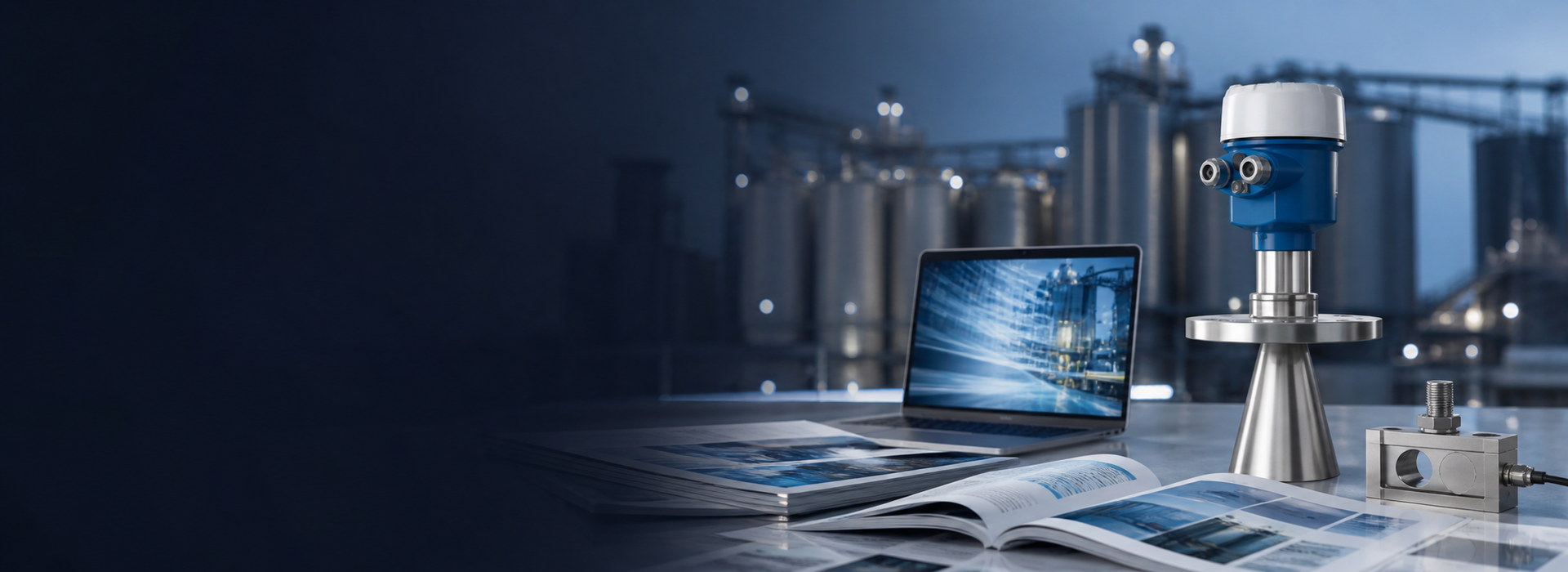
1. What Is a High-Frequency Radar Level Meter?
A high-frequency radar level meter is a non-contact instrument that uses high-frequency electromagnetic waves for continuous liquid-level measurement.
The radar transmits electromagnetic waves toward the surface of the medium through an antenna. When the signal reaches the liquid surface, it is reflected. The instrument receives the returning signal and calculates the distance between the radar antenna and the liquid surface according to the propagation time, frequency change, or phase relationship.
The actual liquid level can then be calculated by combining this distance with the tank height and zero-point position.
Radar frequencies commonly used in current industrial projects include 6GHz, 26GHz, and approximately 80GHz. Among them, 26GHz and 80GHz are generally classified as relatively high-frequency radar measurement solutions.
In particular, 80GHz radar is increasingly used in chemical processing, water treatment, storage tanks, reactors, small vessels, and tanks with complex internal structures because of its shorter wavelength, more focused beam, and smaller antenna size.
However, a higher frequency does not mean better performance under every operating condition.
Correct high-frequency radar level meter selection requires comprehensive consideration of the medium, tank structure, measuring distance, temperature, pressure, steam, foam, condensation, mounting connection, and control-system requirements.
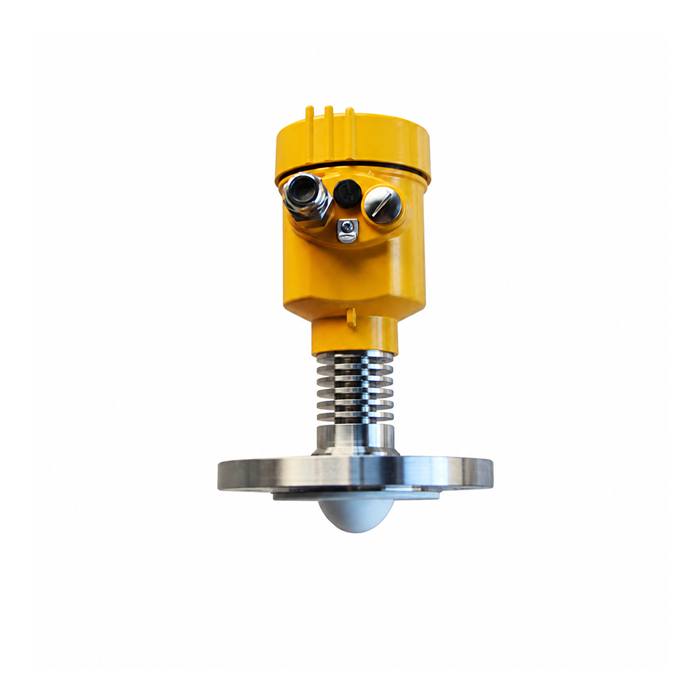
2. How Can High-Frequency Radar Level Meters Be Classified?
Radar level meters cannot be classified using only one method.
From an engineering-selection perspective, the more practical classification methods include:
Classification by operating frequency;
Classification by measurement principle;
Classification by antenna and process-connection structure;
Classification by application and measurement grade.
Only after understanding these classifications can a suitable radar level meter be selected for a specific project.
3. Classification by Operating Frequency
1. 6GHz Radar Level Meter
6GHz is a relatively low radar frequency.
It has a longer wavelength and generally a wider beam. It is still used in certain large liquid storage tanks, applications with severe surface fluctuations, and special steam and condensation conditions.
However, because its antenna is relatively large, its installation flexibility is generally lower than that of higher-frequency radar in small tanks, confined mounting positions, or vessels with complex internal structures.
2. 26GHz Radar Level Meter
26GHz radar has been used in industrial applications for many years. The technology is mature and suitable for a large number of conventional liquid storage tanks and process vessels.
Common applications include:
Water tanks;
Sewage basins;
Chemical storage tanks;
Acid and alkali storage tanks;
Fuel tanks;
Reaction vessels;
Certain powder and granular-material silos.
Compared with lower-frequency radar, a 26GHz radar can use a smaller antenna and produce a more concentrated beam. It therefore remains highly versatile in many industrial projects.
3. 80GHz Radar Level Meter
80GHz is currently an important technological direction in high-frequency radar level measurement.
Its main characteristics include:
Small beam angle;
Good directivity;
Small antenna size;
Strong ability to avoid obstacles inside the tank;
Suitability for narrow tanks;
Suitability for small process connections;
Suitability for tanks with complex internal structures.
For tanks containing agitators, coils, ladders, filling pipes, or other mechanical structures, the narrower radar beam can reduce interference echoes generated by these structures.
Therefore, 80GHz radar has become one of the common choices for newly constructed chemical, water-treatment, and automated storage-tank projects.
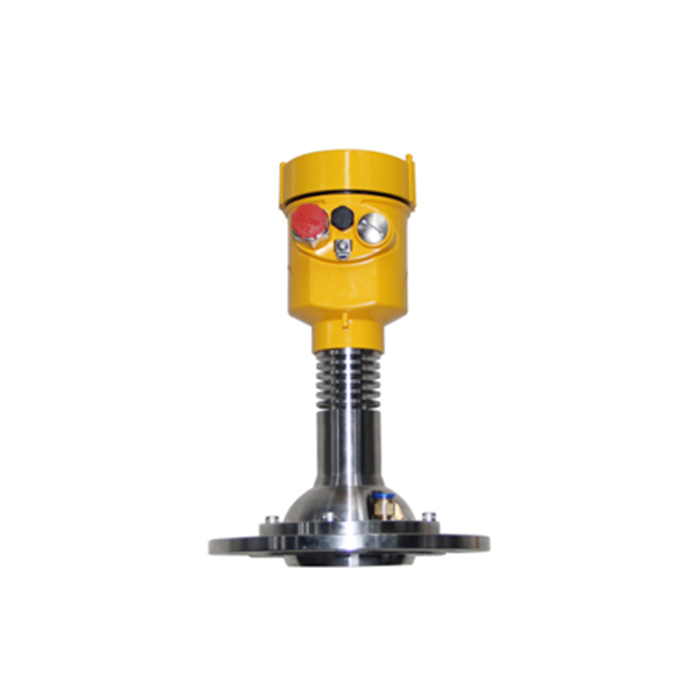
4. Classification by Measurement Principle
1. Pulse Radar Level Meter
A pulse radar calculates distance by transmitting microwave pulses and receiving signals reflected from the surface of the medium.
Its basic principle is related to the propagation time of electromagnetic waves.
Pulse radar is a mature technology that has been extensively used in industrial level measurement.
2. FMCW Radar Level Meter
FMCW means frequency-modulated continuous wave.
The instrument continuously transmits a radar signal whose frequency changes over time and calculates the target distance by comparing the frequency difference between the transmitted signal and the returning signal.
Many current 80GHz radar level meters use FMCW technology.
FMCW technology offers strong signal-processing capabilities and can be used for high-accuracy liquid-level measurement, complex storage tanks, and certain long-distance measurement applications.
During project selection, the terms “pulse” and “FMCW” should not be the only factors compared. The actual product specifications, including measurement accuracy, beam angle, measuring range, dead zone, process temperature, and signal output, must also be reviewed.
5. Classification by Antenna Structure
The antenna is a very important component of a radar level meter.
The antenna type directly affects signal transmission, beam angle, directivity, and adaptability to site conditions.
Common radar level meter antennas mainly include the following types.
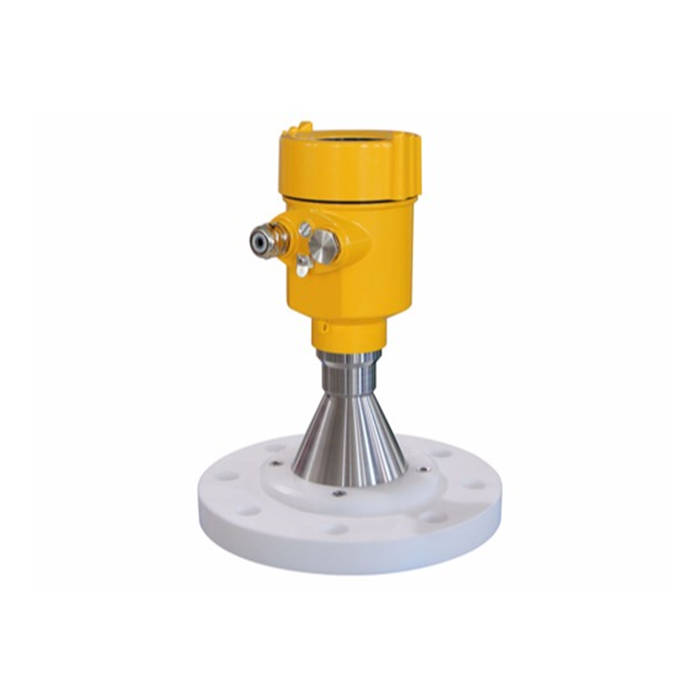
1. Horn Antenna
The horn antenna is a very common structure used in traditional radar level meters.
It features mature construction and good directivity and can be used in many conventional liquid storage tanks and industrial process vessels.
At the same operating frequency, a larger horn diameter generally makes it easier to obtain a narrower beam.
Therefore, the following factors should be considered comprehensively when selecting a horn antenna:
Radar frequency;
Antenna diameter;
Mounting flange;
Tank height;
Tank diameter;
Internal obstacles.
If the mounting nozzle has a small diameter, it is also necessary to confirm whether the antenna can be inserted properly or installed correctly at the nozzle position.
2. Parabolic Antenna
A parabolic antenna provides strong directivity and signal-focusing capability.
Depending on the site conditions, parabolic antennas can be used for free-space measurements in traditional large storage tanks and long-distance applications.
However, parabolic antennas are generally large and therefore require adequate installation space.
If the medium is prone to severe adhesion, crystallization, or coking, the effect of contamination on the antenna surface and radar signal must also be considered.
Therefore, for asphalt, heavy oil, and high-temperature media that are prone to coking, the parabolic antenna should not be selected solely according to the measuring range. Antenna contamination must also be carefully evaluated.
3. Planar Antenna or Array Antenna
Planar antennas and array structures are used in certain tank-gauging applications and stilling-well or bypass-pipe installations.
These structures can be designed to transmit radar signals under specific propagation conditions.
In particular, when a stilling well is used in a large storage-tank automatic gauging system, a radar product explicitly designed to support that installation method should be selected.
Please note:
“Stilling-well radar” and “guided wave radar” are not the same concept.
A free-space radar transmitting inside a stilling well remains a non-contact radar measurement instrument. Guided wave radar guides electromagnetic waves along a metal rod or steel cable. The two technologies use different operating structures.
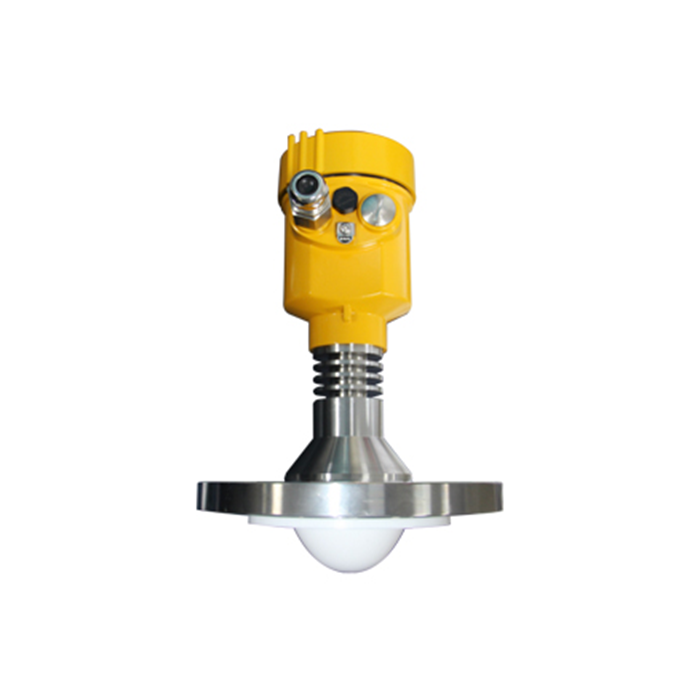
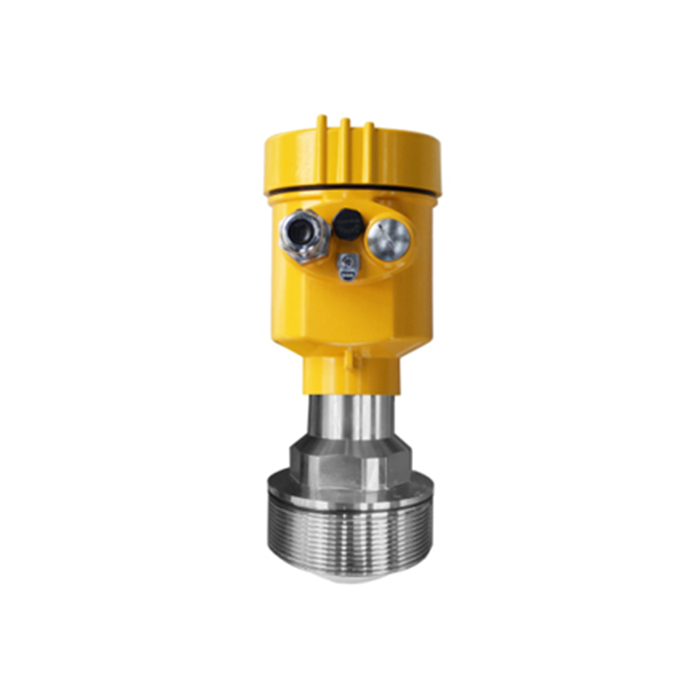
4. Lens Antenna
Lens antennas are widely used in modern high-frequency radar instruments, particularly 80GHz radar level meters.
This structure enables a compact antenna design and good beam focusing.
Lens antennas can also be combined with threaded, flanged, and sanitary process connections. They are therefore particularly suitable for:
Small storage tanks;
Chemical process tanks;
Water-treatment chemical tanks;
Food and pharmaceutical vessels;
Equipment with limited installation space.
Whether a particular model is suitable for corrosive, high-temperature, or sanitary applications must be confirmed according to the antenna and process-connection materials.
6. Classification by Application Grade
1. Process-Control Radar Level Meter
Most chemical, water-treatment, sewage, and industrial storage-tank projects use process-control radar level meters.
Their primary functions include:
Continuous liquid-level monitoring;
High- and low-level control;
Pump start and stop control;
Storage-tank inventory management;
PLC or SCADA data acquisition.
These projects place greater emphasis on stability, measuring range, output signal, temperature and pressure resistance, and adaptability to site conditions.
2. High-Accuracy Tank-Gauging Radar
Petroleum, refined-oil, large tank-farm, and inventory-gauging projects may require substantially higher measurement accuracy than ordinary process-control applications.
If the measurement data will be used for inventory management or custody transfer, an ordinary process radar should not be selected solely on that basis.
The required measurement accuracy, certification standards, installation structure, and complete tank-farm gauging system must be confirmed according to the project requirements.
In other words:
Ordinary level control and custody-transfer measurement are two different application grades.
An ordinary process instrument cannot be assumed suitable for commercial settlement merely because radar level meters are generally considered accurate.
7. What Should Be Considered First When Selecting a High-Frequency Radar Level Meter?
The first factor to consider when selecting a high-frequency radar level meter is the medium.
This is an issue that is easily overlooked in many projects.
At a minimum, the following information must be confirmed:
Medium name;
Whether the medium is electrically conductive;
Dielectric characteristics;
Whether the medium is corrosive;
Whether the medium is viscous;
Whether the medium crystallizes easily;
Whether the medium adheres easily;
Whether foam is generated;
Whether steam is present.
For example, although clean water and concentrated sulfuric acid may have exactly the same measuring range, their requirements for antenna and process-connection materials can be completely different.
Diesel and sewage also cannot be measured using a product selected solely according to the measuring range.
Therefore, when purchasing a radar level meter, the first item of information provided should be the medium, rather than only stating that a 10-meter measuring range is required.
8. Selection According to Tank Height and Diameter
The tank dimensions directly affect radar level meter selection.
The following information should be provided:
Total tank height;
Tank diameter;
Highest liquid level;
Lowest liquid level;
Radar mounting position.
For example, a tank measuring 10m high and 2m in diameter and a tank measuring 10m high and 20m in diameter have the same measuring range, but their radar-beam requirements are different.
For tall and narrow tanks, an 80GHz narrow-beam radar generally offers greater advantages.
If the tank also contains pipes, an agitator, or coils, greater attention should be paid to the beam angle and mounting position.
9. Selection According to the Tank’s Internal Structure
Actual industrial storage tanks are rarely completely empty.
Common internal structures include:
Agitators;
Heating coils;
Ladders;
Support beams;
Filling pipes;
Discharge pipes;
Reinforcing ribs.
All of these structures may generate radar reflections.
During selection and installation, the main radar beam should be positioned to avoid these structures whenever possible.
Therefore, for complex tanks, the measuring range and accuracy are not the only factors that should be considered.
The beam angle is a very important parameter when selecting a high-frequency radar level meter.
An 80GHz radar can generally produce a narrower beam and therefore offers clear advantages in tanks with complex internal structures.
10. How Should a Radar Level Meter Be Selected for a Floating-Roof Tank?
A floating-roof tank is a relatively specialized application.
If the radar must measure the actual liquid level beneath the floating roof, an ordinary free-space radar generally cannot be aimed directly at the liquid surface from above the floating roof.
Depending on the tank structure, a dedicated stilling well, guide pipe, or tank-gauging solution suitable for floating-roof tanks can be used.
It is incorrect to make the simple statement:
“A floating-roof tank must use guided wave radar.”
Guided wave radar and free-space radar operating inside a stilling well are two different technologies.
For large petroleum storage tanks and high-accuracy inventory-gauging projects, the corresponding tank-gauging radar system should be selected according to the tank structure, stilling-well dimensions, and measurement grade.
11. How Should a Radar Level Meter Be Selected When Steam Is Present?
Radar uses electromagnetic waves for measurement and therefore does not depend on the speed of sound in air in the same way as an ultrasonic level meter.
This makes radar highly suitable for many industrial processes involving changes in temperature, pressure, and steam.
However, it is incorrect to say that steam has absolutely no effect on radar.
In high-temperature environments, large amounts of steam may be accompanied by severe condensation.
If condensation or an adhered layer of the medium remains on the antenna surface for a long time, the radar signal may be affected.
Therefore, for the following applications:
High-temperature water tanks;
Reactors;
Evaporators;
Steam-condensation systems;
Sealed tanks with high humidity;
The actual process temperature, pressure, steam conditions, and condensation conditions should be provided before the appropriate radar frequency and antenna structure are selected.
12. How Should a Radar Level Meter Be Selected When Foam Is Present?
Foam creates complex operating conditions for radar level measurement.
The first step is to determine what the project actually needs to measure:
The top surface of the foam?
Or the actual liquid surface beneath the foam?
These are two completely different requirements.
The effect of foam depends on its thickness, density, water content, bubble size, and the characteristics of the medium.
Therefore, for reactors, aeration basins, and chemical processes involving severe foam, the actual foam conditions should be explained in advance.
If the foam is extremely severe, free-space radar, guided wave radar, and other measurement methods should be evaluated comprehensively.
13. How Should a Radar Level Meter Be Selected for High-Temperature and High-Pressure Projects?
Radar level meters can be used in many high-temperature and high-pressure processes, but whether an instrument meets the requirements depends on its specific construction.
The following parameters must be confirmed during selection:
Normal operating temperature;
Maximum process temperature;
Normal operating pressure;
Maximum pressure;
Whether a vacuum is present;
Process-connection type;
Sealing material;
Antenna material.
The radar frequency alone must not be used as the basis for selection.
An 80GHz radar is not automatically a high-temperature radar, nor does it mean that every 80GHz product can be used in a high-pressure reactor.
The final decision must be based on the permitted process-temperature and pressure ranges of the specific model.
14. How Should a Radar Level Meter Be Selected for a Medium with a Low Dielectric Constant?
When the radar signal reaches the surface of the medium, a sufficiently strong reflection must be generated to achieve stable measurement.
Different media have different radar-wave reflection capabilities.
For liquids with low dielectric characteristics, the echo may be relatively weak.
For example, the suitability of the selected product should be carefully confirmed for certain oils, solvents, and chemical media with low dielectric constants.
In engineering applications, the fixed rule that “a low dielectric constant always requires one particular antenna type” should not be applied.
The following factors must also be considered comprehensively:
Measuring distance;
Antenna gain;
Mounting method;
Tank structure;
Radar frequency;
Signal-processing capability.
For a special medium, it is best to provide its exact name for product selection.
15. How Should the Output Signal Be Selected?
Common output options for industrial radar level meters include:
4–20mA;
4–20mA + HART;
RS485;
Modbus RTU;
Other digital communication methods.
If the project uses a conventional PLC analog input, a 4–20mA output can be selected.
If parameter configuration, diagnostics, and digital communication are required, HART can be considered according to the control system.
If the system uses an RS485 bus, confirm whether the instrument supports Modbus RTU and verify its communication address, baud rate, and register definitions.
Before purchasing, confirm whether the instrument will ultimately be connected to a:
PLC;
DCS;
RTU;
Data logger;
IoT gateway;
SCADA system.
Do not wait until the instrument arrives at the site before determining the communication protocol.
16. What Parameters Must Be Provided for High-Frequency Radar Level Meter Selection?
To complete high-frequency radar level meter selection quickly, it is recommended that at least the following information be provided during project procurement:
What parameters must be provided for radar level meter selection?
To select the radar level meter model more accurately, it is recommended that as much of the following information as possible be provided during an inquiry or project-selection process:
Measured medium and measuring range
Name of the measured medium;
Measuring range;
Total tank height;
Tank diameter.
Tank operating conditions
Normal operating temperature and maximum temperature;
Normal operating pressure and maximum pressure;
Whether a vacuum is present;
Whether steam is present;
Whether foam is present;
Whether condensation forms easily.
Internal tank structure
Whether an agitator is present;
Whether internal pipes, heating coils, support structures, or other obstacles are present;
Whether structures that may affect the signal are located near the radar mounting position.
Mounting and connection method
Mounting-port diameter;
Threaded or flanged connection;
Flange specification and pressure rating, if applicable;
Approximate distance between the mounting position and the tank wall or filling inlet.
Electrical and functional requirements
Supply voltage;
Output signal, such as 4–20mA or RS485 Modbus;
Whether a local display is required;
Whether explosion-proof construction is required;
Whether the instrument will be used for custody transfer, inventory gauging, or ordinary process-level monitoring.
Site information
If conditions permit, it is also recommended that the following be provided:
Site photographs of the tank;
Tank-structure drawings;
Mounting-port dimension drawings;
Diagrams of the internal tank structure.
The more complete the information provided, the easier it will be to determine the appropriate radar frequency, antenna type, measuring range, process connection, material, and mounting method. This reduces the risk of false echoes, measuring dead zones, or unstable signals after installation.
For radar level meter project selection, METRAVON recommends confirming the actual site conditions first and then determining the radar frequency, antenna type, process connection, measuring range, and output method.
FAQ
Q1: What Frequencies Are Generally Used for High-Frequency Radar Level Meters?
High-frequency radar products commonly used in current industrial projects include 26GHz and approximately 80GHz models.
In new projects, 80GHz radar is increasingly used in complex and small tanks because of its narrow beam and small antenna.
The specific model should still be selected according to the actual operating conditions.
Q2: Is an 80GHz Radar Level Meter Better Than a 26GHz Model?
This cannot be determined so simply.
An 80GHz radar offers clear advantages in terms of its narrow beam, small antenna, and suitability for complex internal structures.
However, 26GHz radar is a mature technology and can still provide stable measurement in a large number of conventional industrial storage tanks.
The selection should be based on site conditions rather than frequency alone.
Q3: Can a Radar Level Meter Measure Corrosive Liquids?
Yes, but suitable antenna, process-connection, and sealing materials must be selected according to the medium.
For acids, alkalis, and other corrosive chemicals, provide the medium name, concentration, and process temperature before selecting the model.
Q4: Can a Radar Level Meter Be Used in a Sewage Basin?
Yes.
For sewage basins, equalization tanks, and industrial wastewater storage tanks, non-contact radar can reduce problems caused by direct contact between the sensor and sewage.
If severe foam is present, this should be explained in advance.
Q5: Can a Radar Level Meter Be Used When an Agitator Is Present?
Yes.
A radar with a relatively narrow beam is recommended. The mounting position should be selected carefully so that the main beam avoids the agitator shaft and blades.
An 80GHz radar is generally more suitable for complex internal structures.
Q6: Can a Radar Level Meter Measure a Vacuum Vessel?
Many radar products can be used in vacuum environments.
However, suitability also depends on the process-pressure rating and sealing structure of the specific instrument.
The minimum and maximum process pressures must be provided during procurement.
Q7: Is a Radar Level Meter Affected by Changes in Medium Density?
Radar directly measures the distance between the medium surface and the antenna. It does not calculate liquid level from hydrostatic pressure. Therefore, changes in medium density generally do not create the same density-compensation issues associated with pressure-based level measurement.
However, the dielectric characteristics of the medium affect the radar echo strength.
Q8: Can an Ordinary Radar Level Meter Be Used for Custody-Transfer Measurement?
This cannot be determined solely from the accuracy of an ordinary process instrument.
If liquid-level data will be used for custody transfer or high-accuracy tank-farm gauging, a tank-gauging radar system that complies with the project’s measurement and certification requirements should be selected.
Q9: Must a Floating-Roof Tank Use Guided Wave Radar?
No.
Depending on the specific structure, a floating-roof tank can use a stilling well, guide pipe, or dedicated tank-gauging radar solution.
Free-space radar measurement inside a stilling well is not the same technology as guided wave radar.
Q10: What Are the Three Most Important Parameters for High-Frequency Radar Level Meter Selection?
If only three parameters can initially be provided, the following are recommended:
Measured medium;
Tank height and measuring range;
Process temperature and pressure.
However, reliable engineering selection also requires further confirmation of the tank diameter, mounting connection, steam, foam, internal structures, and output signal.
Conclusion
The classification and selection of a high-frequency radar level meter cannot be based solely on the measuring range, nor should it be assumed that a higher frequency is always better.
From an engineering-application perspective, radar level meters can be classified according to operating frequency, measurement principle, antenna structure, and application grade.
26GHz radar is a mature technology suitable for a large number of conventional industrial level-measurement projects.
80GHz radar features a narrow beam, good directivity, and a small antenna. It is particularly suitable for narrow tanks, small process connections, and complex tanks containing pipes, agitators, and other obstacles.
Horn antennas, lens antennas, planar antennas, and parabolic antennas each have their own applicable conditions. Their performance cannot be judged solely from their appearance.
For large tank farms, floating-roof tanks, and custody-transfer projects, stilling wells, measurement accuracy, and relevant project standards must also be considered.
The correct sequence for high-frequency radar level meter selection should be:
Measured medium → Tank structure → Measuring range → Temperature and pressure → Steam and foam → Internal obstacles → Mounting connection → Radar frequency → Antenna type → Output signal.
For continuous industrial liquid-level monitoring projects involving chemical processing, water treatment, wastewater treatment, storage tanks, reactors, and other applications, METRAVON can select and configure high-frequency radar level meters according to the medium, measuring range, tank dimensions, temperature, pressure, mounting connection, and communication method.