


 Chinese
 Spanish
 Russian
 Portuguese
 French
 German
 Indonesian
 Thai
 Vietnamese
 Arabic
 Italian
 Turkish
 Polish
 Japanese


Wood pellet silo level may fall after a delivery even when no material has been withdrawn. Settling and redistribution can change the surface seen by the radar without changing the total mass. Before adjusting the instrument to match a delivery ticket, distinguish the measured surface distance from the calculation used to estimate inventory.
Keep delivery mass and radar distance as separate records
A delivery ticket describes a mass transaction under its own measurement method. Radar describes distance to a reflecting part of the pellet surface. Connecting them requires silo geometry, an assumption about surface shape and a suitable bulk-density basis. A single-point level change cannot independently verify all of those assumptions.
The METRAVON MV-RD21 is an 80 GHz bulk-solids radar with a nominal 3-degree beam. Its published distance accuracy is not an inventory-mass guarantee. A narrower beam can help avoid structures, but it still observes a local part of an uneven material surface.
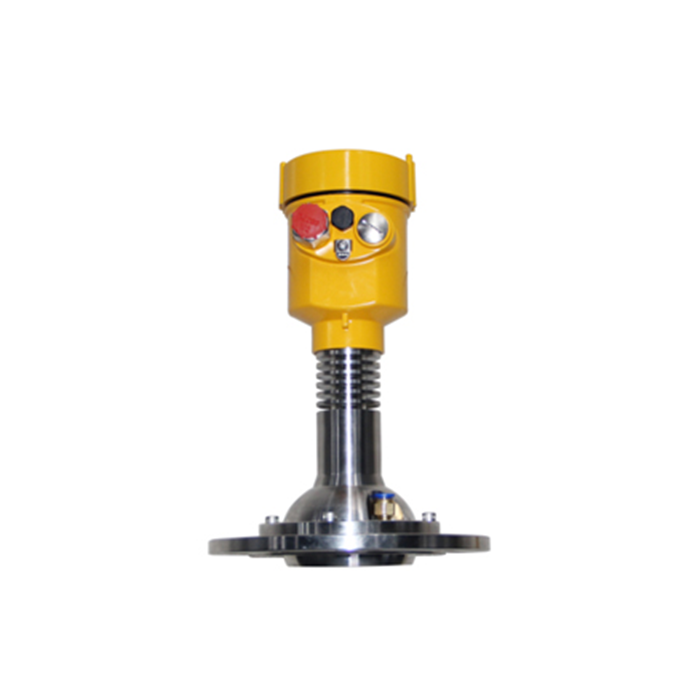
Wood pellet silo level should be compared at defined process states
| Record | Purpose in reconciliation |
|---|---|
| Before delivery | Establish the starting surface reading and whether discharge is continuing. |
| During filling | Identify dust, the falling stream and moving peaks that affect the observed target. |
| After settling | Use a declared comparison time and note any withdrawal since the delivery ended. |
| Material | Retain batch information relevant to density, fines and moisture assumptions. |
Do not invent a universal settling time. Choose and document a repeatable comparison condition appropriate to the plant, then test whether the readings have stabilised sufficiently for the intended inventory estimate. If discharge cannot stop, account for the withdrawal over the same interval instead of treating the delivery as the only mass change.
Investigate disagreement in the right order
First verify that the radar is following pellets rather than a fixed internal structure or the fill stream. Next check the timestamp and process state. Only then assess the volume conversion and bulk-density assumptions. A fixed distance offset introduced to match one delivery can distort subsequent empty-space and high-level indications.
Compare several deliveries before assigning a conversion model. A correction that works only for one fill pattern is not a general silo calibration. Review the limits of level-to-tonnage conversion before using it for accounting. Where accurate commercial mass reconciliation is required, evaluate an appropriate weighing method independently; the level instrument can continue to provide operational surface information.
Inventory questions
Q1. Does a falling reading after filling prove leakage or discharge?
No. Settling and a changing local pile shape are alternative explanations. Review discharge activity and other evidence before classifying the change as a material loss.
Q2. Can the radar be calibrated using the truck's delivered mass?
That mass may help assess an inventory conversion, but it is not a direct reference for distance. Keep distance verification separate and state the assumptions linking mass, volume and surface level.
Summary
Reconcile pellet deliveries through time-aligned process and material records, not an arbitrary radar offset. Send the silo section, filling position and delivery trends for an MV-RD21 installation and inventory-method review.
