


 Chinese
 Spanish
 Russian
 Portuguese
 French
 German
 Indonesian
 Thai
 Vietnamese
 Arabic
 Italian
 Turkish
 Polish
 Japanese


A hydrostatic transmitter can measure pressure correctly while the calculated liquid level is wrong. Hydrostatic level and density changes are linked because the same liquid depth produces a different pressure when density changes. Check the density used in conversion before treating the discrepancy as pressure-sensor drift.
Use pressure and density in consistent units
For a uniform liquid in an open or correctly vented vessel, the hydrostatic contribution is p = rho x g x h. Here p is pressure in pascals, rho is density in kg/m3, g is gravitational acceleration in m/s2 and h is depth above the pressure measuring point in metres. Gas-space pressure and any additional measurement arrangement must be accounted for separately.
As an illustration, a 2.0 m column at 800 kg/m3 produces 15,696 Pa when g is taken as 9.81 m/s2. Dividing that pressure by a configured density of 1,000 kg/m3 gives an indicated depth of 1.6 m. The 0.4 m difference comes from the assumed density, not a demonstrated pressure error.
Hydrostatic level and density changes: collect both records
| Evidence | What to establish |
|---|---|
| Pressure | The actual measured value, units and pressure reference. |
| Liquid condition | Composition and density at the relevant operating temperature. |
| Conversion | The density value and measuring-point elevation used by the transmitter or receiver. |
| Independent level | A suitable reference to separate real liquid movement from a calculation change. |
A temperature reading alone is not a density correction unless a valid relationship for the actual liquid is available. Different recipes or dissolved material can change that relationship. Record the source of density data rather than silently using the value for water.
What changes when radar is considered?
The METRAVON MV-RD12 measures distance to a liquid target using radar. It does not convert hydrostatic pressure into depth, so that particular density assumption is absent from its distance measurement. Foam, reflection conditions, connection suitability and vessel geometry still need review.
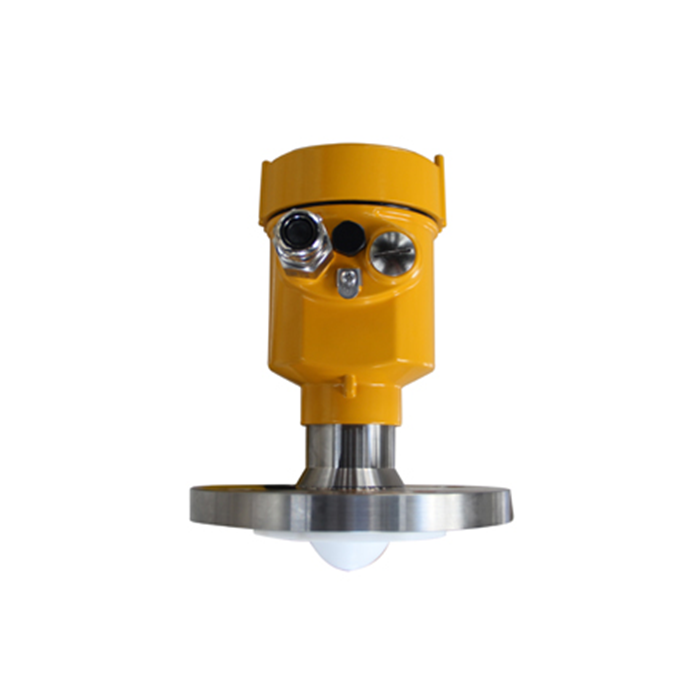
If the required output is mass rather than level, density remains relevant to the later volume-to-mass calculation. A radar replacement does not remove every density-dependent part of an inventory system. Identify the final quantity before comparing the technologies.
Q1. Can the open-tank equation be used directly in a pressurised vessel?
Not without accounting for the gas-space pressure and the actual pressure measurement arrangement. A lower connection can experience both gas pressure and liquid head.
Q2. Should the zero be shifted to match one density condition?
Not as a substitute for resolving the conversion. A one-point adjustment can conceal the cause and leave errors elsewhere in the span or after another composition change.
Summary
Separate pressure performance from the liquid properties used to calculate depth. Provide pressure readings, density information and the required output quantity for an MV-RD12 alternative assessment.
