Chinese
 Spanish
 Russian
 Portuguese
 French
 German
 Indonesian
 Thai
Thai Vietnamese
 Arabic
 Italian
 Turkish
 Polish
 Japanese
Ultrasonic and radar level transmitters are both widely used non-contact technologies for continuous liquid and bulk-solid level measurement. Both determine the distance between the sensor and the material surface, but they use different types of signals and therefore behave differently under changing temperature, pressure, vapor, foam, dust and process conditions.
Ultrasonic instruments use acoustic waves, while radar instruments use electromagnetic waves. This difference in measurement principle is the main reason the two technologies have different application limits. Selection should be based on the process environment, required accuracy, installation conditions and total project cost.
1. How Does an Ultrasonic Level Transmitter Work?
An ultrasonic level transmitter is installed above the material surface and sends an acoustic pulse toward the liquid or solid. The pulse is reflected by the surface and received again by the transducer.
The instrument calculates the distance from the round-trip travel time:
Distance = Sound Velocity × Round-Trip Time ÷ 2
When the installation reference height is known, the actual level can be calculated as:
Level = Reference Height − Measured Distance
Because the sound wave travels through the gas space between the sensor and the material surface, changes in air temperature, gas composition, vapor, foam and strong airflow can influence sound propagation and echo quality. Industrial ultrasonic transmitters therefore commonly use temperature compensation to reduce temperature-related error.
2. How Does a Radar Level Transmitter Work?
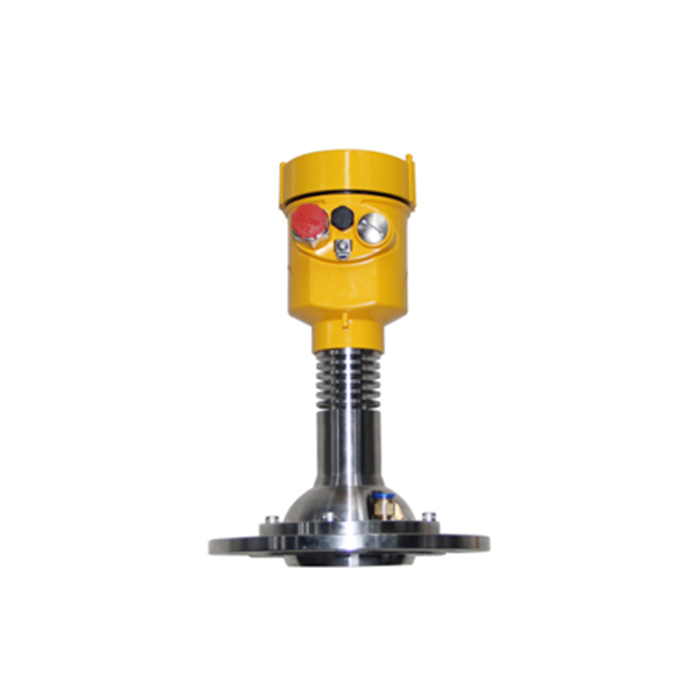
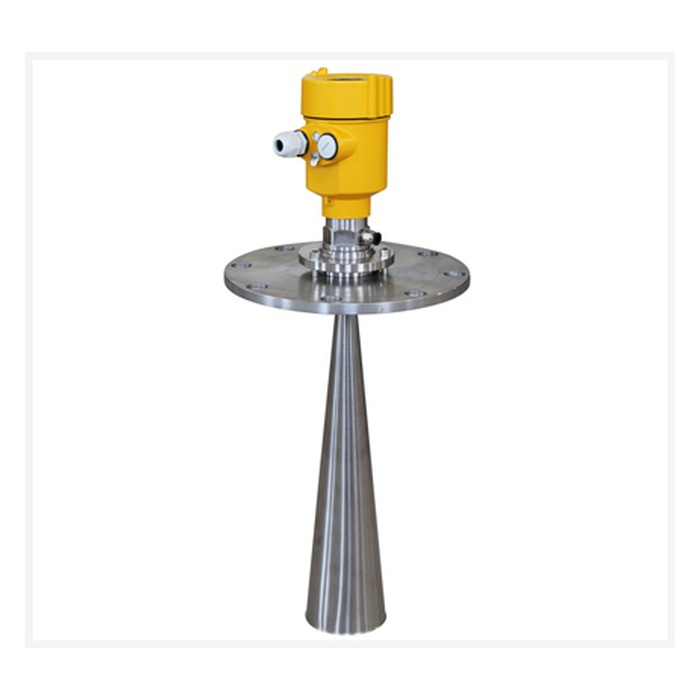
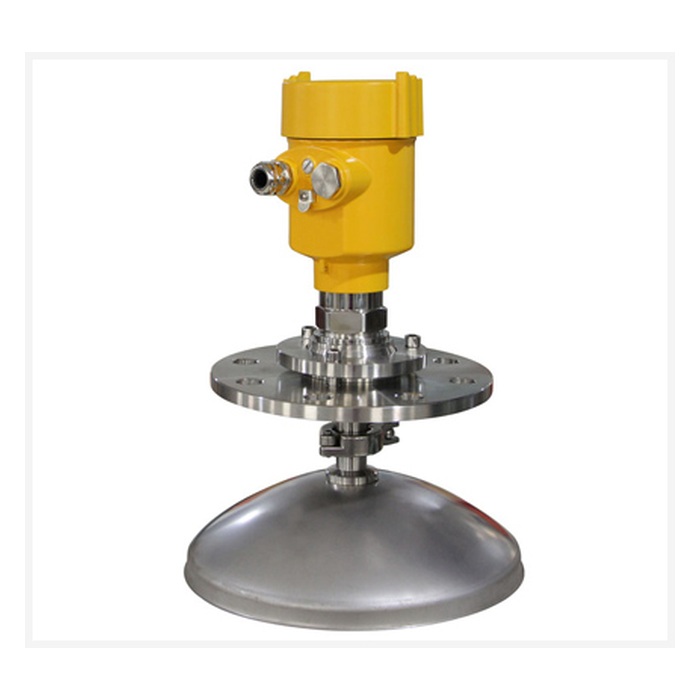
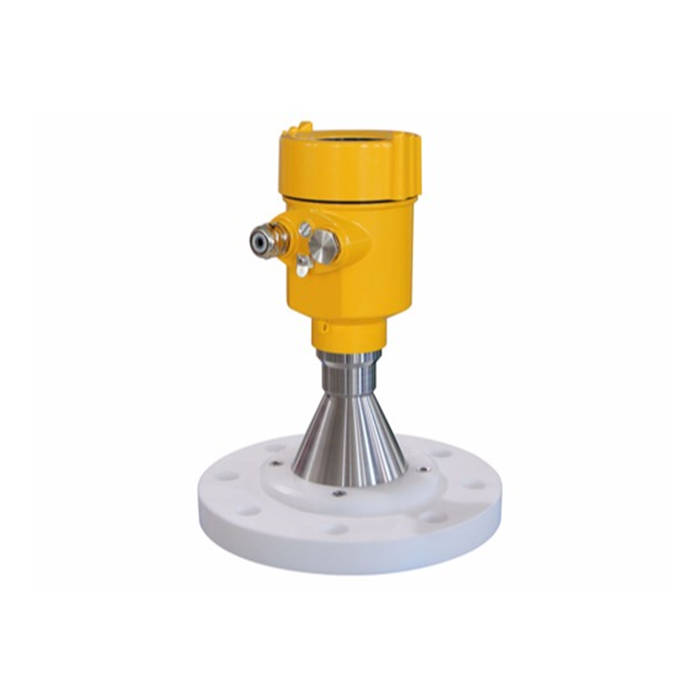
A radar level transmitter sends high-frequency electromagnetic waves from an antenna toward the material surface. The waves are reflected by the liquid or solid and received by the antenna.
The instrument determines distance from signal travel time or, in FMCW radar, from the frequency difference between the transmitted and reflected signals. The measured distance is then converted into actual level.
Radar does not depend on the speed of sound in air and can operate in vacuum conditions. It is generally less sensitive to changes in air temperature, pressure and airflow. Actual radar performance is influenced more by dielectric properties, antenna design, foam, condensation, dust and installation geometry.
3. Main Differences Between Ultrasonic and Radar Level Measurement
| Comparison Item | Ultrasonic Level Transmitter | Radar Level Transmitter |
|---|---|---|
| Measurement Signal | High-frequency acoustic wave | Electromagnetic wave / microwave |
| Measurement Method | Non-contact | Non-contact |
| Temperature Changes | Sound velocity changes with temperature, so compensation is normally required | Generally less sensitive to air-temperature variation |
| Process Pressure | More commonly used at atmospheric or limited pressure, depending on model | Industrial versions are available for vacuum and higher-pressure applications |
| Vapor and Gas Conditions | Strong vapor or changing gas composition can affect propagation | Generally suitable for a wider range of gas-phase conditions |
| Foam | Thick foam can significantly attenuate the acoustic echo | Can also be affected by foam, depending on foam properties and radar type |
| Dust | Heavy dust can attenuate the acoustic signal | Often better suited to dusty bulk-solid applications |
| Vacuum | Not suitable because acoustic waves require a propagation medium | Suitable |
| Medium Influence | Surface condition and gas-space properties are important | Dielectric properties and echo reflectivity are important |
| Typical Cost Position | Often cost-effective for conventional water-level applications | Cost depends on frequency, range, temperature, pressure, certification and interface configuration |
4. Is Ultrasonic Measurement Limited to Atmospheric Conditions?
The operating range of an ultrasonic level transmitter depends on the specific product. Industrial instruments are available with different process-temperature, ambient-temperature and pressure ratings, so ultrasonic measurement is not limited only to open, completely unpressurized tanks.
However, ultrasonic waves must travel through the gas space above the material. High temperature, higher pressure, heavy vapor, unusual gas composition or strong temperature gradients can make the measurement environment more demanding. These conditions should be evaluated against the selected transducer and instrument specifications.
5. Can Radar Replace Ultrasonic in Every Application?
Radar and ultrasonic measurement serve overlapping but different application ranges. Radar generally provides a wider operating window in high-temperature, pressurized, vacuum, vapor-rich and demanding industrial processes. Ultrasonic measurement remains a mature and economical solution for many water tanks, wastewater basins, open channels and conventional atmospheric applications.
The final technology should be selected according to process conditions, required measurement performance, installation constraints and project cost rather than treating one technology as a universal replacement for the other.
6. Which Technology Is Better When Foam Is Present?
Foam is a challenging condition for both technologies. Thick foam can absorb ultrasonic energy and significantly reduce the true liquid-surface echo. Radar can also be attenuated or reflected by foam depending on foam thickness, water content, bubble structure, medium properties and operating frequency.
Light or intermittent foam may still allow reliable measurement with either technology. Persistent dense foam may require a more detailed comparison of non-contact radar, guided wave radar, pressure-based measurement or another suitable level technology.
7. Which Technology Is More Suitable for Dusty Bulk-Solid Silos?
Both ultrasonic and radar technologies can be used for selected bulk-solid applications, but dust, sloped material surfaces and acoustic scattering can reduce the usable range of ultrasonic instruments.
High-frequency radar, especially 80GHz radar, provides a narrow beam that can help avoid silo walls, beams and internal structures. It is therefore widely used in cement, grain, minerals, coal and chemical raw-material silos.
Selection should still consider dust concentration, silo height, material-surface angle, dielectric properties and the available mounting position.
8. Which Technology Provides Higher Accuracy?
Measurement accuracy cannot be determined only by the words “radar” or “ultrasonic.” Different instruments have different accuracy classes, measuring ranges, signal-processing capability and application limits. Installation quality and process conditions also influence actual field performance.
Radar usually maintains stable measurement across a wider range of temperature, pressure and vapor conditions, which provides more product options for demanding process-control and storage applications. In stable conventional water-level applications, ultrasonic instruments can also provide accuracy that meets project requirements.
9. How Do the Costs Compare?
There is no fixed price ratio between radar and ultrasonic level transmitters. Product cost depends on measuring range, radar or acoustic design, accuracy, process temperature and pressure, enclosure protection, hazardous-area certification, materials, antenna or transducer structure and communication interfaces.
For conventional atmospheric water-level measurement, ultrasonic transmitters often provide a cost-effective solution. For high-temperature or pressurized tanks, vacuum processes, heavy vapor or dusty silos, the wider application capability of radar may better match the technical requirements.
10. Which Technology Fits Different Applications?
Water Tanks and Reservoirs
Both ultrasonic and radar can be used. Selection can be based on environment, required accuracy and project budget.
Wastewater Basins
Foam, vapor and surface movement should be considered. Ultrasonic is suitable for many conventional conditions, while radar can be evaluated for more demanding environments.
High-Temperature or Pressurized Tanks
Radar instruments with suitable process-temperature and pressure ratings are commonly evaluated first.
Vacuum Vessels
Radar uses electromagnetic waves and is suitable for vacuum level measurement.
Bulk-Solid Silos
High dust, long measuring range and complex silo geometry often favor high-frequency radar.
Open Channels
Ultrasonic measurement has a long application history and cost advantage, while radar can also be selected according to environmental conditions.
11. What Information Is Required for Selection?
| Selection Parameter | Information to Confirm |
|---|---|
| Process Medium | Water, wastewater, oil, chemical liquid, slurry, powder or granules |
| Measuring Range | Maximum distance from the sensor to the lowest expected level |
| Process Temperature | Normal, minimum and maximum operating temperature |
| Process Pressure | Open, atmospheric, positive pressure or vacuum conditions |
| Surface Condition | Foam, movement, agitation or sloped bulk-solid surface |
| Gas-Space Conditions | Vapor, volatile gases, temperature gradients or dust |
| Installation Environment | Tank diameter, nozzle, beams, agitators and available mounting space |
| Output Interface | 4–20mA, HART, RS485 Modbus RTU or other required interface |
FAQ
Q1: Is radar always better than ultrasonic level measurement?
A1: The two technologies have different application ranges. Radar is commonly evaluated for demanding temperature, pressure, vacuum, vapor and dust conditions, while water tanks, open channels and conventional atmospheric applications can use either technology depending on project requirements.
Q2: Can ultrasonic level transmitters be used on pressurized tanks?
A2: Selected models can operate under limited pressure. The allowable process pressure depends on the transducer and instrument construction. Higher-pressure vessels commonly require evaluation of radar or another suitable technology.
Q3: Is radar affected by foam?
A3: Yes. The effect depends on foam thickness, water content, bubble structure, radar frequency and process-medium properties. Persistent dense foam should be evaluated specifically.
Q4: Why does ultrasonic measurement require temperature compensation?
A4: The speed of sound in air changes with temperature. Temperature compensation corrects the sound-velocity calculation and reduces temperature-related distance error.
Q5: Can radar operate in a vacuum?
A5: Yes. Radar uses electromagnetic waves and does not require air as a propagation medium. The selected instrument must still meet the required process-temperature, pressure and mechanical specifications.
Q6: Should bulk solids be measured with ultrasonic or radar?
A6: Both technologies can be used for selected solids. High-dust, long-range or complex silo applications often favor high-frequency radar, while simpler short-range applications can also use ultrasonic measurement.
Q7: Is a radar level transmitter always twice the price of an ultrasonic transmitter?
A7: No. There is no fixed price ratio. Cost depends on measuring range, frequency, accuracy, materials, temperature and pressure rating, protection, certification and communication interfaces.
Q8: Can both technologies connect to a PLC?
A8: Yes. Depending on the instrument, interfaces such as 4–20mA, RS485 Modbus RTU and HART can be used for integration with PLCs, DCS, RTUs and data-acquisition systems.
Conclusion
The main difference between ultrasonic and radar level transmitters is the measurement signal. Ultrasonic instruments use acoustic waves, so gas-space temperature, composition, vapor and foam can influence propagation. Radar uses electromagnetic waves and generally provides a wider operating window under vacuum, temperature and pressure variation.
Radar is not intended to replace every ultrasonic application, and ultrasonic technology is not limited only to completely open, vapor-free tanks. Conventional water-level and open-channel applications can benefit from the maturity and cost efficiency of ultrasonic measurement, while high-temperature, pressurized, vacuum, vapor-rich and dusty applications often justify evaluation of radar.
METRAVON can configure ultrasonic or radar level measurement solutions according to process medium, measuring range, temperature, pressure, foam, vapor, dust, vessel geometry and automation-interface requirements, with integration options for PLCs, RTUs, DCS and remote monitoring systems.