Chinese
 Spanish
 Russian
 Portuguese
 French
 German
 Indonesian
 Thai
Thai Vietnamese
 Arabic
 Italian
 Turkish
 Polish
 Japanese

A magnetic level gauge is a contact-type continuous level indication instrument commonly used on storage tanks, towers, vessels, process columns, spherical tanks, boilers and other industrial equipment. Its main advantage is clear local indication while the external display mechanism remains isolated from the process medium.
Compared with glass tube or glass plate level gauges, the external indicator of a magnetic level gauge normally does not come into direct contact with the liquid. With suitable float design, chamber material, pressure rating and process connection, the instrument can be used for many industrial liquids, including selected high-temperature, pressurized and corrosive applications.
1. How Does a Magnetic Level Gauge Work?
A magnetic level gauge normally consists of a bypass chamber, magnetic float, external flap or roller indicator, scale and process connections. The chamber is connected to the vessel through upper and lower nozzles so that the liquid level inside the chamber follows the level inside the main vessel.
As the liquid level changes, the magnetic float moves up or down inside the chamber. A permanent magnet inside the float magnetically couples with the external indicator, causing the flaps or rollers to rotate and display the current liquid level through a clear color contrast.
Because the external indicator is isolated from the process medium, operators can read the level directly without relying on a transparent glass section exposed to the liquid.
2. Main Features of a Magnetic Level Gauge
Clear Local Indication
High-contrast flaps or rollers provide direct visual indication for routine inspection.
Process Medium Is Contained Inside the Chamber
The external indicator does not contact the process medium, helping maintain process containment and operating safety.
Simple Mechanical Structure
The main moving component is the internal float, while the external display operates through magnetic coupling.
Flexible Installation
Side-mounted designs are common, while top-mounted or other configurations can be used for selected vessel arrangements.
Remote Transmission Option
Selected configurations can add a level transmitter to convert float position into a standard output signal.
Alarm Switch Option
Magnetic switches can be added for high, low or other alarm points and interlock functions.
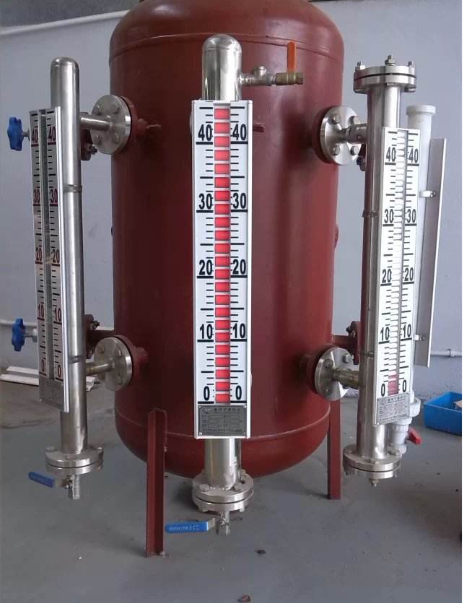
3. What Are the Main Advantages?
The main advantages of a magnetic level gauge are strong local visibility, process isolation and flexible function expansion. It is particularly useful where operators need a direct field indication while avoiding direct exposure of a glass indicator to hot, pressurized or hazardous process liquid.
Easy to Read from a Distance
Large indicators and strong color contrast improve field visibility.
No Process Glass Required
The display does not require a transparent glass column in direct contact with the process liquid.
Independent of Dielectric Constant
The float operates by buoyancy, so dielectric constant does not directly determine the level indication.
Local and Remote Functions Can Be Combined
One chamber can support local indication together with remote transmission and alarm switches.
Suitable for Many Industrial Liquids
With suitable materials and float design, applications can include water, oils and many process liquids.
4. What Are the Main Limitations?
A magnetic level gauge relies on free movement of a float inside the chamber. Liquid density, viscosity, crystallization, deposits, suspended solids and magnetic particles can therefore affect float movement and measurement reliability.
| Process Factor | Engineering Impact |
|---|---|
| Liquid Density | The float must be selected according to medium density; large density changes should be identified during selection |
| High Viscosity | Very viscous liquids can slow float response or restrict free movement |
| Crystallization and Scaling | Deposits may form on the float or chamber wall and increase the risk of sticking |
| Suspended Solids | Heavy solids, sludge or sediment may interfere with float movement or chamber connections |
| Magnetic Particles | Ferromagnetic particles may influence magnetic coupling and float operation |
5. Can Magnetic Level Gauges Be Used at High Temperature and Pressure?
Magnetic level gauges can be configured for elevated temperature or pressurized applications through appropriate chamber material, float design, flange rating, seals and process connections. The allowable process temperature and pressure depend on the specific product configuration.
High-temperature applications should also consider the temperature limits of the float magnet, external indicator, seals and any insulation arrangement. For low-temperature or solidifying media, insulation, heat tracing or jacketed chambers can be used where appropriate to maintain process flow inside the chamber.
6. Can Magnetic Level Gauges Be Used for Corrosive Liquids?
Corrosive applications require careful selection of chamber, float and process-connection materials according to the chemical, concentration, temperature and pressure. Industrial configurations may use stainless steel, engineering plastics, lined structures or other corrosion-resistant materials.
Material compatibility should cover all wetted components. For strong acids, alkalis, solvents or other aggressive media, complete process information should be provided during selection.
7. Can a Magnetic Level Gauge Measure Liquid-Liquid Interface?
Selected magnetic float level gauges can be designed for interface measurement between two immiscible liquids. The float is selected according to the density difference between the upper and lower liquids so that it remains stable near the target interface.
Interface applications should therefore specify the density of both liquids, process temperature and expected density variation. A standard level float and an interface float may use different designs.
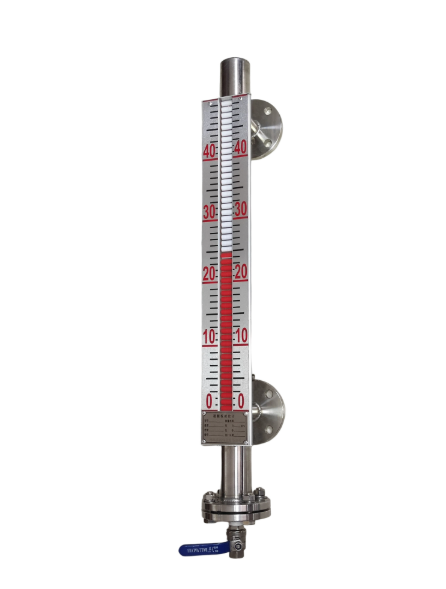
8. What Installation Methods Are Available?
Side-Mounted
The chamber connects to the vessel through upper and lower process connections and is a common arrangement for storage and process tanks.
Top-Mounted
Suitable for selected applications where upper and lower side connections are not available, depending on the specific mechanical design.
Jacketed or Heat-Traced
Can be used where insulation, freeze protection or maintenance of fluidity is required.
For side-mounted magnetic level gauges, the upper and lower process connections should remain open to the vessel so that the chamber level follows the main process level. Good chamber verticality is also important for free float movement.
9. How Are Remote Transmission and Alarms Added?
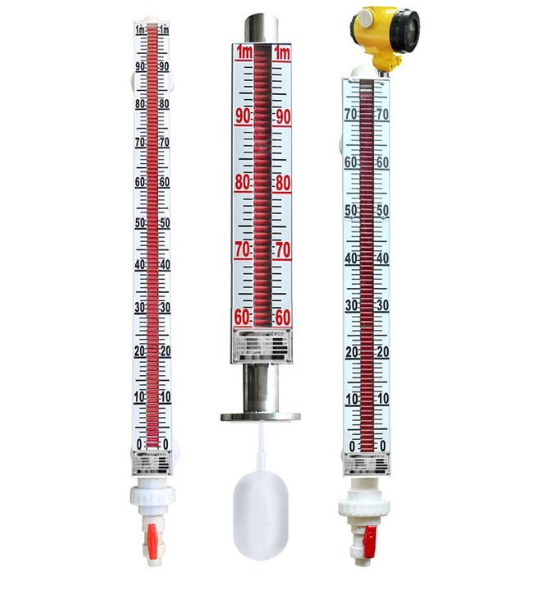
The basic magnetic level gauge provides local mechanical indication. Where the level must also be transmitted to a PLC, DCS or control room, a remote level transmitter can be added depending on the product configuration.
The transmitter detects the position of the magnetic float and converts it into a standard electrical signal such as 4–20mA or another industrial interface. Magnetic switches can also be installed at selected positions for high-level, low-level or other alarm and interlock functions.
Magnetic Float Level → Local Indicator → Level Transmitter / Magnetic Switch → PLC / DCS / Alarm System
10. Typical Applications
Chemical Storage Tanks
Used for acids, alkalis, solvents and other process liquids with appropriate material selection.
Petroleum and Storage
Suitable for selected oils, fuels and process-storage applications.
Water Treatment Systems
Used on process-water tanks, chemical dosing vessels, pressure vessels and auxiliary storage equipment.
Boilers and Pressure Equipment
Configured according to the required temperature, pressure and safety rating.
Food and Pharmaceutical Equipment
Selected structures can be configured according to material, cleanliness and hygienic requirements.
11. What Information Is Required for Selection?
| Selection Parameter | Information to Confirm |
|---|---|
| Process Medium | Liquid composition and corrosiveness |
| Liquid Density | Used for float buoyancy and size selection |
| Viscosity | Used to evaluate float response and chamber flow conditions |
| Measuring Range | Actual liquid-level range and center-to-center distance between process connections |
| Process Temperature | Minimum, normal and maximum operating temperature |
| Process Pressure | Normal and maximum design pressure |
| Process Connection | Flange standard, size, pressure class or other connection type |
| Wetted Material | Select according to corrosion and process compatibility |
| Remote Transmission | Whether 4–20mA or another remote output is required |
| Alarm Requirement | Number and position of high, low or multi-point alarm switches |
12. Magnetic Level Gauge vs Radar Level Transmitter
| Comparison Item | Magnetic Level Gauge | Radar Level Transmitter |
|---|---|---|
| Measurement Method | Contact measurement using a magnetic float | Non-contact electromagnetic measurement |
| Local Indication | Direct mechanical indication with flaps or rollers | Normally displayed electronically |
| Density Influence | Float must be selected according to liquid density | Liquid density does not normally directly affect distance measurement |
| Buildup and Crystallization | Can restrict free movement of the float | Non-contact design reduces direct influence, although antenna buildup may still matter |
| Remote Transmission | Optional remote transmitter | Normally available directly from the electronic transmitter |
FAQ
Q1: Does a magnetic level gauge require power?
A1: Basic local indication normally operates mechanically through the magnetic float and external indicator and does not require external power. Remote transmitters or alarm switches may require power depending on the configuration.
Q2: Can a magnetic level gauge measure corrosive liquids?
A2: Yes, with suitable wetted materials or corrosion-resistant construction. Medium composition, concentration, temperature and pressure should be confirmed during selection.
Q3: Is a magnetic level gauge affected by liquid density?
A3: Yes. The float operates by buoyancy and must be selected according to liquid density. Large density changes should be identified during selection.
Q4: Is a magnetic level gauge suitable for high-viscosity liquids?
A4: Suitability depends on the actual viscosity and flow behavior. Very viscous, crystallizing or scaling media can restrict float movement and chamber circulation.
Q5: Can a magnetic level gauge provide a 4–20mA output?
A5: Selected configurations can add a remote level transmitter that converts float position into 4–20mA or another industrial signal.
Q6: Can it provide high and low level alarms?
A6: Yes. Magnetic switches can be installed at selected positions to provide high, low or other level alarm signals.
Q7: Can a magnetic level gauge measure bulk solids?
A7: No. Magnetic level gauges rely on buoyancy and free float movement in a liquid and are mainly used for liquids and selected liquid-liquid interface measurements.
Q8: What is most important when installing a side-mounted magnetic level gauge?
A8: The upper and lower process connections should remain open to the vessel, the chamber should maintain good vertical alignment, and center-to-center distance, process temperature, pressure and liquid density should match the selected configuration.
Conclusion
A magnetic level gauge uses magnetic coupling between an internal float and an external flap or roller indicator to provide continuous local level indication. Its main advantages include clear visual indication, process isolation of the external display, simple mechanical construction and the ability to add remote transmission and alarm functions.
Selection depends strongly on liquid density, viscosity, crystallization tendency, corrosiveness, process temperature and pressure. High-temperature, pressurized or corrosive applications can be configured through suitable chamber materials, float design, flange rating and sealing structure, while remote transmission and alarm functions can be added according to the automation system requirements.
METRAVON magnetic level measurement products can be configured according to process medium, density, measuring range, process temperature, process pressure, process connection and remote-output requirements, with integration options for PLCs, DCS and industrial automation systems to provide visible, compatible and scalable level measurement for tanks, process vessels and industrial equipment.