


 Chinese
 Spanish
 Russian
 Portuguese
 French
 German
 Indonesian
 Thai
 Vietnamese
 Arabic
 Italian
 Turkish
 Polish
 Japanese

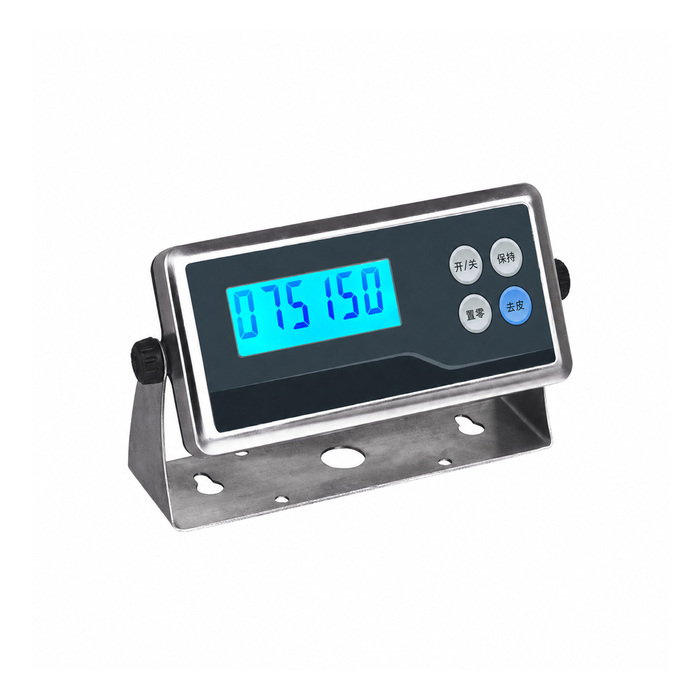

METRAVON MV-WI0006 is a battery-operated weighing indicator with a six-digit backlit LCD and 3.3 V load-cell excitation. Its supply is three AA-size batteries or DC 5 V; those supply arrangements must not be confused with the voltage delivered to the sensor bridge. The reference input interval is -3 to +12 mV for one to four 350-ohm analogue load cells. For portable weighing, confirm the complete sensor circuit and battery duty rather than choosing only by the low-power description.
Check sensor operation at 3.3 V before replacing a mains indicator
Obtain the load-cell permitted excitation and rated sensitivity. A sensor used with a 5 V indicator may produce a different millivolt output when excited at 3.3 V, even though its nominal weight capacity is unchanged. For a hypothetical 2 mV/V bridge, the nominal rated signal would be 6.6 mV at 3.3 V; that example does not establish compatibility for an unidentified sensor. Compare the actual tare, working signal and required increment with the input interval and resolution before approving replacement.
Plan AA-battery operation around the real sensor load
The reference describes three AA-size dry batteries or a DC 5 V source. It does not establish an internal charger for those dry cells. Confirm cell type, permitted external supply and the intended changeover procedure with the offered version. The stated continuous-use reference is 30 hours with four 350-ohm sensors, not unlimited standby or a guarantee under every backlight and accessory setting. Agree sufficient operating reserve and a practical battery replacement plan for the intended shift or mobile route.
| Item | Value | Selection notes |
|---|---|---|
| Instrument supply | Three AA-size batteries or DC 5 V | Dry-battery description does not establish a charging function. |
| Bridge excitation / input | 3.3 V DC / -3 to +12 mV | Check permitted sensor excitation and total signal including tare. |
| Load-cell connection | Four-wire; one to four 350-ohm cells | Count refers to bridge drive, not separate weight channels. |
| Display | Six-digit 20 mm backlit LCD | Confirm backlight operation and visibility for the actual duty. |
| Display / internal counts | 15,000 / 1,000,000 | Minimum reference: 1 microvolt per verification interval; verify useful scale performance. |
| Continuous battery reference | 30 hours with four 350-ohm sensors | Confirm battery and accessory conditions before planning operating reserve. |
| Communication options | RS232 or BLE package | Obtain supplied interface, message or service definition and receiver compatibility. |
Use hold as a defined reading function, not proof of dynamic accuracy
Hold and animal-weighing functions are listed, but the relevant trigger, filtering and accepted reading conditions need to be understood for the actual application. A frozen value can remain visible after the load changes. Define when the displayed or transmitted result may be recorded and how the operator recognises a valid measurement. Test that workflow with representative loads and movement instead of assuming that a hold key guarantees a particular settling time or removes mechanical instability.
Order the optional data connection and obtain its application details
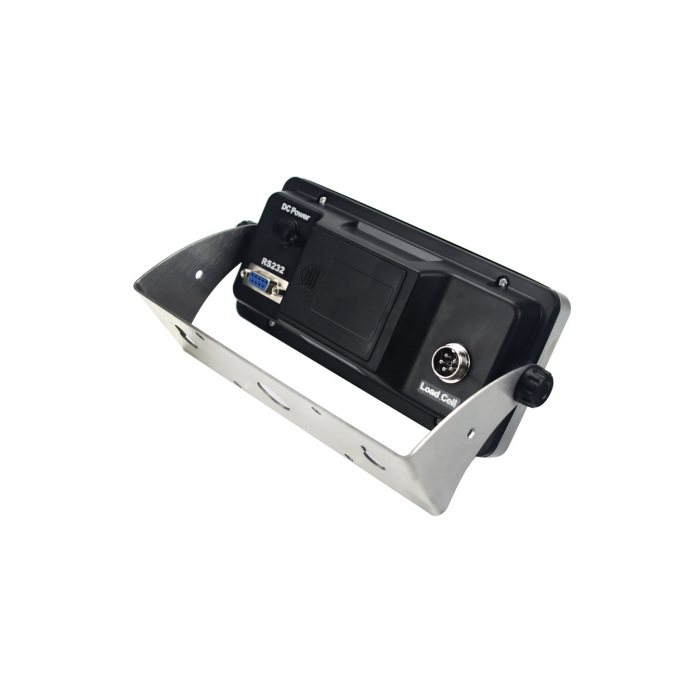
RS232 at selectable 600-9600 baud and a BLE option are described. They do not establish that a pictured rear connector is enabled in every delivered unit or that every phone application can read the data. Confirm the serial message format or BLE service, the receiving software and any required status information. No RS485, Modbus RTU, cloud connection or automatic data-logging service follows from the Bluetooth description. Where a printed record is needed, identify the compatible printer arrangement as part of the offer.
Verify the portable scale in both its physical and power configurations
The reference lists 15,000 display counts, 1,000,000 internal counts and a minimum signal of 1 microvolt per verification interval. These are not a complete scale-accuracy guarantee. After calibration, check repeat readings, tare handling and return after unloading under the intended mounting and use conditions. Verify operation with the selected supply and any communications accessory fitted. Record the sensor wiring and division settings along with the battery configuration so that a later power or indicator change can be checked consistently.
The MV-WI0005 four-wire indicator uses 5 V excitation and a different supply arrangement. Compare the sensor requirements before replacing one configuration with the other.
Bridge voltage, dry cells and optional data links
Q1. Does the DC 5 V socket mean the load cell receives 5 V?
No. The listed bridge excitation is 3.3 V, separate from the external instrument supply. Confirm that the installed load cell permits that excitation and provides enough signal for the required weighing increment.
Q2. Can the three AA cells be charged through the indicator?
The reference specifies dry batteries and does not establish an internal charging function. Use only the battery and external-supply arrangement approved for the delivered version; do not assume that a DC input is a charger.
Q3. Does BLE support guarantee compatibility with a phone app?
The offered BLE interface and data service must match the application. Obtain its documentation and test the intended receiving workflow; a general wireless-version description is not an application compatibility statement.
Q4. Can each of four connected sensors be read separately?
The stated capability is to drive the analogue sensor circuit. It does not establish four independently sampled channels. Specify that need separately rather than expecting it from the maximum sensor count.
