


 Chinese
 Spanish
 Russian
 Portuguese
 French
 German
 Indonesian
 Thai
 Vietnamese
 Arabic
 Italian
 Turkish
 Polish
 Japanese



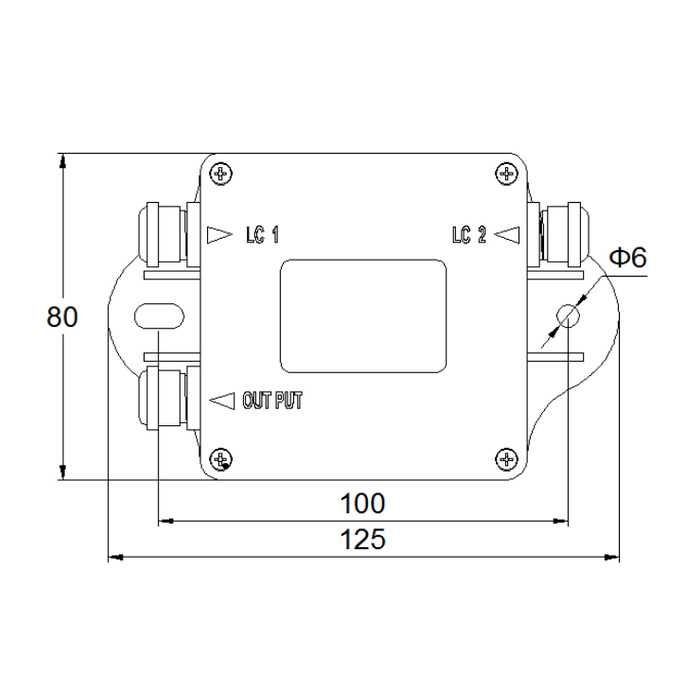
METRAVON MV-WI0015 is a digital weighing transmitter with RS232 communication for one 350 ohm analog load cell. It uses commands to read data, calibrate and set parameters. Two supply versions are listed: 5-8 V and 9-12 V. Choose the version before designing the power connection; these are not one continuous 5-12 V input range.
Two supply versions, one sensor channel
| Version | Input supply | Listed operating current |
|---|---|---|
| Nominal 5 V | 5-8 V | 25 mA at 5 V |
| Nominal 9 V | 9-12 V | 35 mA at 9 V |
The current figures are specified at their respective nominal voltages; they are not a maximum-current rating for every operating condition. Check the delivered version and wiring instructions before applying power. Neither version is specified for direct connection to a 24 V control supply.
The drive capability is one 350 ohm analog sensor. Here, "digital" describes the transmitter's communication and processing functions, not a promise of compatibility with a digital load-cell bus. Obtain confirmation of the permissible analog input signal and sensor excitation requirements for the intended load cell.
Build the host connection around the command set
| Serial parameter | Published specification |
|---|---|
| Electrical interface | RS232 |
| Baud rate | 9600 bit/s |
| Data format | 8 data bits; no parity |
| Operation | Command-based reading, writing and execution |
| Configuration functions | Basic functions, calibration and parameter setting |
Request the command reference, connector pinout, stop-bit setting and response examples for the supplied version. A controller, PC or data logger must send accepted commands and interpret the returned values. Confirm units, sign, decimal position and any status information from that reference rather than guessing from a sample number.
Before connecting the host to a working machine, test data reading separately from calibration and parameter-write commands. Establish which commands may change the measurement configuration, then prevent the normal acquisition routine from issuing them accidentally. Verify the saved settings after a restart using the documented procedure; do not assume every write is persistent.
Integration questions
Q1. Can an RS485 Modbus RTU input read the transmitter directly?
The listed port is RS232 and the protocol is described as a command set, not Modbus RTU. An electrical converter alone does not translate application commands. Check both the physical connection and host software; if protocol conversion is required, it must be explicitly designed and tested.
Q2. Is a 4-20 mA output included with the RS232 version?
The catalogue marks 4-20 mA as optional but does not provide its detailed specification here. Request confirmation of availability, wiring, scaling and whether it can operate alongside serial communication. For a documented current-output selection, also assess MV-WI0014, whose supply and linearity specifications are different.
Q3. What should the data-acquisition test include?
Compare returned readings with reference loads, then test the host's handling of a missing or incomplete response. Confirm recovery after reconnecting and after restarting the equipment. Document the polling interval that works with the supplied command implementation; 9600 bit/s does not specify the weight-measurement update rate.
Request MV-WI0015 with the required supply version, sensor specification and receiving-device details. Include the intended read/write functions and any analog-output requirement so that hardware selection, command documentation and acceptance testing are agreed together.
