


 Chinese
 Spanish
 Russian
 Portuguese
 French
 German
 Indonesian
 Thai
 Vietnamese
 Arabic
 Italian
 Turkish
 Polish
 Japanese



METRAVON MV-WI0003 is a wireless weighing receiver for a matched multi-platform measurement system. The reference configuration uses Zigbee at 2.4 GHz and accepts up to six wireless weighing nodes. It receives the node measurements rather than supplying excitation directly to six bare load cells. Define the platform arrangement, channel identities and required weight record before ordering the receiver and transmitting assemblies.
Assign wireless weighing channels to physical platforms
Give each platform a defined position and identity in the proposed system. State which individual readings and totals the operator needs, and whether loads are captured together or through a prescribed sequence. The maximum node count is not proof that arbitrary third-party transmitters can be paired or that a total remains valid when one expected platform is absent. Obtain the supplied pairing procedure and establish the required response to a missing or stale channel. Do not infer that behaviour from the presence of a radio indicator.
Treat the 80 m radio figure as a reference, not a site guarantee
The radio specification lists 80 m, but the application still needs a check at the actual positions of the receiver and platforms. Metal structures, vehicle positions, intervening equipment and antenna orientation can change the usable link. Test the intended operating arrangement and agree what the operator must do if a reading is delayed or unavailable. Sharing the Zigbee band is not sufficient evidence of a common application protocol, matching firmware or interchangeable radio hardware.
| Item | Value | Selection notes |
|---|---|---|
| System role | Wireless weighing receiver | Bare analogue cells require the corresponding sensing and transmitting equipment. |
| Radio reference | Zigbee / 2.4 GHz | Matched application protocol and pairing are required, not frequency alone. |
| Maximum reference node count | Six | Agree which platform identities are required for a valid total. |
| Radio-distance reference | 80 m | Confirm usable communication at the actual working locations. |
| Receiver display | Six-digit backlit LCD | Digit size and case dimensions differ between references; specify the supplied version. |
| Receiver battery duty | Configuration confirmation required | Published 25/30-hour references are not one guaranteed runtime for every package. |
Keep receiver and transmitter power budgets separate
Each side of the wireless link has its own supply and operating duty. The receiver is listed with AC 110-240 V at 50/60 Hz and a specified internal battery arrangement. Reference documents differ on receiver continuous runtime, giving 25 and 30 hours, while the transmitting-node figures also differ between versions. Require a battery and runtime statement for the actual package rather than combining the longest figures into one promise. Check charging, spare-power arrangements and the practical sequence for a mobile weighing shift.
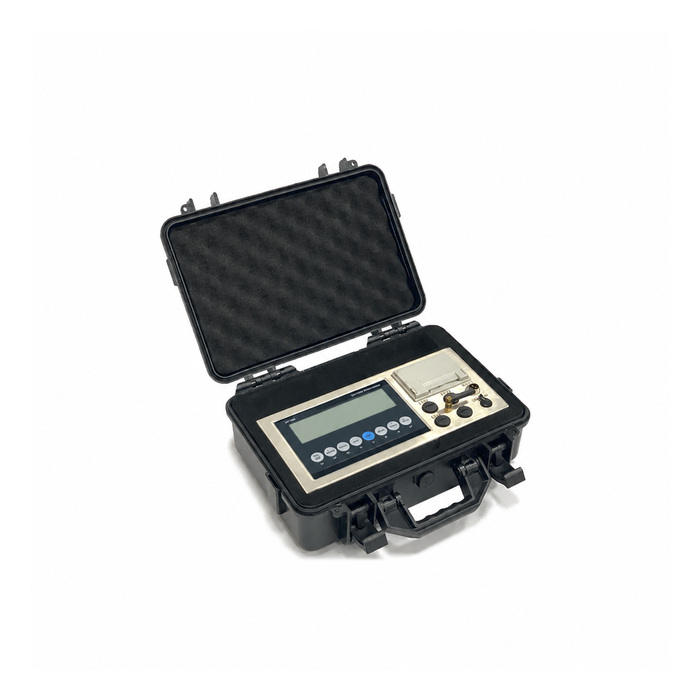
Confirm the display, case and records in the offered package
The receiver descriptions agree on a backlit six-digit LCD, but differ on digit height and case dimensions. Obtain the exact receiver drawing and display version if it must fit a cabinet, vehicle or storage case. The reference system provides individual and total-weight display, data storage and query functions. Clarify the required record fields, memory behaviour and any printer or RS232 connection with the offer. The presence of an integral printer in a photograph does not define every delivered configuration or a software data format.
Verify a complete set of nodes before accepting the system
Use agreed reference loads on the actual platforms and confirm the displayed channel assignments, individual readings and required total. Check removal and reconnection of an expected node using the supplied procedure, without assuming an alarm or automatic rejection that has not been documented. Compare stored or printed values with the observed readings. Record the node identities, pairing settings and receiver configuration so that a replacement platform can be assessed as part of the same measurement system.
Matched nodes, missing readings and battery duty
Q1. Does six-node operation mean six load cells connect to the receiver?
No. It describes receiving measurements from matched wireless nodes. Sensor excitation and acquisition belong to the platform or transmitting assembly, whose sensor capacity and wiring must be specified separately.
Q2. Will any Zigbee weighing transmitter work with it?
The application protocol, radio version, pairing and measurement format must match. Obtain confirmation for the proposed node identities; a common frequency or wireless-standard name is not a compatibility approval.
Q3. What should be done if one platform stops updating?
The supplied operating procedure must define whether a total may still be used and how the missing or stale reading is identified. Test that condition during acceptance rather than assuming the receiver automatically rejects an incomplete measurement.
Q4. Can the larger runtime figure be used for shift planning?
The reference versions disagree, so require the runtime and power arrangement for the actual receiver and nodes. Include operating reserve and charging access instead of treating an unqualified catalogue number as a guaranteed shift duration.
