


 Chinese
 Spanish
 Russian
 Portuguese
 French
 German
 Indonesian
 Thai
 Vietnamese
 Arabic
 Italian
 Turkish
 Polish
 Japanese


Radar process connection selection has two acceptance tests: the assembly must contain or support the instrument correctly, and the antenna must have a suitable measurement path. Passing a leak test does not prove a clear beam; a good level reading does not approve a pressure joint.
Radar Process Connection Selection Starts With the Vessel Interface
| Mount | Specify | Do not assume |
|---|---|---|
| Thread | Exact thread form and size, sealing arrangement, material and tool clearance. | Equal nominal size does not mean parallel and tapered threads will mate and seal correctly. |
| Flange | Standard, nominal size, rating, facing, gasket and the complete nozzle section. | A matching bolt circle does not establish pressure, temperature or chemical suitability. |
| Bracket | Support stiffness, locked orientation, anchors and safe access above an open vessel. | An external support does not provide a sealed connection to a pressurised tank. |
The METRAVON MV-RD11S lists G3/4A or 3/4 NPT options. MV-RD12 uses larger 1.5-inch threaded options. State the required version on the enquiry: choosing the compact model and later adding reducers can move the antenna into an unsuitable narrow passage.
Review the Antenna Position After Every Adapter
An adapter drawing should show its internal bore and the resulting antenna face position, not just its external threads. Check for shoulders, weld intrusion and recesses that can collect condensate. Measure the final reference-plane height so the original empty-distance setting is not carried over without correction.
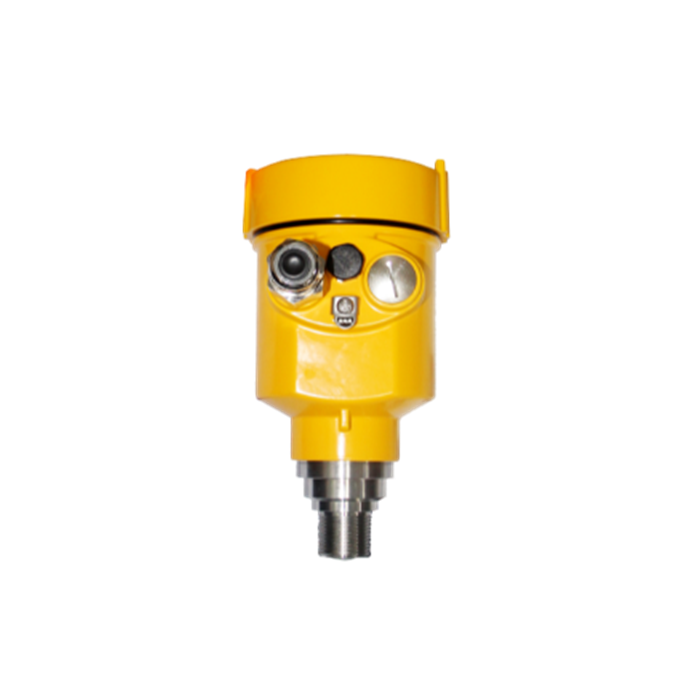
For a flange, compare the selected antenna and nozzle together. A larger flange opening may simplify antenna clearance, but that does not remove gasket-compatibility or loading checks. Use the approved assembly procedure for tightening and support; do not invent a universal installation torque for different seals and materials.
Support Open-Vessel Installations Without Moving the Target
For a non-pressurised installation, the bracket must retain its position when equipment vibrates, maintenance staff access the area or outdoor loads act on it. A flexible cover can change where a narrow beam lands. Provide a repeatable stop or marked locked position if the instrument must swing away for cleaning.
Cable routing should permit the intended movement without pulling a gland or twisting the housing. Keep covers accessible and drainage unobstructed. The removal procedure must address the vessel contents even when the support itself is outside the process boundary.
Connection Questions
Q1. Does a threaded connection mean atmospheric service only?
No. Suitability depends on the rated complete assembly, seal, materials and process conditions. Conversely, a flange is not automatically approved for every pressure. Obtain the configuration-specific limits for either arrangement.
Q2. Can an old flange be reused with a new radar?
Only after checking condition, rating, gasket interface and the new antenna geometry. Reusing the hole pattern does not preserve the old measurement reference or establish compatibility with the replacement materials.
Summary
Procure a defined installed assembly rather than a connection label. Submit the existing connection drawing and operating conditions for review, including any proposed adapter and the space available for maintenance.
