Chinese
 Spanish
 Russian
 Portuguese
 French
 German
 Indonesian
 Thai
Thai Vietnamese
 Arabic
 Italian
 Turkish
 Polish
 Japanese
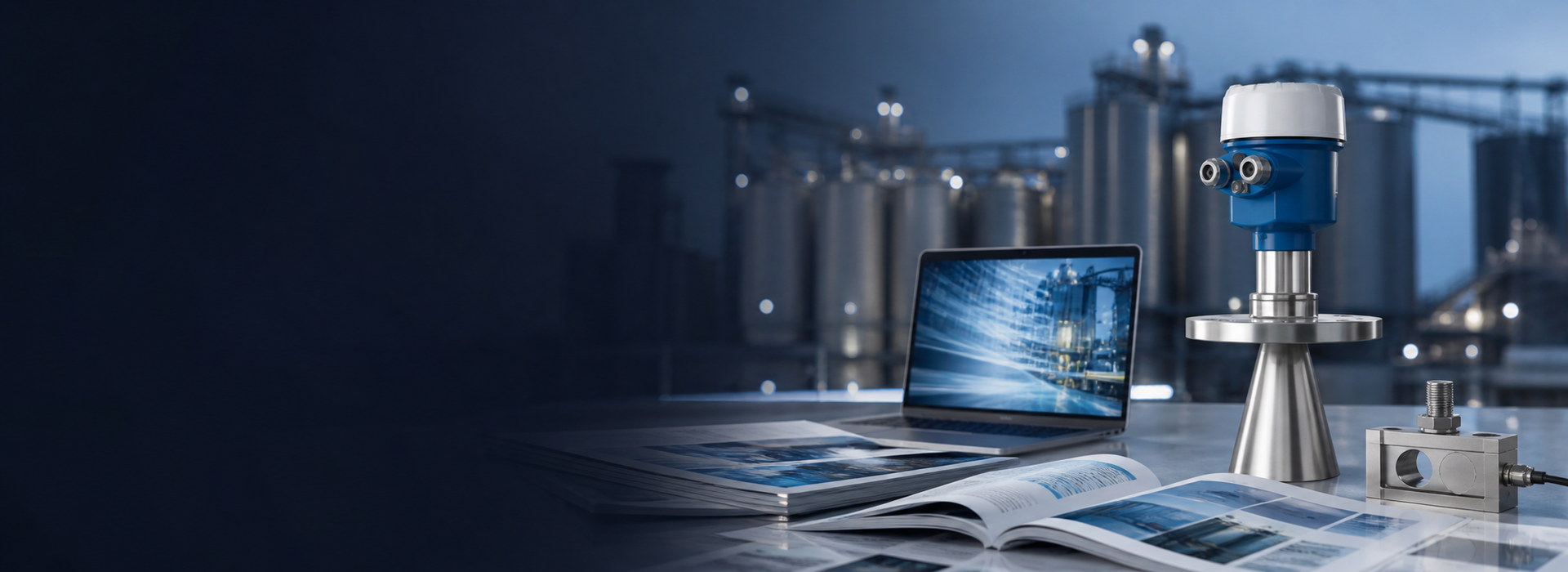
What Is the Difference Between 80 GHz and 26 GHz Radar Level Transmitters? Principles, Performance, and Selection Guide
The main difference between 80 GHz and 26 GHz radar level transmitters is not simply that one has a longer measurement range than the other. Different operating frequencies affect beam angle, antenna size, short-range measurement capability, and the ability to avoid interference from internal vessel structures.
Taking the typical configurations of relevant METRAVON product series as an example:
| Parameter | 80 GHz Radar Level Transmitter | 26 GHz Radar Level Transmitter |
|---|---|---|
| Measurement Range | 0.3-120m | 0.3-70m |
| Typical Minimum Beam Angle | Approximately 3° | Approximately 8° |
| Minimum Dielectric Constant | Approximately 1.4 | Approximately 1.6 |
| Maximum Process Temperature | Models available up to approximately 200°C | Models available up to approximately 150°C |
| Maximum Working Pressure | Models available up to approximately 40bar | Models available up to approximately 25bar |
| Typical Applications | Narrow tanks, complex silos, small process connections, high-accuracy level measurement | Conventional liquid tanks, silos, water treatment, and general industrial level measurement |
Note: The parameters above represent the configuration capabilities of specific product series. They should not be treated as universal specifications for every 80 GHz or 26 GHz radar level transmitter. Actual measurement range, process temperature, pressure capability, and dielectric constant requirements also depend on antenna design, process connection, sealing materials, and the specific model.
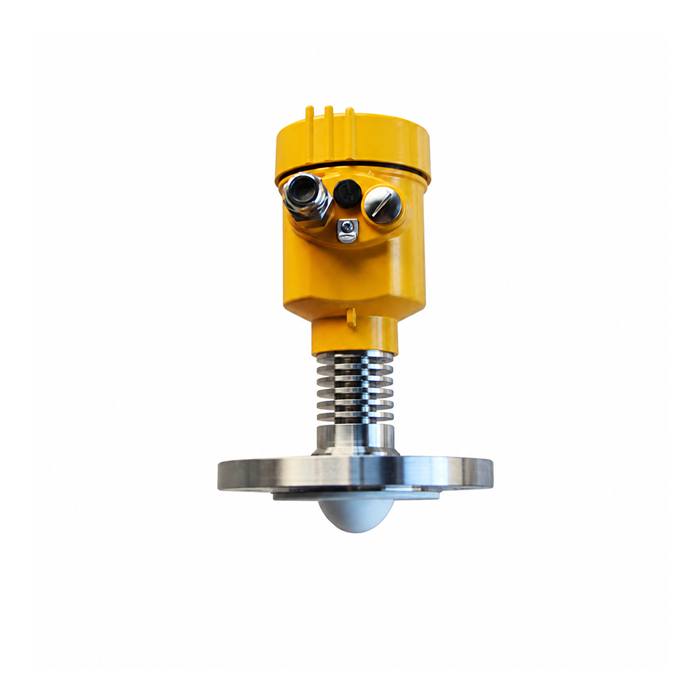
1. Beam Angle: A Major Advantage of 80 GHz Radar
At the same or similar antenna size, a higher radar frequency generally makes it easier to form a narrower beam.
Some industrial 80 GHz radar transmitters can achieve a beam angle of approximately 3°, allowing more radar energy to be concentrated on the material surface. With an appropriate antenna design, a narrow beam can reduce interference echoes from tank walls and internal structures. The actual beam angle should always be confirmed according to the technical specifications of the selected model.
A narrower radar beam makes it easier to avoid:
Tank walls;
Cross beams;
Ladders;
Agitators;
Heating coils;
Filling pipes;
Other internal structures.
Therefore, in small-diameter tanks, narrow silos, reactors with complex internal structures, and limited installation spaces, an 80 GHz radar level transmitter can often obtain a clearer useful echo.
By comparison, the beam of a 26 GHz radar is generally wider, so the installation position requires more attention to the distance from tank walls and internal obstacles.
Why Are 80 GHz Radar Level Transmitters Becoming More Common?
The increasing use of 80 GHz radar in industrial level measurement is not simply because of a higher operating frequency. One of the main reasons is that the technology addresses many installation challenges found in complex tanks and silos.
Narrower Radar Beam
A narrow beam can reduce false echoes from tank walls and internal structures.
In small-diameter vessels, a wide radar beam may illuminate part of the vessel wall and increase the difficulty of signal processing. An 80 GHz radar can concentrate more energy on the actual material surface.
Better Suitability for Small Process Connections
Some industrial applications provide only a small top opening or mounting flange.
Because 80 GHz radar can form a narrow beam using a relatively small antenna, it offers good engineering adaptability for DN40, DN50, and similar small process connections.
Better Suitability for Complex Silos
Powders, grains, cement, minerals, and other granular materials usually do not form a flat horizontal surface.
Typical surface conditions may include:
Conical material piles;
Funnel-shaped surfaces;
Wall buildup;
Material impact during filling;
Irregular reflective surfaces.
A more concentrated radar beam helps reduce interference from surrounding structures. For this reason, 80 GHz radar level transmitters have clear advantages in many complex solid-level applications.
Has 26 GHz Radar Been Replaced by 80 GHz Radar?
No.
Although 80 GHz radar technology is developing rapidly, 26 GHz radar level transmitters still have significant practical value in many industrial projects.
For structurally simple water tanks, wastewater basins, oil tanks, chemical tanks, and conventional silos, if a 26 GHz radar already provides a stable echo, there is no need to replace it simply to increase the operating frequency.
Some industrial 26 GHz radar instruments also use FMCW technology and can be used for both liquid and solid level measurement. Actual suitability depends on the specific model, measured medium, and site conditions.
Therefore, 80 GHz and 26 GHz should not be viewed simply as new versus old technology. They should be selected according to the actual process conditions.
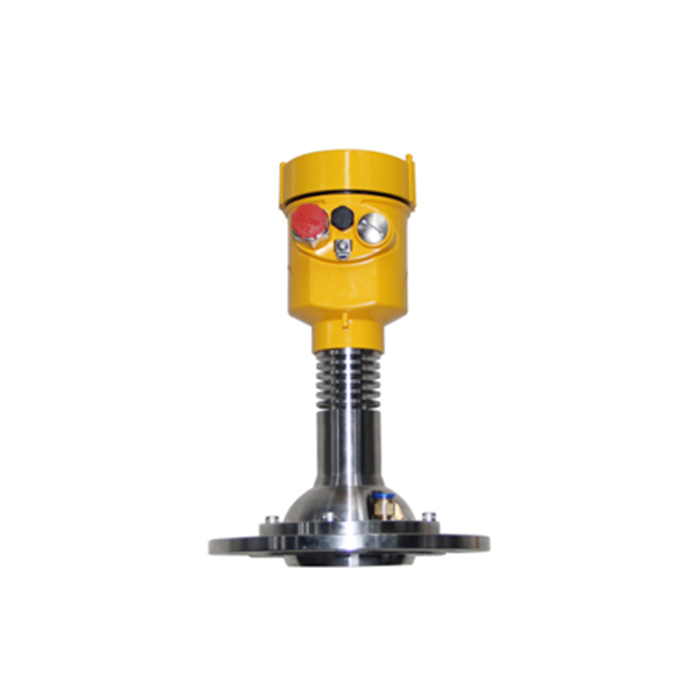
How to Choose Between 80 GHz and 26 GHz Radar Level Transmitters
In practical projects, the following factors should be evaluated.
1. Tank Diameter and Internal Structure
If the vessel diameter is small or the tank contains many internal obstacles:
80 GHz radar should usually be considered first.
Typical examples include:
Small-diameter tanks;
Reactors;
Agitated tanks;
Tanks with heating coils;
Vessels with internal reinforcement;
Narrow silos.
If the vessel has a simple internal structure and a large diameter, both 26 GHz and 80 GHz radar can be evaluated.
2. Measurement Distance
Long-distance level measurement should not be selected based only on radar frequency.
The following factors should also be confirmed:
Maximum measurement distance;
Dielectric constant of the medium;
Antenna type;
Material surface condition;
Presence of dust;
Radar beam angle;
Echo strength.
Some 80 GHz products can provide very long measurement ranges, but 26 GHz industrial radar can also provide continuous level measurement over tens of meters.
Therefore, the statement “80 GHz always measures farther than 26 GHz” is not generally correct.
3. Type of Measured Material
Liquid Storage Tanks
Both frequencies can be used for relatively regular liquid surfaces such as clean water, industrial water, wastewater, and many chemical liquids.
If the tank structure is simple, the main comparison should include:
Measurement range, accuracy, process connection, material compatibility, output protocol, and project cost.
Solid Silos
Cement, grain, plastic pellets, mineral powder, fly ash, and other powders or granular materials usually have irregular material surfaces.
In these applications, selection should focus on:
Beam angle + Silo structure + Dust + Material angle + Maximum distance
For complex silos, 80 GHz radar is generally better able to avoid vessel walls and internal structures.
4. Vapor, Foam, and Condensation
This should not be judged simply by assuming that 80 GHz is always more advanced.
Foam may reduce the effective reflection from the liquid surface, while vapor, condensation, and antenna contamination can also affect echo quality.
In some applications, lower-frequency radar may be less sensitive to vapor, foam, or antenna contamination, while the main advantage of higher-frequency radar is the narrower beam.
Therefore, where heavy vapor, thick foam, or severe condensation is present, the specific medium and site conditions should be evaluated before selecting the radar model.
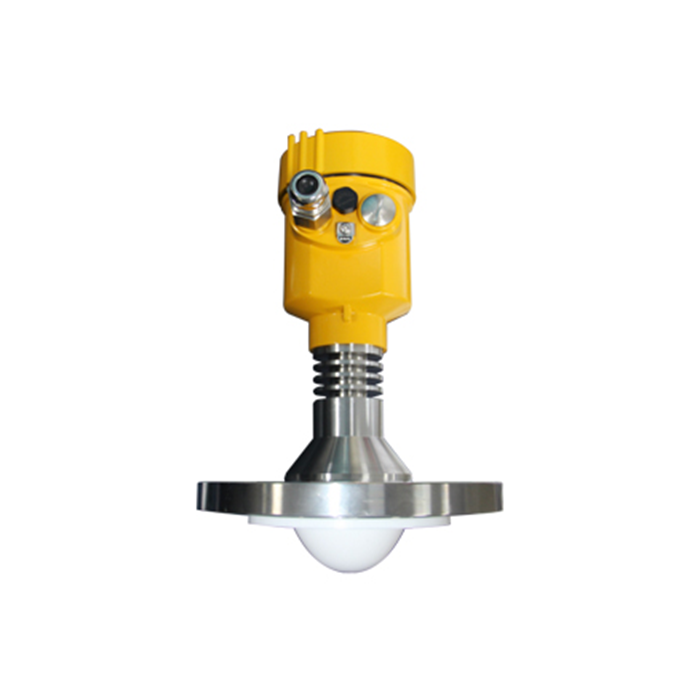
Position of 80 GHz and 26 GHz Radar Level Transmitters in Industrial Systems
In industrial automation and IoT monitoring projects, radar level transmitters are normally installed at the field sensing layer.
A typical architecture is:
80 GHz / 26 GHz radar level transmitter → PLC / RTU / Data logger → Industrial gateway → SCADA / IoT platform
Different communication interfaces can be selected according to the project architecture.
4–20 mA
Suitable for:
PLC systems;
DCS systems;
Traditional industrial control systems;
Long-distance analog signal transmission.
4–20 mA + HART
HART adds digital communication to the 4–20 mA analog signal and can be used for:
Parameter configuration;
Device diagnostics;
Device status reading;
Instrument maintenance.
RS485 Modbus RTU
Suitable for:
IoT data loggers;
RTUs;
PLCs;
Industrial gateways;
Multi-sensor buses.
A typical system can be designed as:
Radar level transmitter → RS485 Modbus RTU → 4G industrial gateway → MQTT / HTTP → Cloud server
This architecture supports not only real-time level monitoring, but also historical data storage, high/low-level alarms, trend analysis, and centralized management of multiple sites.
Important: RS485, Modbus RTU, 4–20 mA, and HART are model-specific interface options. Not every 80 GHz or 26 GHz radar transmitter provides all of these interfaces.
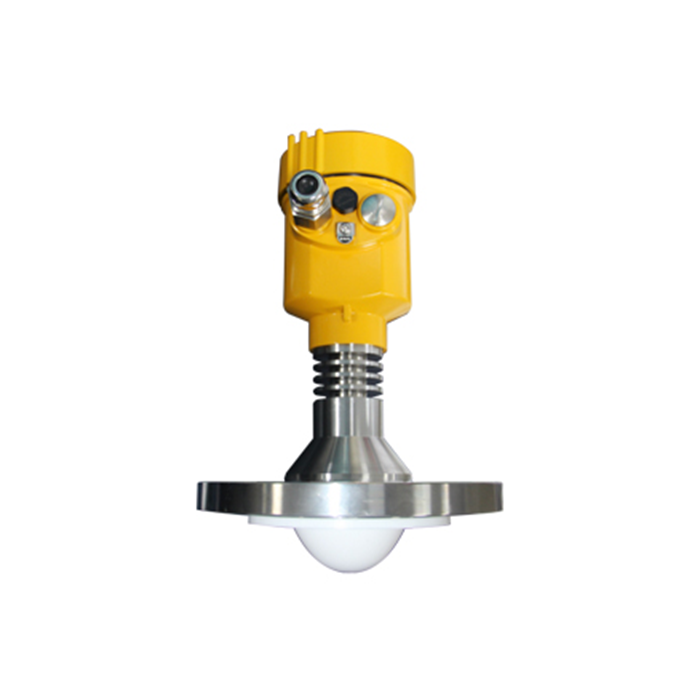
Typical Applications of 80 GHz and 26 GHz Radar Level Transmitters
1. Water Treatment and Wastewater Basin Level Monitoring
Site Challenges:
Wastewater basins may contain moisture, sludge, foam, and corrosive gases, and many measuring points are installed outdoors.
System Integration:
Install a top-mounted non-contact radar level transmitter and connect it to an RTU or 4G industrial gateway through RS485 Modbus RTU.
User Value:
Reduce contamination and maintenance associated with direct-contact sensors while enabling remote level monitoring, pump control, and overflow alarms.
2. Chemical Storage Tank Level Monitoring
Site Challenges:
Vapor, corrosive media, process pressure, and elevated temperatures may be present.
System Integration:
Select the appropriate antenna and sealing material according to the process medium and connect the transmitter to a PLC or DCS through 4–20 mA/HART.
User Value:
Provide continuous non-contact level monitoring for high/low-level alarms and process control.
3. Cement, Grain, and Mineral Powder Silos
Site Challenges:
High dust concentration, irregular material surfaces, wall buildup, and large silo height.
System Integration:
For complex silos, a narrow-beam 80 GHz radar can be evaluated first. The installation position should avoid the filling stream and internal structures.
User Value:
Improve continuous material-level measurement stability and provide real-time data for inventory, production planning, and material replenishment.
4. Small Tanks and Reactors
Site Challenges:
The vessel diameter is small and may contain agitators, heating coils, or internal support structures.
System Integration:
Use narrow-beam 80 GHz radar to reduce false echoes from the vessel wall and internal structures.
User Value:
Reduce measurement interference caused by limited installation space.
5. Remote Water Monitoring and Industrial IoT
Site Challenges:
Measurement points are widely distributed, fixed communication infrastructure may not be available, and long-term unattended operation is required.
System Integration:
Use:
Radar level transmitter + RS485 data logger + 4G gateway + Solar power supply + MQTT / HTTP server
to provide centralized multi-site data transmission.
User Value:
Enable remote level queries, historical trend analysis, abnormal-condition alarms, and third-party platform API integration.
80 GHz vs 26 GHz Radar Level Transmitter Selection Table
| Project Condition | Recommended Priority |
|---|---|
| Small-diameter tank | 80 GHz |
| Many internal obstacles | 80 GHz |
| Small process connection | 80 GHz |
| High silo or complex material surface | 80 GHz |
| Conventional water tank | 26 GHz or 80 GHz |
| Conventional wastewater basin | 26 GHz or 80 GHz |
| Large tank with simple internal structure | 26 GHz or 80 GHz |
| Heavy vapor, foam, or condensation | Evaluate according to the specific model and process conditions |
| High-dust solid silo | Evaluate 80 GHz first and confirm antenna anti-buildup design |
| Existing system uses 4–20 mA | Select according to output interface requirements |
| IoT / RTU integration required | Confirm availability of RS485 Modbus RTU |
| Hazardous area | Select according to project requirements such as ATEX / IECEx |
The most important point is:
Do not select a radar level transmitter only according to whether it is 80 GHz or 26 GHz.
Correct radar level instrument selection should consider at least:
Medium + Measurement range + Tank structure + Beam angle + Temperature + Pressure + Process connection + Output protocol + Explosion protection requirements
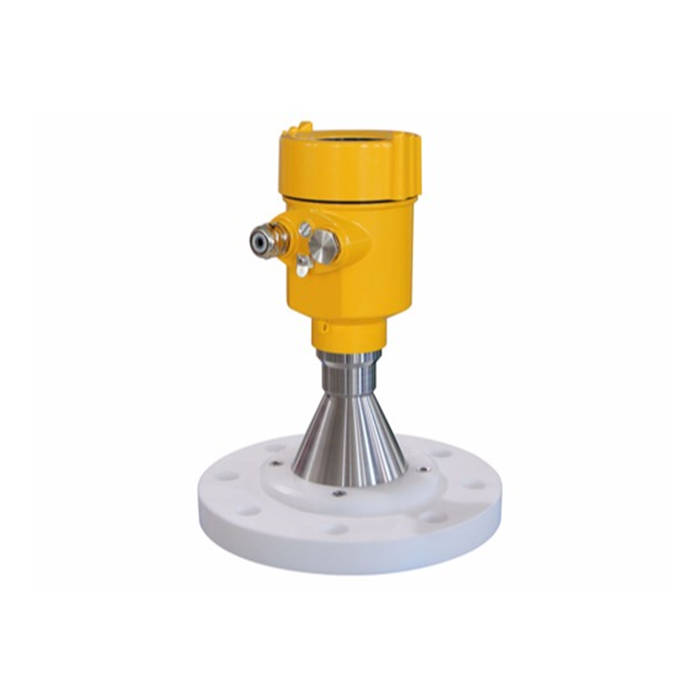
Radar Level Transmitter System Integration Considerations
For RS485 Modbus RTU radar level transmitters, the following parameters should be confirmed in advance:
Slave ID;
Baud rate;
Data bits;
Parity;
Stop bits;
Modbus register addresses;
Data format;
Byte order;
Measurement scaling factor.
If multiple radar level transmitters are connected to the same RS485 bus, each device should use a different address. A proper bus or daisy-chain topology should be used rather than an uncontrolled star connection.
For 4–20 mA radar transmitters, confirm:
2-wire or 4-wire configuration;
Loop supply voltage;
PLC analog input type;
Level corresponding to 4mA;
Level corresponding to 20mA;
Fault current configuration.
Outdoor projects should also consider:
Lightning protection, surge protection, waterproof wiring, shield grounding, power supply design, and communication network.
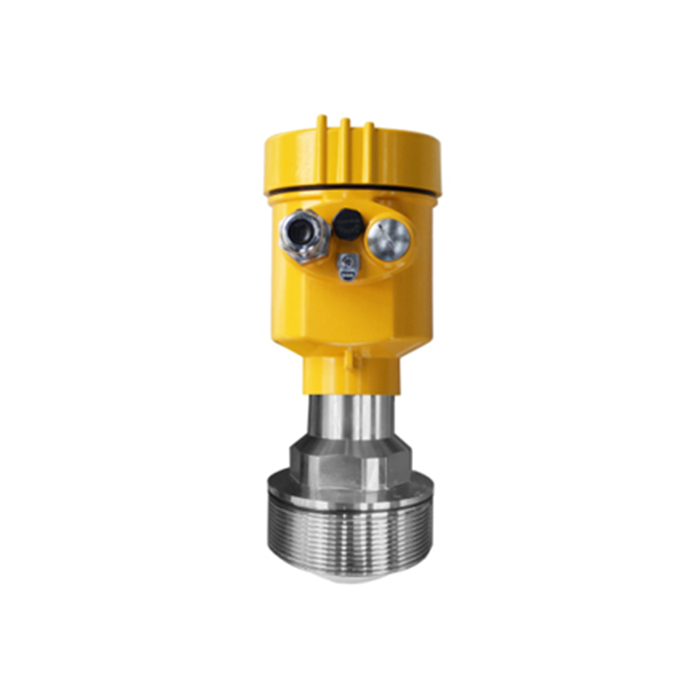
FAQ: Common Questions About 80 GHz and 26 GHz Radar Level Transmitters
Q1: Is 80 GHz Radar Always Better Than 26 GHz Radar?
No.
80 GHz radar has clear advantages in narrow beam angle, small process connections, and complex vessels, but 26 GHz radar can still provide stable measurement in many conventional tanks and industrial processes.
Selection should be based on actual process conditions rather than operating frequency alone.
Q2: Why Does 80 GHz Radar Have a Narrower Beam?
Radar antenna size, operating frequency, and wavelength all affect the beam angle.
Under similar antenna-size conditions, increasing the frequency shortens the wavelength and makes it easier to form a more concentrated radar beam. Therefore, 80 GHz radar can generally achieve a smaller beam angle.
Q3: Can 80 GHz Radar Measure Powder and Bulk Solids?
Yes.
Cement, grain, plastic pellets, mineral powder, and other solid materials are common applications for millimeter-wave radar.
However, selection should consider dust concentration, measurement range, dielectric constant, material angle, and silo structure.
Q4: Can 26 GHz Radar Measure Liquids?
Yes.
26 GHz radar has been widely used for non-contact level measurement of water, wastewater, oils, and various industrial liquids.
Q5: Can Radar Level Transmitters Work in Dusty Environments?
Usually yes, but this should not be interpreted as being completely unaffected by dust.
High dust concentrations may reduce signal quality, while dust buildup on the antenna can also affect measurement.
Antenna structure, installation position, echo strength, and possible air-purge measures should be considered.
Q6: Is 80 GHz Radar Suitable for High Temperature and High Pressure?
High-temperature and high-pressure models can be designed, but 80 GHz itself does not automatically mean that the instrument can withstand high temperature or high pressure.
Process temperature and pressure capability depend on the process connection, sealing system, antenna structure, and mechanical design.
The specific product datasheet should always be checked.
Q7: Can an 80 GHz Radar Connect Directly to a PLC?
Yes, depending on the output interface.
If the device supports 4–20 mA, HART, or RS485 Modbus RTU, it can connect to the corresponding PLC input or communication module.
Q8: Can a Radar Level Transmitter Connect to a 4G Cloud Platform?
Yes.
A typical architecture is:
Radar level transmitter → RS485 / 4–20 mA → RTU or IoT gateway → 4G → MQTT / HTTP → Cloud platform
The radar instrument is mainly responsible for measurement, while network communication and protocol conversion are normally handled by the data logger, RTU, or industrial gateway.
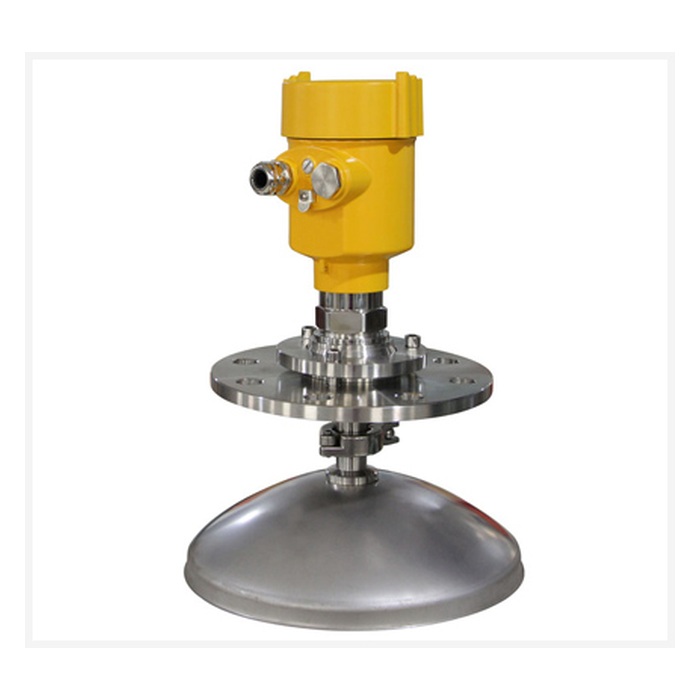
Conclusion: Should You Choose 80 GHz or 26 GHz Radar?
Both 80 GHz and 26 GHz radar level transmitters are mature non-contact level measurement technologies.
The main engineering advantages of 80 GHz radar are:
Narrower radar beam;
Smaller antenna size;
Better ability to avoid internal obstacles.
For this reason, 80 GHz radar is particularly suitable for small tanks, complex reactors, narrow installation spaces, and solid-material silos.
26 GHz radar remains suitable for a large number of conventional storage tanks, water treatment systems, chemical level applications, and industrial bulk-solid measurements. It should not be considered obsolete simply because higher-frequency radar is available.
For METRAVON radar level monitoring projects, it is recommended to provide the following information before selecting the final model:
Measured medium, maximum measurement distance, tank dimensions, temperature, pressure, internal structures, process connection, output protocol, and site photos.
Based on this information, the project can determine whether an 80 GHz or 26 GHz radar level transmitter is more suitable and whether the required communication interface should be RS485 Modbus RTU, 4–20 mA, or HART.