


 Chinese
 Spanish
 Russian
 Portuguese
 French
 German
 Indonesian
 Thai
 Vietnamese
 Arabic
 Italian
 Turkish
 Polish
 Japanese

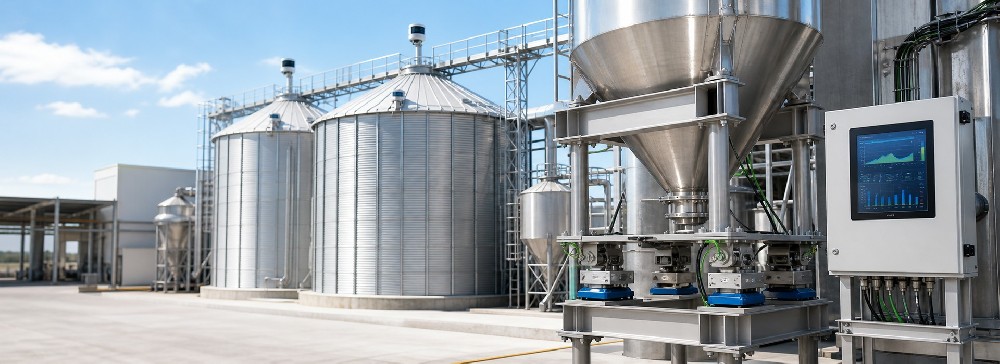

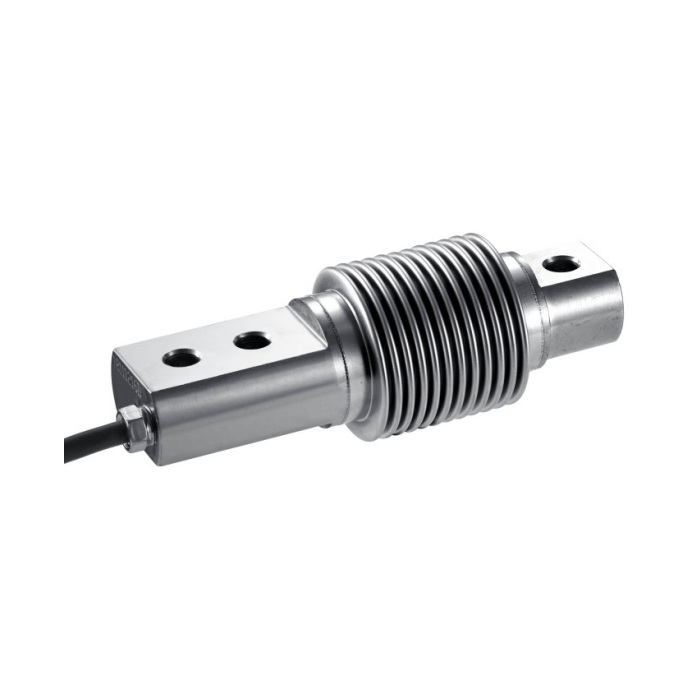
METRAVON MV-LC0122 is a stainless steel bellows load cell for platform, hopper and tank weighing. It uses a cantilever arrangement with one end fixed and the other carrying the applied load. The bellows encloses the measuring region; it is not a flexible coupling that allows the equipment to pull, twist or bend the sensor arbitrarily. The listed family is 50-500 kg.
Leave clearance around the stainless steel bellows load cell
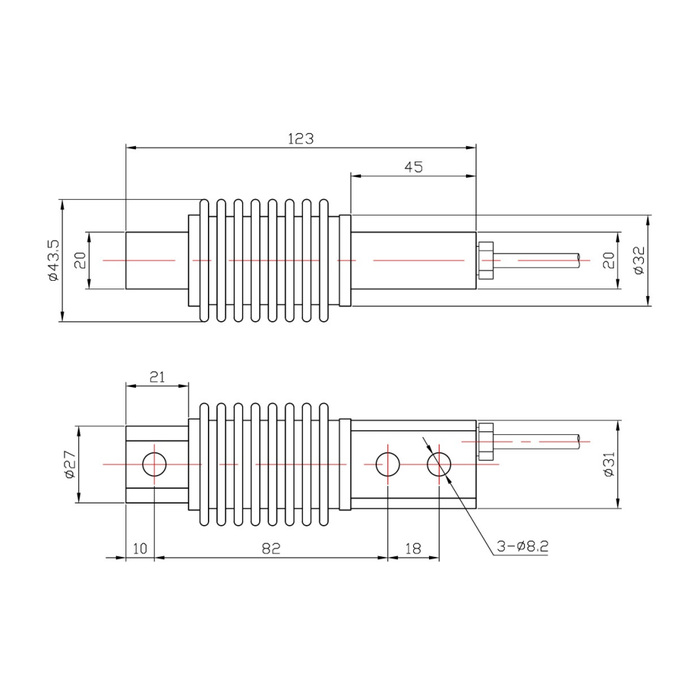
The reference overall length is 123 mm and the maximum bellows diameter is 43.5 mm. Check the complete envelope rather than sizing a guard from the narrower end sections. A cover, accumulated material or a nearby bracket must not press on the bellows or interfere with normal deflection. If protection from falling material is needed, design the guard so that it cannot become an additional load path when the platform moves.
Check all three holes before a 500 kg replacement
The drawing identifies three 8.2 mm holes in the standard view and explicitly changes them to three 10.5 mm holes at 500 kg. The two fixed-end holes have an 18 mm centre spacing in the reference drawing. Obtain the selected-capacity drawing and compare the load-end attachment too. Do not retain the old bolts or drill a new plate from the general outline without resolving the capacity-specific hole sizes and required fastener arrangement.
| Item | Value | Selection notes |
|---|---|---|
| Capacity family | 50-500 kg | Specify supported tare and the useful material additions. |
| Reference length | 123 mm | Use the complete selected-capacity mounting drawing. |
| Maximum bellows diameter | 43.5 mm | Allow clearance from guards and surrounding structures. |
| Standard / 500 kg holes | 8.2 / 10.5 mm | The drawing identifies three holes in each case. |
| Fixed-end hole spacing | 18 mm | Confirm bolt selection and base engagement separately. |
| Material / enclosure | Stainless steel / IP66 | Submit cleaning exposure rather than assuming hygienic approval. |
Keep cleaning exposure separate from the material description
Stainless steel and IP66 are documented, with -20 to +70 deg C operation. They do not identify a particular alloy grade, cleaning-chemical compatibility or a hygienic installation approval. Provide the cleaning method, product contact requirements and exposure at the cable termination. Inspect the bellows and cable for damage during maintenance; avoid using the thin corrugated cover as a handhold or a point to lever the assembly into alignment.
Check small hopper additions through the complete signal channel
The bridge provides 2.0 +/-0.05 mV/V and needs 5-12 V DC excitation. Input resistance is 380 +/-30 ohms and output resistance 350 +/-5 ohms; the cable is listed at 3 m and 5 mm diameter. Specify a suitable weighing conditioner if the controller needs 4-20 mA or a digital interface. Test additions representative of the smallest useful batch change after the hopper tare and discharge connection are installed. The +/-0.03% FS nonlinearity, hysteresis and repeatability values do not establish the final batching error by themselves.
Bellows protection and capacity-specific fixings
Q1. Can the bellows compensate for a misaligned mounting bracket?
No coupling movement or permitted misalignment is established by the corrugated cover. Correct the base and loading geometry before calibration. A forced installation can introduce a changing force even when the display can initially be zeroed.
Q2. Can the 500 kg version use the holes shown for a lower rating?
The installation drawing specifies 10.5 mm holes at 500 kg instead of the general 8.2 mm holes. Compare the exact delivered outline and the mating bracket. The hole note must be resolved before retaining existing fixings.
Q3. Will a stainless-steel body make cleaning residue irrelevant to weighing?
Residue can bridge the clearance or press against the bellows, creating a mechanical interaction regardless of corrosion resistance. Inspect those spaces and compare the unloaded indication after cleaning. Also assess the actual chemicals and cable termination for the proposed cleaning procedure.
