


 Chinese
 Spanish
 Russian
 Portuguese
 French
 German
 Indonesian
 Thai
 Vietnamese
 Arabic
 Italian
 Turkish
 Polish
 Japanese


Mining bin level monitoring should begin with the falling-material path. A radar may have sufficient measuring range yet fail repeatedly because its bracket moves, its opening receives rock impact, or it observes a different part of the pile when the feeder starts. Solve the physical installation before treating every unstable reading as an electronics problem.
Inspect the Mount With the Handling Equipment in Mind
Map conveyor discharge, truck dumping where applicable, rebound and the highest credible pile. Keep the antenna outside direct impact, including the path of large lumps. A cover can protect the housing, but a metal guard across the measurement opening creates another radar target.
Use a support whose stiffness and movement are appropriate to the installation. Do not assume that a nearby handrail or thin access cover is a stable reference. Inspect anchors, cable restraint and the relationship between the sensor and moving liners. After early operation, compare the mounting position with the installation photographs.
Mining Bin Level Monitoring: Identify What Changed
| When | Compare | Likely review |
|---|---|---|
| Dumping | Echo trace, incoming stream and bracket movement. | Impact exposure and target selection during the loading event. |
| Feeder starts | Surface movement and the discharge funnel location. | Whether the observed point still represents the control duty. |
| After repair | Liner, guard and antenna positions against the earlier drawing. | New fixed reflections or a changed measurement reference. |
| At low stock | Radar distance, feeder delivery and the outlet geometry. | Usable burden above the feeder, not only average bin height. |
These comparisons narrow the investigation; they do not establish a diagnosis by themselves. Preserve the raw distance and equipment state before changing filtering, offsets or the echo map. A display that becomes quiet after heavy damping may simply be too slow for the surge-bin duty.
Match MV-RD21 to the Required Response and View
The METRAVON MV-RD21 is a non-contact bulk-solids radar using a 76 mm PTFE lens with a nominal 3-degree beam. Select the range from the antenna reference to the nearest and farthest useful surfaces. The narrow beam is helpful around structural members, but it does not remove reflections from a badly positioned guard or guarantee an average pile height.
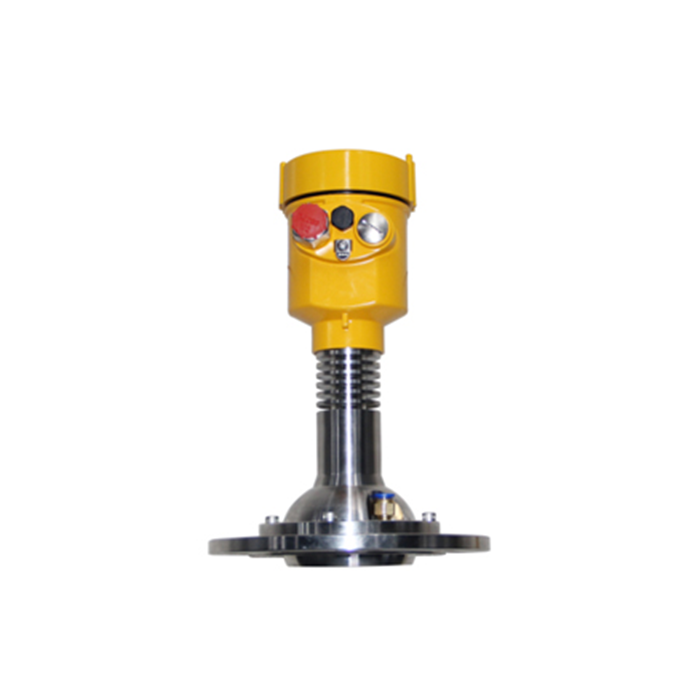
Specify the actual temperature, dust, vibration environment and site equipment requirements in the enquiry. The product description does not supply a universal allowable vibration for every bracket or establish the complete installation's hazardous-area approval. Ask for the configuration and mounting arrangement that the offer covers.
Check the Material Still Arriving After a Stop
A high-level action must allow for sensor response, filtering, controller delay, upstream stopping and material already moving toward the bin. Determine that sequence for the actual conveyors or feeder, and assess where the arriving material will form its peak. A roof clearance based on a different loading route is not necessarily conservative.
At the low end, establish the burden needed by the downstream process. The radar can see a surface above a discharge funnel while the feeder is becoming starved. Use suitable process evidence where the consequence requires it. Any independent protective function must be designed separately from normal level regulation.
Questions During Replacement
Q1. Will a longer-range radar fix losses during dumping?
Not necessarily. First determine whether the signal is obscured by the stream, the lens is accumulating deposits, or the mounting is moving. A larger nominal range does not correct physical impact or a measurement path through the incoming material.
Q2. Can the inventory estimate be calibrated against a belt scale?
Weighed movements can help assess it, provided time intervals and material identity match. Keep in mind that radar sees one part of an uneven surface. Agreement over one fill does not establish mass accuracy across every pile shape or density condition.
Q3. What should be rechecked after replacing liners?
Compare the internal geometry, antenna orientation and fixed echoes with the earlier record. Verify the useful low and high regions again, then check the receiving-system values and response. New steelwork can change the measurement path even when the transmitter has not moved.
Summary
A durable mining-bin installation keeps the instrument out of impact and ties the reading to the handling sequence. Send the loading trajectory, bin section and failure records for review. Include the required control response so instrument selection and mounting work are assessed together.
