Chinese
 Spanish
 Russian
 Portuguese
 French
 German
 Indonesian
 Thai
Thai Vietnamese
 Arabic
 Italian
 Turkish
 Polish
 Japanese
Radar Level Transmitter Installation: 80GHz Selection, Corrosion Resistance and Common Troubleshooting
Radar level transmitters use electromagnetic waves for continuous measurement of liquids and bulk solids. They are widely used in storage tanks, reactors, water-treatment equipment, chemical vessels and powder or granular-material silos. Non-contact radar reduces direct exposure of the sensing element to the process medium, but measurement stability still depends on mounting position, beam characteristics, process properties, antenna condition and parameter configuration.
A suitable installation can reduce interference echoes from vessel walls, nozzles, beams, agitators and filling streams. Correct selection of radar frequency, antenna, wetted materials and process connection is equally important for matching the actual application.
1. How Should the Mounting Position Be Selected?
A non-contact radar level transmitter is normally installed at the top of the vessel so that the radar beam reaches the liquid or bulk-solid surface directly. The mounting position should be selected according to vessel diameter, antenna beam angle, nozzle geometry and internal structures.
Some radar products specify a minimum distance from the vessel wall or recommend a position based on a fraction of vessel diameter. These values vary with radar frequency, antenna design and product model. Narrow-beam high-frequency radar generally provides greater mounting flexibility, so the final position should follow the beam characteristics and installation instructions of the selected instrument.
Avoid Filling Streams
Incoming liquid, spray or falling solids can enter the main beam and generate unstable echoes.
Avoid Large Obstacles
Beams, pipes, ladders and agitators can create fixed reflections.
Control Wall Reflections
Select the mounting position according to beam angle and vessel geometry to reduce wall reflections.
Maintain Stable Antenna Orientation
Flanges, threaded connections and mounting brackets should remain rigid and follow the orientation requirements of the specific product.
2. Can a Radar Level Transmitter Be Installed in the Center of a Tank?
The suitability of center mounting depends on vessel geometry, antenna beam characteristics and radar design. Some symmetrical or domed vessels can generate stronger multiple reflections around the center, so an off-center position may be preferred in certain applications.
Modern narrow-beam radar provides greater mounting flexibility. For tanks with conical bottoms, the installation position should also consider low-level coverage so that the radar beam reaches the required bottom area effectively.
3. What Should Be Considered for Nozzle Installation?
Radar level transmitters are frequently installed on a process nozzle at the top of a vessel. Nozzle diameter, length, internal surface and antenna position can all affect signal propagation.
| Installation Item | General Guidance |
|---|---|
| Nozzle Diameter | Select according to antenna size, operating frequency and product documentation |
| Nozzle Length | Use a suitable short nozzle where practical; maximum allowable length depends on the specific model |
| Internal Surface | Keep smooth and minimize large welds, burrs, steps and other strong reflectors |
| Antenna Position | Some antenna designs should extend beyond the nozzle; follow the installation instructions for the selected product |
4. What Is an 80GHz Radar Level Transmitter?
80GHz radar is a high-frequency non-contact level measurement technology. Industrial 80GHz instruments commonly use FMCW, or frequency-modulated continuous-wave technology. The transmitter continuously changes the transmitted frequency during a sweep and determines distance from the frequency difference between the transmitted signal and the returned echo.
Compared with lower-frequency radar, 80GHz has a shorter wavelength. With a similar antenna size, this can produce a narrower beam, helping reduce interference from vessel walls, beams and other internal structures.
Actual beam angle, measurement accuracy, measuring cycle and maximum range depend on antenna size, electronics design and the specific product. An 80GHz operating frequency does not automatically mean a 1° beam angle, 1mm accuracy or a fixed response time.
5. What Should Be Confirmed When Selecting an 80GHz Radar?
Measuring Range
Confirm maximum and minimum level and the distance from the sensor to the vessel bottom.
Process Medium
Identify liquid, slurry, powder or granules and consider dielectric properties.
Temperature and Pressure
Select a model that matches minimum, normal and maximum process conditions.
Beam Angle
Match antenna and beam characteristics to vessel diameter, nozzle and internal structures.
Antenna Material
Chemical applications should confirm compatibility of antenna, process seal and other wetted components.
Output and Communication
Select 4–20mA, HART, RS485 Modbus RTU or another interface according to the control system.
6. Is 80GHz Radar Suitable for High-Dust and High-Vapor Applications?
High-frequency radar is widely used for powders, granules and complex silos. Its narrow beam helps avoid internal structures, and radar generally offers a wider operating range than ultrasonic technology in dusty environments.
Vapor, condensation and antenna buildup should still be evaluated. Heavy condensation on the antenna surface can change echo behavior, while performance in vapor-rich applications depends on antenna design, frequency, medium and mounting position.
Persistent high-vapor, high-temperature or severe-condensation applications should use a radar model with suitable process-temperature, pressure and antenna construction.
7. How Should a Corrosion-Resistant Radar Be Selected?
For sulfuric acid, hydrochloric acid, nitric acid, strong alkalis and other corrosive liquids, material compatibility is a key selection factor. All wetted parts should be considered, including the antenna, process seal, flange and threaded connection.
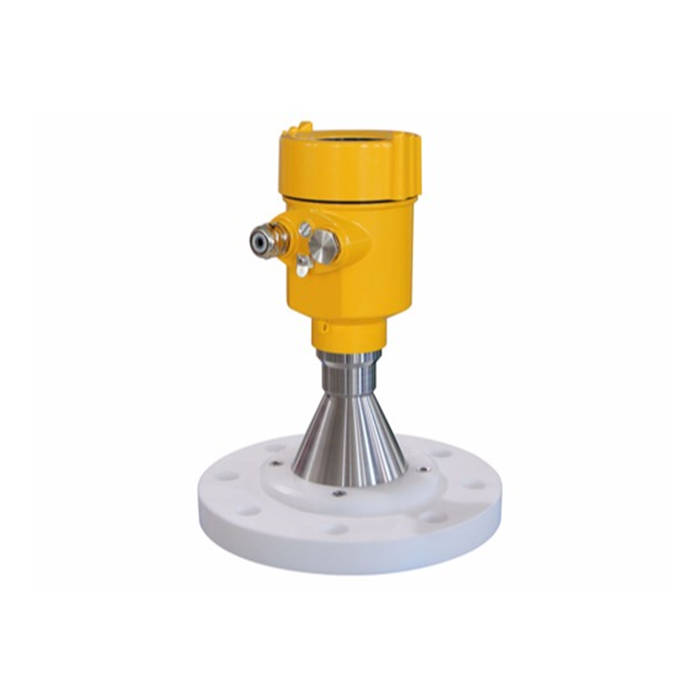
Industrial corrosion-resistant radar can use PTFE, PFA, PVDF or other chemically resistant materials, or corrosion-resistant process-seal designs combined with suitable metallic structures. The final material should be selected according to medium type, concentration, temperature and pressure.
| Selection Information | What to Confirm |
|---|---|
| Chemical Medium | Identify the specific chemical |
| Concentration | Different concentrations may require different material compatibility |
| Process Temperature | Higher temperature can affect chemical resistance |
| Process Pressure | Determines process connection, seal and mechanical rating |
| Vapor and Condensation | Evaluate antenna condensation and corrosive vapor exposure |
8. What Causes Inaccurate Radar Level Readings?
Abnormal radar readings should normally be analyzed from process conditions, mounting position, parameter configuration, echo behavior and output-loop status.
| Observed Condition | Common Inspection Direction |
|---|---|
| Measurement Remains Fixed | Check actual level, power supply, sensor status, echo tracking and output configuration |
| Large Difference From Actual Level | Check tank height, empty/full adjustment, reference plane, range and installation offset |
| Reading Jumps | Check internal obstacles, surface movement, filling streams and false echoes |
| Abnormal High-Level Measurement | Check nozzle reflections, near-range interference, antenna contamination and upper measurement settings |
| Abnormal Low-Level Measurement | Check low-dielectric medium, tank-bottom echo, conical bottom and zero-point settings |
9. How Should Power and 4–20mA Output Faults Be Checked?
If the radar transmitter has no output or the control system shows an abnormal value, first check the power supply, cable, terminals, safety barrier, isolator and PLC analog input module.
Smart 4–20mA radar transmitters may use high or low alarm currents to indicate measurement or device faults. The exact fault-current definition varies by manufacturer and model, so a current above 22mA or below 3.5mA should not automatically be interpreted as failure of a specific display or electronic module.
Troubleshooting should combine local diagnostic information, measured output current, echo curve and the product manual.
10. What Is a False Echo?
In addition to the actual liquid or material surface, radar can receive reflections from vessel walls, beams, heating coils, agitators, nozzles and other fixed structures.
Modern intelligent radar instruments often provide echo-curve analysis and false-echo suppression functions. During commissioning, the actual process level should be known and the learning range should be configured appropriately.
A suitable mounting position reduces the strength of fixed interference echoes, so mechanical installation and digital echo processing should be considered together.
11. What Should Be Checked When Radar Is Unstable in a Bulk-Solid Silo?
Bulk solids form sloped and changing surfaces and may generate dust, filling streams and moving material piles. Echo conditions are therefore more complex than those of a calm liquid surface.
Check whether the radar is aimed directly into the filling stream
Check whether the beam reaches the wall or structural beams
Verify range and bulk-solid parameters
Review echo curves at empty and normal material levels
Inspect the antenna for heavy dust or buildup
Optimize antenna direction according to the material surface angle
12. What Are the Main Advantages of Radar Level Measurement?
Non-Contact Measurement
The sensor normally does not remain immersed in the process medium, reducing mechanical wear and direct contamination.
Wide Application Range
Suitable models can be used in vacuum, pressurized, high-temperature, vapor-rich and dusty environments.
Suitable for Liquids and Solids
Can be applied to storage tanks, process vessels, powders and granular-material silos.
Relatively Low Maintenance
There are no continuously moving floats or weights, so routine maintenance focuses mainly on antenna and installation condition.
Digital Diagnostics
Selected smart radar models can provide echo curves, signal quality, device status and remote parameter configuration.
13. Is Radar Affected by Temperature, Pressure and Medium Changes?
Radar uses electromagnetic waves, so changes in temperature and pressure do not create distance errors through changes in the speed of sound as they can with ultrasonic measurement. This is one reason radar can be used in vacuum and across a wider range of process conditions.
The complete measurement system must still be selected for the required process temperature and pressure because these conditions affect the antenna, process seal, flange and mechanical structure. Dielectric properties, surface condition, foam, condensation and buildup can also influence echo quality.
14. What Should Be Checked After Installation and Commissioning?
| Inspection Item | What to Confirm |
|---|---|
| Mounting Position | The beam avoids the filling stream and major fixed obstacles |
| Measurement Reference | Tank height, reference plane, 0% and 100% settings are correct |
| Echo Condition | The true level echo is identified consistently |
| Output Signal | 4–20mA, HART or RS485 data matches the actual process level |
| Sealing and Cabling | Process connection, housing, cable glands and wiring are correctly restored |
FAQ
Q1: Must a radar level transmitter always be installed at least 200mm from the vessel wall?
A1: The required distance depends on radar beam angle, antenna design and vessel dimensions. Some models provide similar recommendations, but the final distance should follow the installation documentation of the selected product.
Q2: Do all 80GHz radar transmitters have a 1° beam angle?
A2: No. Beam angle varies with antenna size and construction. High-frequency radar generally provides a narrow beam, but the actual angle is product-specific.
Q3: Do all 80GHz radar transmitters provide 1mm accuracy?
A3: No. Measurement accuracy depends on instrument design, range and application conditions. Different 80GHz products can have significantly different accuracy specifications.
Q4: Can radar level transmitters be used for strongly corrosive acids and alkalis?
A4: Yes, when a suitable corrosion-resistant antenna, process seal and wetted-material configuration is selected. Medium type, concentration, temperature and pressure should be confirmed during selection.
Q5: Does an output current above 22mA mean the display module has failed?
A5: Not necessarily. Fault-current definitions vary by device and configuration. Local diagnostics and the specific product documentation should be used to determine the actual fault.
Q6: Is radar affected by foam?
A6: Yes. The effect depends on foam thickness, water content, medium properties, radar frequency and antenna design.
Q7: Is 80GHz radar suitable for bulk-solid silos?
A7: It is suitable for many powder and granular-material applications. The narrow beam helps avoid vessel walls and internal structures, while dust, surface angle, range and material reflectivity should still be considered.
Q8: Is false-echo learning required after installation?
A8: Where strong fixed reflections are present, echo learning or false-echo suppression can be used according to the instrument capabilities and commissioning procedure.
Conclusion
Long-term radar level measurement stability depends not only on the transmitter itself but also on mounting position, beam characteristics, nozzle geometry, vessel shape and process conditions. The primary radar beam should have a clear measurement path and should avoid filling streams and major fixed obstacles.
80GHz radar offers high frequency, short wavelength and narrow-beam characteristics that provide useful mounting flexibility in complex vessels and bulk-solid silos. Beam angle, accuracy, response time and measuring range remain product-specific specifications. Corrosive, high-temperature, pressurized, vapor-rich, condensation-prone and dusty applications should be matched with suitable materials, mechanical construction and process ratings.
METRAVON radar level measurement products can be configured according to process medium, measuring range, temperature, pressure, corrosiveness, dust, vapor and automation-interface requirements, with support for industrial interfaces such as 4–20mA and RS485 Modbus RTU for stable, compatible and scalable level measurement in storage tanks, process vessels and bulk-solid silos.