


 Chinese
 Spanish
 Russian
 Portuguese
 French
 German
 Indonesian
 Thai
 Vietnamese
 Arabic
 Italian
 Turkish
 Polish
 Japanese

A conduit can operate with a free surface during normal flow and become full during a storm or downstream restriction. Open-channel flowmeter selection must cover that transition. A successful reading in the part-full state does not qualify the instrument for a surcharged or fully pressurised condition.
Specify the hydraulic states, not only the pipe diameter
| State | Selection question |
|---|---|
| Part-full | Is there an accessible free surface and a suitable measurement section? |
| Near full | Does the mounting retain the required surface clearance and usable view? |
| Surcharged | Which instrument and method can report the required flow when the conduit fills? |
| Recovery | How is valid open-channel measurement re-established after the event? |
Provide expected upstream and downstream conditions, obstructions and possible backwater. Do not describe a station as open-channel solely because the pipe normally contains air. Include the events during which flow data are most important.
What MV-RD2480 measures
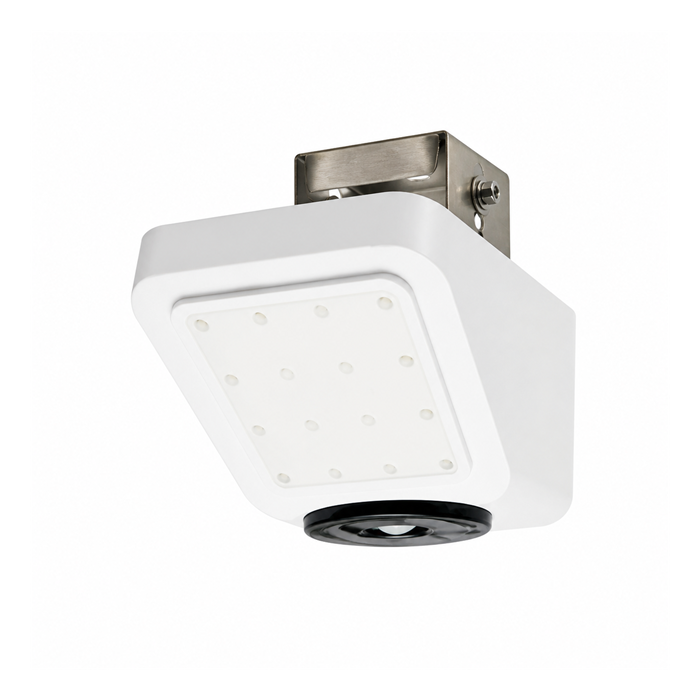
The METRAVON MV-RD2480 combines radar surface velocity with water-level measurement. Its catalogue lists RS485 with Modbus RTU and a 9-28 V DC supply. The measurement arrangement requires an appropriate free surface; it is not specified as a meter for flow inside a full pressurised pipe.
For velocity-area measurement, discharge depends on the wetted cross-sectional area and mean velocity. Surface velocity must be related to the cross-section's mean velocity through an appropriate validated method. Entering nominal diameter alone does not establish either the actual wetted area or that velocity relationship.
Open-channel flowmeter selection needs an explicit unavailable state
If a required flow condition is outside the proposed instrument's capability, resolve it before purchase. The project may need another measurement arrangement or a clearly defined gap in reported discharge. Do not extrapolate a part-full calculation into a full-pipe condition without a justified method.
Specify how the RTU, data logger and totaliser handle invalid inputs. An unavailable velocity should not silently become zero flow, particularly during a high-flow event. Identify whether accumulated volume pauses, is marked incomplete or uses another approved data source.
Acceptance at the measuring section
Survey the actual channel profile and measurement reference. Compare reported discharge with an appropriate independent method over the intended operating states. Include sediment and geometry changes in the inspection plan because they change the area associated with water level.
Q1. Can a covered channel still use non-contact radar?
Potentially, if a free surface and suitable mounting path remain available and the complete installation is qualified. A cover and a full conduit are different conditions.
Q2. Is a sensor's velocity range the station's flow range?
No. Discharge also depends on area, geometry and the relationship between measured surface velocity and mean flow. Establish the station range from the complete method.
Summary
Define the part-full, near-full and surcharge duties before selecting the meter. Submit the conduit section, expected water states and validation method for an MV-RD2480 review.
