


 Chinese
 Spanish
 Russian
 Portuguese
 French
 German
 Indonesian
 Thai
 Vietnamese
 Arabic
 Italian
 Turkish
 Polish
 Japanese


Bubbler water level faults can originate at the submerged outlet even though the pressure instrument is dry inside a cabinet. Before ordering a replacement transmitter, compare the reported pressure, an independent water-level observation and the condition of the gas path. A stable display alone does not establish that the system is measuring the current water head.
Use the symptom to choose the next check
A bubbler supplies gas through tubing to an immersed orifice. During correct operation, the measured pressure relates to the water depth above that outlet. The outlet elevation and the gas path are therefore part of the measurement, not accessories separate from the pressure sensor.
| Observed behaviour | Evidence to collect | What not to conclude yet |
|---|---|---|
| Reading remains fixed while an independent reference changes | Gas-supply status, raw pressure, record timestamps and the instrument's own diagnostic information | A fixed value does not prove either a clear outlet or a failed transmitter. |
| Persistent offset after a flood or channel work | Outlet position, mounting history and the station datum record | Do not recalibrate before checking whether the physical reference moved. |
| Response becomes slow or differs between rising and falling water | Timing against a reference, tubing condition and gas-system operating records | Lag alone does not identify the location or cause of a restriction. |
| Cabinet reading is credible but the remote record is wrong | Local value, transmitted variable, receiver scaling and timestamps | Do not replace the submerged tubing solely because the remote value is incorrect. |
These observations narrow the investigation; they are not a fault diagnosis by themselves. Use the installed manufacturer's inspection, leak-test and purge procedures. Do not increase gas pressure or flow to clear an unidentified blockage, and do not open pressurised lines without the required isolation.
Bubbler water level faults can be reference errors
In the simplified hydrostatic relationship, pressure difference equals liquid density multiplied by gravitational acceleration and depth above the outlet. The reported station level also needs the outlet elevation relative to the chosen datum. Practical instruments and installations may require additional corrections, so this relationship is not a universal field calibration procedure.
If maintenance moves the outlet, a formerly correct pressure-to-stage conversion may no longer apply. Compare its documented elevation with safe inspection or survey evidence. Where the outlet cannot be inspected, preserve that uncertainty instead of changing the transmitter zero to force agreement with one reading.
Separate pressure-instrument verification from gas-path verification. An approved pressure test can assess the instrument and receiving chain at its test point; it does not prove that the submerged orifice is correctly positioned, unobstructed or representative of the river section. Record where a test pressure was applied and which parts of the system were bypassed.
Check whether the site can support above-water radar
The METRAVON MV-RD12T uses 80 GHz radar to measure from above the water. It is an alternative to assess when submerged-outlet maintenance is difficult. It does not connect to the bubbler tube, and the location of the old instrument cabinet does not establish a suitable radar measurement position.
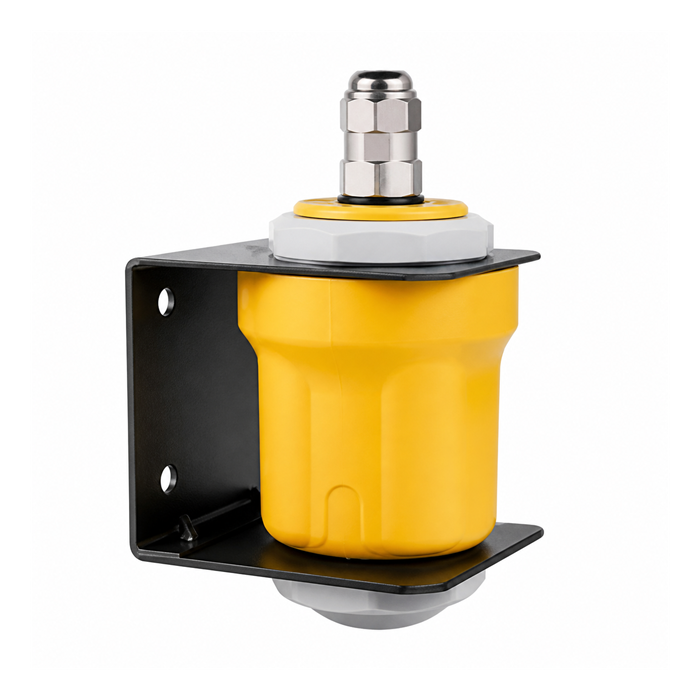
Provide the proposed mounting height, highest and lowest surfaces, nearby steelwork and the normal flow pattern. The beam needs a suitable view of the water rather than the falling stream, dense foam or a structural edge. Position and access must remain suitable through the site's expected operating conditions; an enclosure protection rating does not establish normal radar measurement while its antenna is submerged.
Specify the electrical version for the station's actual supply and receiver. MV-RD12T has separately selected analogue and digital arrangements; an existing pressure-transmitter input is not evidence of compatibility with every radar option. For an RTU integration, request the applicable wiring, variable interpretation, invalid-value indication and timing requirements.
Keep the station datum, establish a new sensor reference
Survey the radar reference against the station datum and calculate level from that geometry. Keep the old outlet record for traceability. Where an authorised overlap is practical, compare both instruments with the same independent reference at more than one safely available level. Resolve an apparent discrepancy in reference height or timing before joining their data histories.
Questions before a repair or conversion
Q1. Does stable pressure prove that the orifice is clear?
No. Confirm that the value is current, then examine the gas system and the outlet using the approved procedure. Pressure stability without a changing-water comparison or gas-path evidence cannot establish that the reading represents current water head.
Q2. Can the radar retain the bubbler's zero setting?
It can report against the same station datum, but its physical reference is above the water rather than at the submerged outlet. Establish the new reference height and verify the sign, units and receiver calculation. Copying the old offset without that conversion can produce a believable but incorrect stage record.
Summary
Repair the identified fault rather than treating every wrong level as a pressure-transmitter failure. For an MV-RD12T conversion review, provide the station section, outlet and datum history, proposed radar location, power supply and receiving interface. These details determine whether conversion is practical and what installation work belongs in the quotation.
