


 Chinese
 Spanish
 Russian
 Portuguese
 French
 German
 Indonesian
 Thai
 Vietnamese
 Arabic
 Italian
 Turkish
 Polish
 Japanese



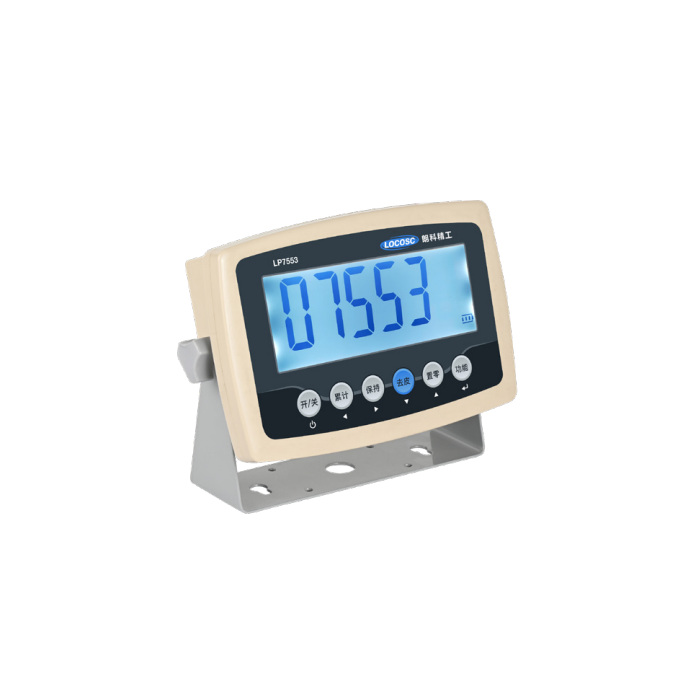
METRAVON MV-WI0011 is a large-display weighing indicator with 3.3 V bridge excitation and a -6 to +19.5 mV input interval. It is specified for one to four 350-ohm analogue sensors and a six-digit 50 mm LED or backlit LCD display configuration. The lower bridge voltage is an important replacement check even when another indicator has a similar signal range or front-panel appearance.
Evaluate a 5 V to 3.3 V indicator change at the sensor
Confirm that the installed sensors permit 3.3 V excitation and calculate their expected millivolt signal using the actual sensitivity and working load. Include tare and the useful increment, not only the greatest positive signal accepted by the instrument. A common input interval does not mean that two indicators excite the bridge identically. After any substitution, the previous calibration settings are not evidence that the displayed mass or output data remain correct.
| Item | Value | Selection notes |
|---|---|---|
| Input interval / bridge voltage | -6 to +19.5 mV / 3.3 V DC | A similar millivolt range does not prove compatibility with a 5 V installation. |
| Sensor drive reference | One to four 350-ohm cells | Confirm actual resistance, wiring and acquisition arrangement. |
| Display alternatives | Six-digit 50 mm LED or LCD | Require the supplied display technology and enclosure drawing. |
| Battery reference | 4 V / 4 Ah | Not interchangeable by assumption with a 6 V battery model. |
| Continuous-use reference | 40 hours with four 350-ohm sensors | Check the delivered battery, display and accessory duty. |
| Serial options | RS232 / RS485, up to 9600 baud | Printing shares serial; confirm port allocation and actual data format. |
Specify the actual large-display enclosure and mounting
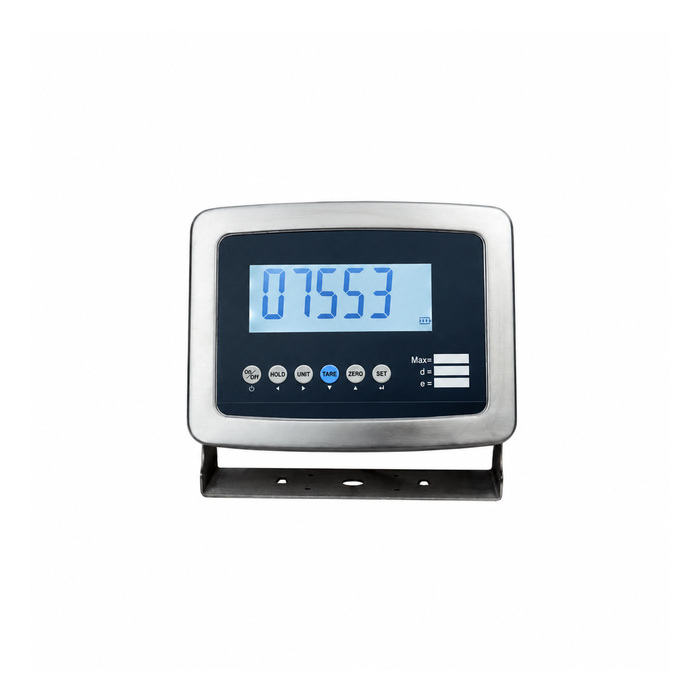
The reference describes 50 mm digits, but the gallery includes more than one enclosure appearance. Confirm display technology, keys, bracket and the rated mechanical drawing for the supplied version. The illustrated 220 mm front width, 85 mm depth reference and 175 mm bracket-height reference are preliminary fit information, not a universal panel cut-out. Check the operator sight line and key access on the real mounting. No outdoor rating or cleaning method can be inferred from an alternative metal-looking housing.
Check the serial role before choosing accessories
RS232 and RS485 options and a BLE interface are described, with selectable serial rates up to 9600 baud. Printing shares the serial connection in the reference arrangement. State whether the serial port will serve a printer, host software or a remote display, and have simultaneous requirements assigned to actual supplied ports. Do not assume that the RS485 option defines Modbus RTU or that BLE provides an application, remote database or cloud service. Obtain the message or service description and test the intended receiver.
Assess the 4 V battery configuration for the intended shift
The internal lead-acid reference is 4 V/4 Ah, with a 40-hour continuous-use figure under a four-cell 350-ohm load. Keep that configuration separate from the 6 V battery and runtime stated for other large-display models. Confirm battery access, charging and the actual mains-input version with the offer. Include backlight and communication use when agreeing practical operating reserve. A similar charging socket or bracket does not establish interchangeable power components.
Verify the installed division and the operator reading state
Display counts are listed as 15,000, internal counts as 1,000,000 and minimum signal as 1 microvolt per verification interval. The separate n = 5,000 reference is not the same as a display-count setting or a certificate for the completed scale. Select a useful division, then verify repeat readings and unloading return against the agreed reference. Check gross/net and held-value behaviour with the operator and confirm that a printed or transmitted result represents the intended reading rather than an old display state.
The MV-WI0010 large-display configuration lists 5 V excitation and different power and option details. Use the comparison to check the actual sensor circuit, not to assume direct interchangeability.
Excitation changes, enclosure versions and shared serial use
Q1. Can it replace a 5 V indicator because the input interval matches?
Check the sensor permitted excitation and the resulting signal per useful division first. Then verify wiring, power and the installed calibration. Matching the input endpoints alone does not establish a suitable replacement.
Q2. Will a metal enclosure photograph establish washdown suitability?
The actual enclosure, sealing, cable entries and cleaning limits must be specified. A material appearance or a large display is not evidence of an ingress rating.
Q3. Can a 6 V battery from another large-display unit be used?
Do not substitute it without the approved power specification. This reference battery is 4 V/4 Ah, and the charge and supply arrangements must match the delivered instrument.
Q4. What must be confirmed for a serial printer and PLC?
State whether both must work simultaneously and obtain the fitted port allocation and message documentation. A shared serial-printer description does not establish two independent connections or a PLC protocol.
