


 Chinese
 Spanish
 Russian
 Portuguese
 French
 German
 Indonesian
 Thai
 Vietnamese
 Arabic
 Italian
 Turkish
 Polish
 Japanese

Guided wave radar cable anchoring should be decided from the forces on the complete installation. Restraining a cable may reduce movement, but it also creates a load path between the upper connection and the lower attachment. A bottom fixing is therefore not a default accessory for every tall vessel.
Guided Wave Radar Cable Anchoring: What Changes Mechanically?
A hanging weight, a lateral guide and a fixed anchor perform different jobs. A weight adds tension through gravity; a guide can limit sideways travel while allowing some axial movement; a fixed anchor restrains the termination. The actual freedom of movement depends on the approved hardware. Do not treat these arrangements as interchangeable on a purchase drawing.
| Load | Site information | Design question |
|---|---|---|
| Self-weight | Cable length, terminal mass and installed orientation. | Can the top connection carry the suspended assembly? |
| Process drag | Filling jet, agitation, solids movement and discharge pattern. | What axial and lateral forces can reach the probe and nozzle? |
| Movement | Thermal expansion and relative movement of roof and base. | Will the restraint permit movement without excessive tension or slack? |
| Deposits | Adhering material, bridging and expected cleaning method. | Could accumulated material load the cable beyond the approved arrangement? |
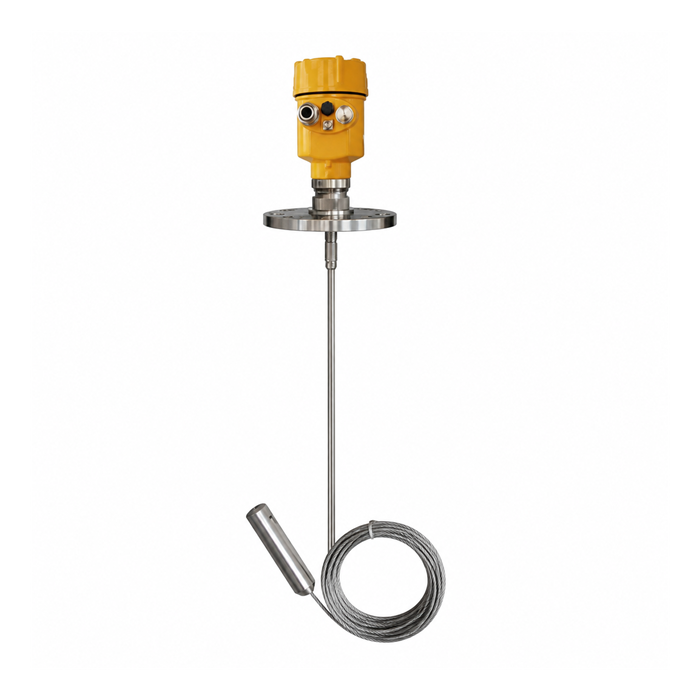
A cable-length rating does not establish an allowable tensile load. The METRAVON MV-RD701 lists cable lengths up to 30 m, but that figure alone cannot approve an anchor, nozzle or support structure. Obtain the allowable loads and termination details for the exact probe offered.
Release the Probe and Vessel Drawings Together
Show the top mounting plane, bottom attachment, finished cable length, nearby internals and removal route on one drawing. The instrument supplier should review the probe arrangement; the vessel designer should confirm the structural attachments. Neither review substitutes for the other.
For solids, include discharge behaviour rather than only bulk density and maximum level. Uneven movement or bridging can impose loads that a static empty-vessel inspection will not reveal. Where acceptable loads cannot be established, assess a non-contact method instead of adding an unverified anchor.
Before commissioning, check the installed clearances and restraints against the approved drawing. Record the empty-vessel condition, then compare measurement and mechanical behaviour during a controlled operating cycle from a safe observation position. Vessel entry and adjustment require the site's isolation and access procedures.
Questions Before Ordering a Cable Probe
Q1. Can an existing bracket serve as the lower anchor?
Only after its location, strength, material and movement allowance have been assessed. A bracket suitable for a previous instrument may impose the wrong tension or geometry on the replacement. Submit its drawing and photographs with the proposed probe details.
Q2. Should the cable be pulled tight to stop unstable readings?
Not without the manufacturer's installation limits. First establish whether the instability comes from movement, contact with an internal part, deposits or signal configuration. Adding tension can increase mechanical risk without correcting the measurement problem.
Summary
Approve anchoring as part of a mechanical design, not as a field remedy chosen after installation. For an MV-RD701 application review, send the vessel drawing, cable length, material movement and proposed attachment details so the probe and supporting structure can be checked together.
