


 Chinese
 Spanish
 Russian
 Portuguese
 French
 German
 Indonesian
 Thai
 Vietnamese
 Arabic
 Italian
 Turkish
 Polish
 Japanese


Fertilizer silo level measurement becomes difficult when the material stops behaving like the dry, free-flowing product used during commissioning. Moisture ingress, fines and long storage can change the pile, create wall deposits or restrict discharge. A trustworthy level reading still needs to be interpreted against those changes.
Fertilizer Silo Level Measurement After Humid Weather or Shutdown
Record the fertilizer grade, additives, moisture conditions and storage duration. Urea granules and different compound fertilizers should not share an assumed corrosion or flow characteristic merely because they use adjacent silos. Obtain the actual product and cleaning information for the materials review.
| Symptom | Inspect | Response |
|---|---|---|
| Fixed echo | Deposits in the nozzle or on the antenna face. | Record the as-found condition before cleaning or changing parameters. |
| No discharge | Gate, feeder and evidence of caking above the outlet. | Use the approved blockage procedure; do not infer flow from surface level. |
| Stock bias | Grade, fines, density and the remaining wall buildup. | Review the inventory model against weighed movements. |
| Weather link | Roof leaks, condensation and moist stagnant pockets. | Correct the source of moisture rather than relying only on frequent lens cleaning. |
Use a Model Specification Without Extending It to Every Chemical
The METRAVON MV-RD21 has a 76 mm PTFE lens and is designed for bulk-solids level measurement. The lens material does not settle the compatibility of seals, flange, bracket, housing or cable entries with fertilizer dust and condensate. Submit the complete chemical exposure for review.
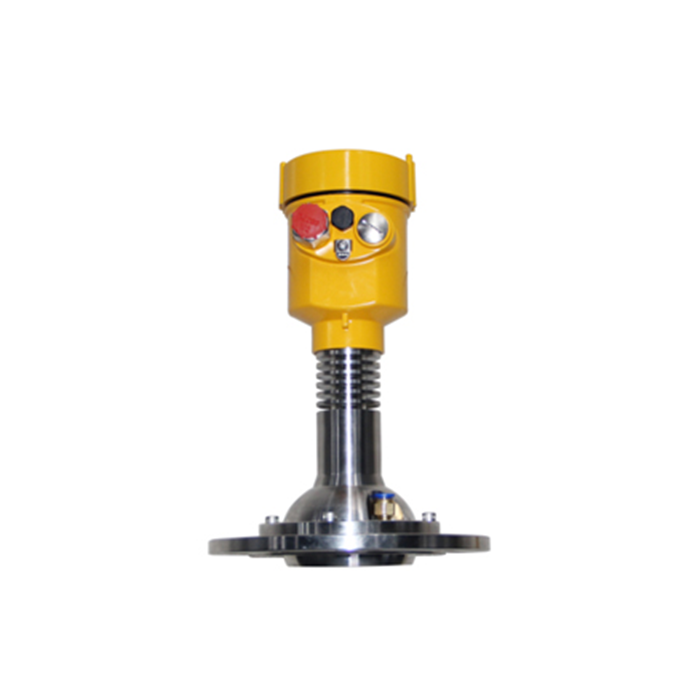
State the normal and maximum material temperature and pressure changes during filling. Select the actual construction and output from the offered configuration. Any hazardous-area requirement must come from the site assessment and be matched by the ordered equipment documents; it should not be copied from an unrelated fertilizer installation.
Keep the Antenna Clear Without Creating a New Dust Trap
Locate the sensor away from the falling stream and places where damp powder collects. Show the nozzle bore and length, including reducers and internal ledges. A bracket or protective plate placed across the beam can introduce a stronger fixed target than the product surface.
Observe filling and discharge before selecting damping. A jump can be a collapsing pile, a change of echo or actual movement of the surface. Save the echo and process state so the cause can be checked. Increasing filtering until the display stops moving may delay a real high-level warning.
Set the early inspection interval from the expected deposit risk, then revise it using actual findings. Record whether the face was dry, coated or wet and whether the reading recovered after the approved cleaning procedure. This makes maintenance evidence useful for deciding whether the installation or the process needs correction.
What the Level Can and Cannot Tell the Operator
For refill control, allow space for material already in the conveying system and for the local pile peak. For stock reporting, identify the density and pile assumptions. For discharge protection, use suitable feeder or flow evidence. These functions can share information, but they should not hide each other's uncertainty.
Compare receipts and consumption by fertilizer grade at matching times. A conversion accepted for dry granules may no longer represent damp, compacted material. Preserve the raw distance when changing a stock calculation, and avoid using a level offset to absorb differences caused by density or inaccessible deposits.
Maintenance Questions
Q1. Should a recurring deposit be removed from the echo map?
Do not mask an unverified target just because it is inconvenient. A deposit can grow into the useful measuring region, and broad suppression can hide the real material surface. Establish the physical cause and correct the nozzle or cleaning issue before reviewing the approved echo settings.
Q2. Can the high reading be trusted when the feeder is empty?
It may be a valid measurement of material above a bridge. Check outlet conditions and the designated flow evidence. Do not enter or disturb the silo based on the radar indication; follow the plant's isolation and blocked-material procedures.
Q3. What information helps assess a replacement?
Provide photographs of the as-found deposits, the existing nozzle section, fertilizer grades, seasonal conditions and saved echo traces. Add the output requirement and maintenance access. This is more useful than requesting another device with the same nominal range.
Summary
Fertilizer level monitoring should remain interpretable after the product and weather change. Submit the material and deposit history for an MV-RD21 installation review. Combine a verified surface signal with separate evidence for flow and a stated basis for estimated stock.
