Chinese
 Spanish
 Russian
 Portuguese
 French
 German
 Indonesian
 Thai
Thai Vietnamese
 Arabic
 Italian
 Turkish
 Polish
 Japanese
Engineering Summary
Ultrasonic and radar level instruments are both used for non-contact level measurement, but they rely on different physical principles. Ultrasonic instruments use mechanical sound waves and therefore depend on the gas path between the sensor and the product surface. Radar uses electromagnetic waves and does not require air as the propagation medium. As a result, radar generally offers a wider operating envelope in vacuum, high temperature, vapor, dust, and complex vessel geometry. However, radar can still be affected by foam, condensation, low dielectric constant, and antenna buildup.
Table of Contents
The Fundamental Difference Between Ultrasonic and Radar
| Item | Ultrasonic Level Instrument | Radar Level Instrument |
|---|---|---|
| Measurement Signal | Mechanical sound wave | Electromagnetic wave / microwave |
| Propagation Medium Required | Requires air or another gas | Does not depend on air; can propagate in vacuum |
| Typical Measurement Principle | Acoustic time of flight | Pulse ToF or FMCW |
| Temperature Influence | More significant; sound-speed compensation is required | Usually less sensitive, but instrument temperature limits still apply |
| Pressure / Vacuum | Cannot operate normally in ideal vacuum | Can be used in vacuum; pressure rating is model specific |
| Dust | Dense dust can attenuate sound | Usually more suitable, but extreme dust still requires evaluation |
| Beam Angle | Often relatively wide | High-frequency radar can provide a narrow beam |
| Complex Vessel Internals | Requires a clear acoustic path | 80 GHz narrow-beam radar often has an advantage |
How Does Ultrasonic Level Measurement Work?
An ultrasonic level sensor transmits high-frequency sound waves through the gas space above the product. The sound reflects from the liquid or solids surface and returns to the receiver.
d = v × t / 2
where d is distance, v is sound velocity in the gas, and t is round-trip propagation time.
The important point is that sound velocity is not perfectly constant under all field conditions. It changes with temperature and gas composition, which is why industrial ultrasonic instruments normally use temperature compensation.
How Does Radar Level Measurement Work?
Radar transmits microwave electromagnetic signals toward the liquid or solids surface and analyzes the reflected echo.
Microwave Transmission → Product Surface Reflection → Echo Reception → Signal Processing → Distance Calculation → Level Conversion
For pulse radar:
d = c × t / 2
For FMCW radar, distance is derived from the frequency difference between the transmitted sweep and the delayed return signal.
“26 GHz” and “80 GHz” describe operating frequency. “Pulse” and “FMCW” describe the measurement and signal-processing method.
Performance Comparison
| Process Condition | Ultrasonic | Radar |
|---|---|---|
| Simple Water Tank | Suitable | Suitable |
| Open Basin | Suitable | Suitable |
| Vacuum Vessel | Not suitable | Can be evaluated |
| High-Temperature Vapor | More strongly affected | Usually worth prioritizing |
| High-Dust Silo | Sound attenuation can be significant | Usually more suitable |
| Thick Foam | May detect the foam surface or lose echo | Also requires foam-specific evaluation |
| Narrow Vessel | Wide beam may interact with walls | 80 GHz narrow beam is advantageous |
| Complex Internals | Interference reflections are more difficult | Narrow-beam radar can avoid obstacles more easily |
| Long-Range Silo | Range must be carefully evaluated | High-performance radar is often more suitable |
| Simple Cost-Sensitive Application | Often cost-effective | Usually higher cost |
How Does Temperature Affect the Two Technologies?
Ultrasonic measurement depends on the speed of sound in the gas path. Because sound velocity changes with temperature, incorrect compensation can create distance errors.
Radar electromagnetic propagation is much less sensitive to normal gas-temperature variation, but the radar instrument itself still has ambient-temperature, process-temperature, seal, and electronics limits.
Pressure and Vacuum Conditions
Vacuum
Ultrasonic waves require a material medium such as air or gas. In ideal vacuum, sound does not propagate normally. Radar electromagnetic waves can propagate in vacuum.
Pressure
For pressurized vessels, instrument mechanical design is critical. Confirm maximum process pressure, flange pressure class, seals, and any required approvals.
How Does Foam Affect Measurement?
It is incorrect to assume that radar always passes through foam while ultrasonic always fails.
Ultrasonic and Foam
Foam can absorb, scatter, or reflect acoustic energy. Thick foam can significantly reduce the true liquid-surface echo.
Radar and Foam
Radar performance depends on foam thickness, moisture content, bubble size, density, operating frequency, and liquid dielectric properties. In some cases, radar may detect the top of the foam rather than the liquid surface below it.
For thick-foam applications, define whether the required measurement target is the true liquid interface or the top surface of the foam.
Which Technology Is Better for Dusty Silos?
High concentrations of cement dust, mineral powder, coal dust, or grain dust can attenuate and scatter ultrasonic energy.
Radar is generally more suitable for dense dust, although extreme dust, antenna buildup, and low-dielectric products can still reduce radar echo quality.
For difficult bulk-solids silos, 80 GHz narrow-beam radar is often worth evaluating first.
Steam and Condensation
Hot vessels can produce vapor, temperature gradients, high humidity, and condensation. These conditions can significantly affect ultrasonic sound velocity and acoustic energy transmission.
Radar is therefore often preferred in strong vapor service, but severe condensation on the radar antenna can still reduce echo quality or create false echoes.
Why Is Beam Angle Important?
Neither ultrasonic nor radar is an infinitely thin line. Both create a beam or measurement cone. Tank walls, beams, ladders, agitators, coils, and filling pipes inside that beam can create unwanted reflections.
One of the main advantages of 80 GHz radar is its ability to form a narrow beam with suitable antenna design. This is especially useful for small-diameter tanks, reactors, narrow silos, and mounting positions close to the vessel wall.
How Should Range and Accuracy Be Compared?
Do not treat fixed numbers such as “ultrasonic 50 m” or “radar 70 m” as universal industry limits. Actual range depends on the specific model and process conditions.
Ultrasonic range depends on acoustic power, frequency, temperature, dust, vapor, target area, and surface angle.
Radar range depends on operating frequency, antenna gain, dielectric constant, solids surface geometry, dust, signal processing, and installation structure.
The correct engineering question is: What is the effective range of this specific model in my actual medium and process conditions?
Is Radar Always More Accurate Than Ultrasonic?
High-performance FMCW millimeter-wave radar can achieve excellent resolution and millimeter-level accuracy, but not every radar is more accurate than every ultrasonic instrument.
For simple water tanks, ultrasonic measurement may fully satisfy the required accuracy. Radar typically offers more advantages in high-accuracy tanks, complex silos, and demanding process control.
26 GHz vs. 80 GHz Radar
| Item | 26 GHz Radar | 80 GHz Radar |
|---|---|---|
| Technology Maturity | Mature | Mature and widely used |
| Beam Angle | Typically wider | Typically narrower |
| Antenna Size | Relatively larger | Can be smaller |
| Simple Large Tanks | Suitable | Suitable |
| Small Vessels | Beam clearance must be evaluated | Often advantageous |
| Complex Internals | Mounting position is more critical | Narrow beam often has an advantage |
| Bulk Solids Silos | Applicable | Complex silos often favor 80 GHz evaluation |
Installation Differences
Ultrasonic Installation
Aim the sensor approximately perpendicular to the product surface.
Avoid filling streams.
Avoid walls and internal structures.
Consider temperature compensation.
Keep the transducer face clean.
Avoid severe vapor and strong gas-flow zones.
Radar Installation
Avoid direct alignment with the filling stream.
Use beam angle to avoid walls and internal structures.
Prevent severe antenna contamination and condensation.
Check nozzle geometry.
Configure empty and full calibration correctly.
Perform false-echo mapping where required.
Typical Industrial Applications
1. Simple Water Tanks and Open Basins
Both ultrasonic and radar can be considered depending on budget, required accuracy, and communication interface.
2. Cement, Mineral Powder, and Coal Silos
Radar is generally preferred for heavy dust, long range, irregular solids surfaces, and complex silo geometry.
3. Chemical Tanks and Reactors
Radar Level Transmitter → 4–20 mA/HART → PLC / DCS
4. Small-Diameter Tanks
80 GHz narrow-beam radar or guided wave radar should be evaluated where wall clearance is limited.
5. Multi-Silo Remote Monitoring
Radar Level Transmitters → RS485 Modbus RTU → RTU / Industrial Gateway → 4G / Ethernet → SCADA / IoT
PLC, RTU, and Industrial Gateway Integration
4–20 mA
Level Transmitter → 4–20 mA → PLC AI / DCS
4–20 mA/HART
Radar Level Transmitter → 4–20 mA/HART → PLC / DCS / HART System
RS485 Modbus RTU
Level Instrument → RS485 Modbus RTU → PLC / RTU / Industrial Gateway
Radar → RS485 → Gateway → 4G / Ethernet → MQTT / HTTP → SCADA / Customer Server
Engineering Selection Table
| Project Condition | Technology to Evaluate First | Reason |
|---|---|---|
| Simple Open Basin | Ultrasonic or radar | Both can work in simple conditions |
| Simple Water Tank | Ultrasonic or radar | Select by cost, accuracy, and interface |
| Vacuum Vessel | Radar | Ultrasonic requires a propagation medium |
| High-Temperature Vapor | Radar | Ultrasonic is more sensitive to gas-path conditions |
| High-Dust Silo | Radar | Acoustic attenuation is usually more severe |
| Small-Diameter Tank | 80 GHz radar or guided wave radar | Narrow beam or guided propagation reduces wall interference |
| Complex Reactor | 80 GHz radar / guided wave radar | Depends on internals and medium |
| Thick Foam | Application-specific evaluation | Both technologies can be affected |
| Simple Cost-Sensitive Project | Ultrasonic | Can offer cost advantages in suitable conditions |
| Long-Term Difficult Process | Radar | Generally offers a wider process envelope |
What Information Should Be Provided Before Selection?
| Selection Item | Required Information |
|---|---|
| Medium | Liquid, powder, granules, slurry, and exact product name |
| Range | Maximum distance to the lowest product surface |
| Vessel Size | Height, diameter, shape |
| Temperature | Ambient and process temperature |
| Pressure | Atmospheric, pressurized, or vacuum |
| Dust | Whether heavy suspended dust is present |
| Foam | Thickness, persistence, moisture content |
| Vapor / Condensation | Whether continuously present |
| Internals | Agitators, coils, ladders, filling pipes |
| Process Connection | Thread, flange, size |
| Output | 4–20 mA, HART, RS485 Modbus RTU |
| Control System | PLC, DCS, RTU, SCADA, industrial gateway |
FAQ
Q1: Which is more accurate, ultrasonic or radar?
High-performance radar can provide higher resolution, but actual accuracy must be compared model by model.
Q2: Can ultrasonic measurement be used in vacuum?
Normally no. Ultrasonic waves require a gas or other material medium. Radar electromagnetic waves can propagate in vacuum.
Q3: Is radar completely unaffected by foam?
No. Thick or wet foam can attenuate or reflect radar signals. In some cases, radar measures the foam surface.
Q4: Why is ultrasonic less suitable for high-dust silos?
Dense suspended dust can absorb and scatter acoustic energy, reducing the usable echo.
Q5: Can radar be used in vacuum and high pressure?
Radar signals can propagate in vacuum, but the instrument’s mechanical pressure rating, seals, and process connection must match the vessel.
Q6: Does ultrasonic measurement require temperature compensation?
Usually yes, because the speed of sound changes with temperature.
Q7: Why is 80 GHz radar suitable for small tanks?
Its shorter wavelength allows narrow-beam antenna designs that reduce reflections from nearby vessel walls.
Q8: Is radar always necessary for a simple water basin?
No. If the process is simple and there is no severe vapor, foam, or temperature gradient, ultrasonic measurement can be a cost-effective solution.
Q9: Can both ultrasonic and radar connect to a PLC?
Yes, depending on the product interface. Common options include 4–20 mA and RS485 Modbus RTU, while many radar instruments also support HART.
Q10: Should ultrasonic and radar be compared mainly by price?
No. First confirm process suitability, then compare range, accuracy, installation, communication interface, maintenance, and life-cycle cost.
Conclusion
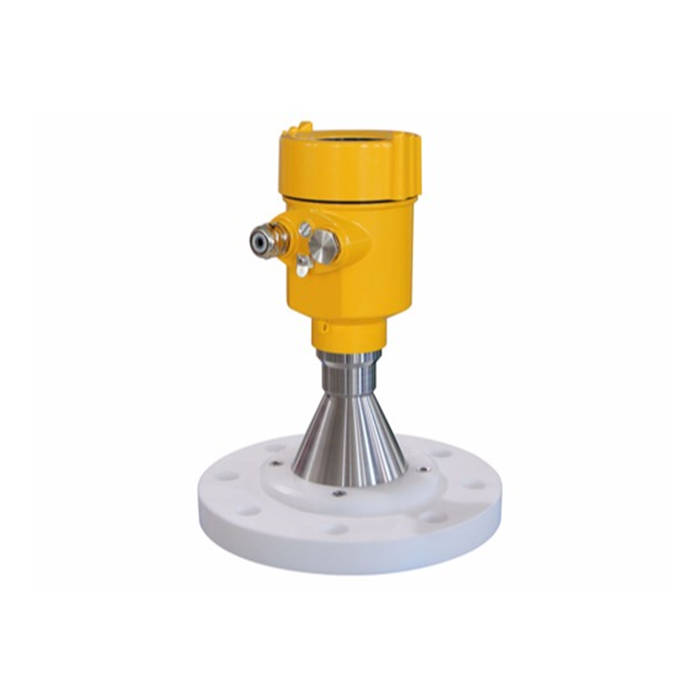
Ultrasonic and radar are both non-contact level technologies, but their propagation physics create different application limits. Ultrasonic is cost-effective for many simple tanks and basins. Radar generally offers a wider process envelope for vacuum, dust, high temperature, vapor, complex vessel internals, and long-range bulk solids applications.
Correct selection should consider medium, range, temperature, pressure, foam, dust, vapor, vessel geometry, installation space, accuracy, and communication interface before choosing ultrasonic, 26 GHz radar, 80 GHz radar, guided wave radar, or another level technology.
METRAVON Industrial Level Measurement Selection
For project evaluation, provide the medium, liquid or solid state, maximum measurement distance, vessel or silo dimensions, process temperature and pressure, vacuum conditions, foam, vapor, dust, condensation conditions, internal structures, process connection, communication interface, host system, and site photos or drawings.