Chinese
 Spanish
 Russian
 Portuguese
 French
 German
 Indonesian
 Thai
Thai Vietnamese
 Arabic
 Italian
 Turkish
 Polish
 Japanese
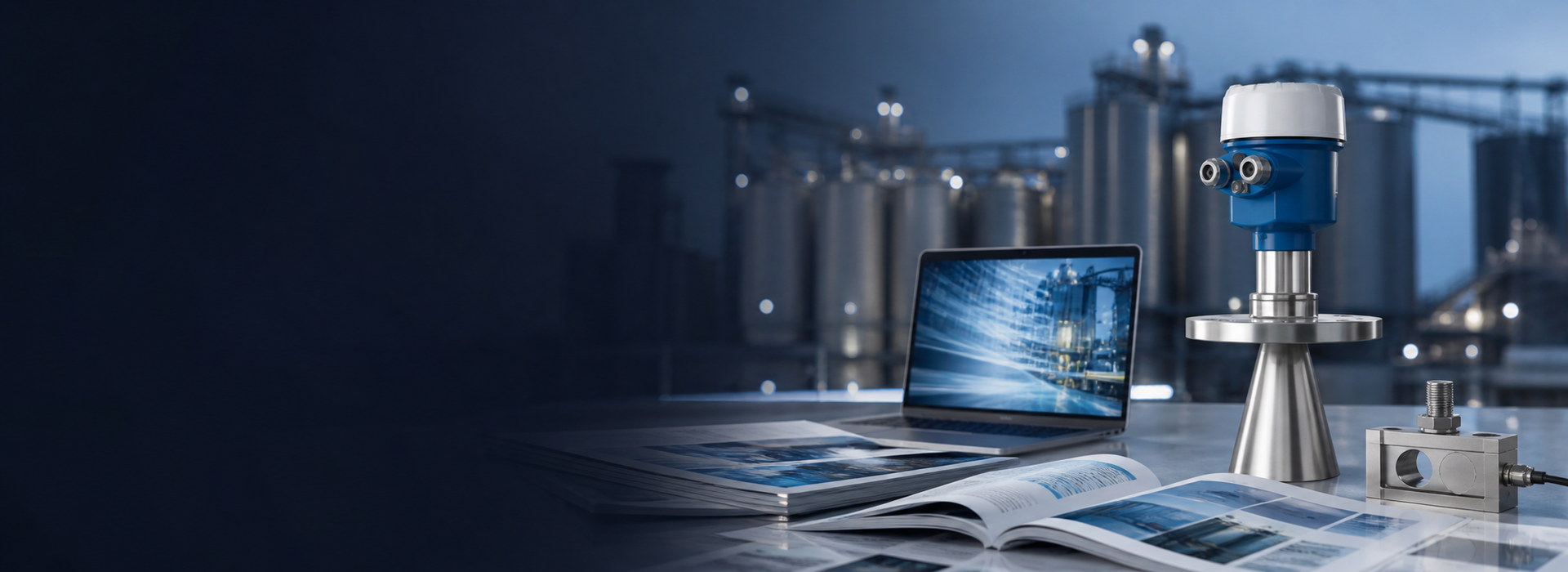
External-mounted level gauges and radar level gauges can both be used for continuous tank level measurement, but their signal paths and installation requirements are fundamentally different. An external-mounted level gauge normally uses ultrasonic energy transmitted through the vessel wall and into the liquid, with the main advantage that no new process opening is required. A radar level gauge transmits electromagnetic waves from the top of the vessel toward the liquid surface and is generally more suitable for long measuring ranges, complex vessels, and both liquid and solid level applications. Therefore, selection should not be based only on accuracy or price. More important factors include whether the vessel can be opened, vessel wall construction, media properties, temperature, pressure, and actual installation conditions.
1. What Is the Main Difference Between an External-Mounted Level Gauge and a Radar Level Gauge?
External-Mounted Level Gauge
Signal path: Sensor → Vessel wall → Liquid → Liquid surface → Echo
The sensor is mounted on the outside of the vessel and does not enter the vessel or directly contact the process medium.
Main advantage: No additional process opening is normally required, making it suitable for existing tanks, sealed vessels, and hazardous media.
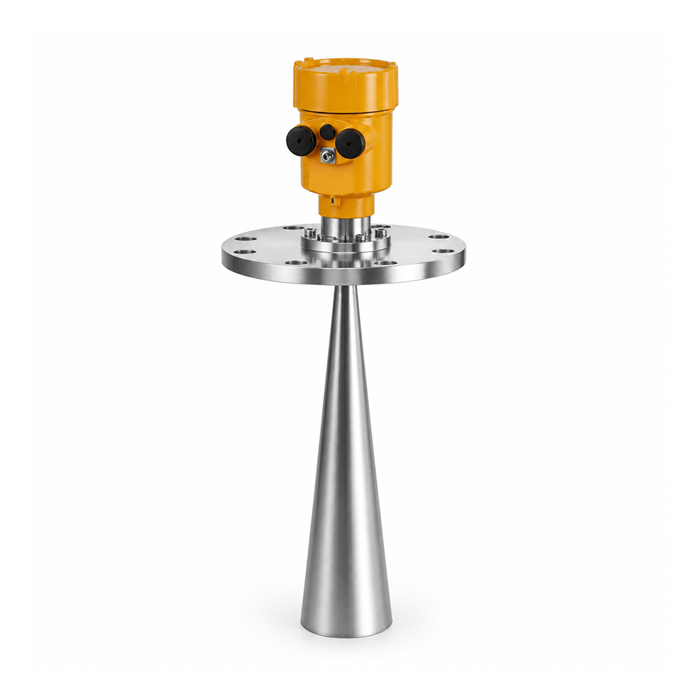
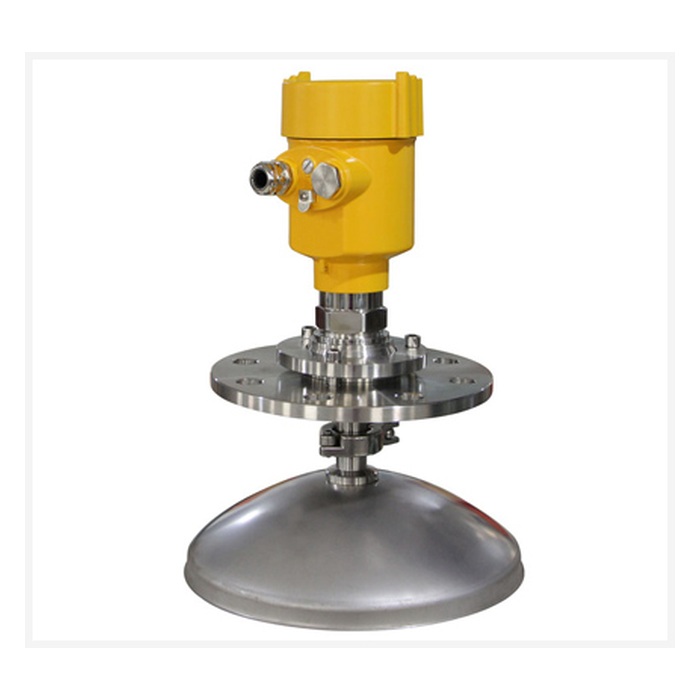
Radar Level Gauge
Signal path: Antenna → Electromagnetic wave → Liquid surface → Reflected echo
The instrument is normally installed at the top of the tank through a threaded connection, flange, or mounting nozzle.
Main advantage: Broad application range, suitable for liquids, slurries, powders, granules, and many solid level applications.
Technically, an external-mounted level gauge is more accurately described as a non-intrusive level measurement device. The sensor is physically attached to the outside of the vessel, but it does not enter or contact the process medium. Free-space radar, by comparison, is a true non-contact level measurement technology.
2. Quick Comparison: External-Mounted Level Gauge vs. Radar Level Gauge
| Item | External-Mounted Level Gauge | Radar Level Gauge |
|---|---|---|
| Measuring principle | Ultrasonic / acoustic propagation | Electromagnetic radar measurement |
| Installation position | Outside vessel wall | Normally on top of the vessel |
| Contact with process medium | No | No for free-space radar |
| Additional tank opening required | Normally no | Normally requires an available top connection |
| Sensitivity to vessel wall | High | Usually not a primary limitation |
| Liquid measurement | Suitable when acoustic conditions are appropriate | Widely applicable |
| Solid level measurement | Usually not the first choice | Widely used |
3. When Is an External-Mounted Level Gauge More Suitable?
The vessel cannot be opened
For vessels already in operation without spare instrument connections, an external-mounted solution can avoid modifying the existing pressure boundary.
Existing tank retrofit
It can reduce the need for tank draining, cutting, welding, shutdown, and other modification work.
Hazardous or corrosive liquids
The sensor does not contact the process medium, reducing concerns related to wetted material corrosion, leakage, and maintenance.
Pressurized sealed vessels
Because the sensor is mounted outside the vessel, it does not directly withstand internal process pressure.
The main value of an external-mounted level gauge is usually not that it provides higher accuracy than every other technology. Its key advantage is the ability to provide continuous level measurement without penetrating the vessel or contacting the process medium.
4. Why Can an External-Mounted Level Gauge Not Be Used on Every Tank?
The ultrasonic signal must pass through the vessel wall and then propagate through the liquid. As a result, external-mounted ultrasonic level measurement is relatively sensitive to both vessel construction and media conditions. The following factors should be checked before selection.
Vessel wall material
Carbon steel and stainless steel can normally be evaluated. Special non-metallic or composite materials require confirmation for the specific instrument.
Wall thickness
Wall thickness affects ultrasonic transmission and signal attenuation. The actual wall thickness should be provided for thick-wall pressure vessels.
Double-wall or multilayer construction
Vacuum gaps, air layers, loose linings, and composite structures can significantly interfere with acoustic transmission.
Bubbles and sediment
Large amounts of bubbles, sediment, crystallization, or suspended solids may scatter or attenuate the ultrasonic signal.
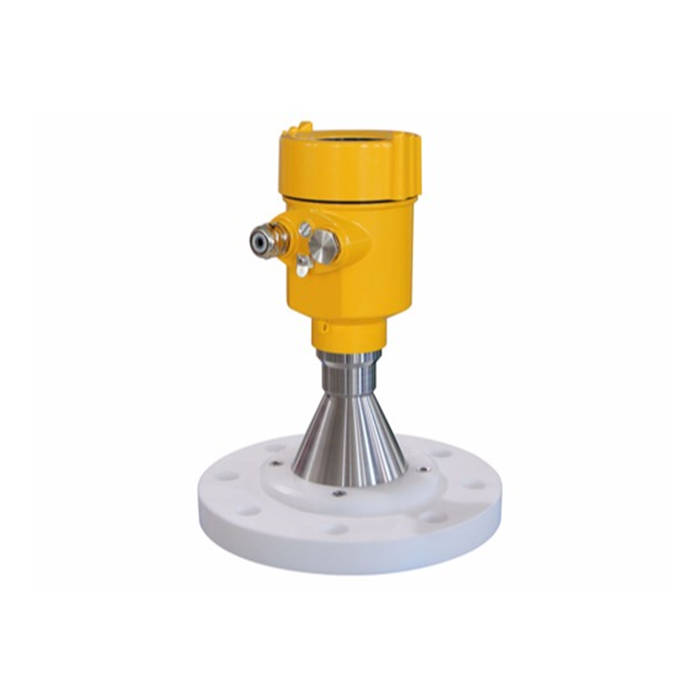
5. When Is a Radar Level Gauge More Suitable?
An existing top connection is available
For new tanks or vessels with a suitable flange or threaded connection, radar installation and commissioning are normally straightforward.
Long measuring range
Large storage tanks, tall vessels, and silos can be matched with radar instruments designed for the required measuring distance.
High-viscosity or sediment-forming media
Free-space radar does not require an acoustic signal to travel upward through the liquid from the bottom of the tank, giving it a wider application range in many difficult media.
Solid level measurement
Grain, cement, mineral powder, plastic pellets, and many other powders and granules are commonly measured with radar level instruments.
Complex internal structures
80GHz radar can use a narrow beam to avoid some pipes, supports, vessel walls, and other internal obstructions.
Complex temperature and pressure conditions
Industrial radar level instruments are available in versions designed for high temperature, high pressure, vacuum, and hazardous areas.
6. What Are the Advantages of an 80GHz Radar Level Gauge?
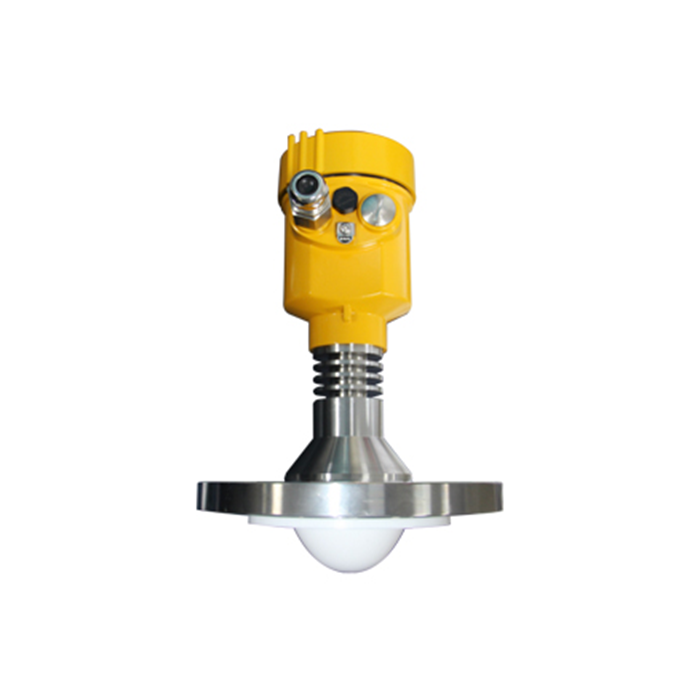
One important advantage of 80GHz radar is that it can achieve a relatively narrow measuring beam with a compact antenna. This makes it particularly useful for narrow vessels and tanks with complex internal structures.
If a tank contains agitators, heating coils, internal pipes, or the radar must be installed relatively close to the vessel wall, a narrow beam can reduce the probability of the radar signal striking unwanted obstructions and can improve identification of the actual liquid surface.
Note:80GHz does not mean that every radar instrument has a fixed 3° beam angle, nor does it mean that all 80GHz radar instruments have the same accuracy or measuring range. Actual performance depends on the antenna size, instrument model, and product design.
7. How Should High-Temperature, High-Pressure and Corrosive Applications Be Selected?
| Process Condition | Selection Consideration |
|---|---|
| High-pressure sealed tank | If no new process opening is permitted, an external-mounted gauge is worth evaluating. If a suitable top connection already exists, a radar instrument with the correct pressure rating can also be used. |
| High-temperature medium | For external-mounted measurement, confirm vessel surface temperature and sensor temperature limits. For radar, confirm antenna, seal, and process connection temperature ratings. |
| Strongly corrosive liquid | External-mounted measurement has no wetted sensor parts and therefore offers an installation advantage. Radar requires correct antenna and process connection materials. |
| Flammable or explosive medium | Both technologies must be selected according to the hazardous-area classification and required explosion-protection certification. |
8. How Do Foam, Vapor and Bubbles Affect the Two Technologies?
Large amounts of bubbles inside the liquid
This can have a significant effect on external-mounted ultrasonic measurement because bubbles may scatter and attenuate the acoustic signal.
Surface foam
Both technologies should be evaluated according to foam thickness, density, and media properties. The presence of foam alone is not enough to determine which technology is suitable.
Vapor environment
Radar uses electromagnetic waves and does not depend on gas-phase sound velocity, so it generally offers a broader application range in complex vapor and gas-space conditions.
9. Quick Selection Guide
| Site Condition | Technology Normally Evaluated First |
|---|---|
| The vessel cannot be opened | External-mounted level gauge |
| No contact with hazardous liquid is preferred | External-mounted level gauge |
| Existing tank retrofit | External-mounted level gauge |
| Solid silo | Radar level gauge |
| Double-wall tank or vacuum jacket | Radar should normally be evaluated first; external-mounted measurement requires special confirmation |
| Large amounts of bubbles or bottom sediment | Radar is normally evaluated first |
| Many internal pipes or supports | 80GHz narrow-beam radar can be considered |
10. What Information Is Required Before Selecting a Level Gauge?
Media Information
Medium name
Viscosity
Presence of bubbles
Suspended solids
Crystallization tendency
Tank Information
Tank height
Tank diameter
Vessel material
Wall thickness
Lining or double-wall construction
Process Conditions
Normal and maximum temperature
Normal and maximum pressure
Vapor conditions
Foam
Vacuum conditions
Installation Conditions
Whether tank modification is allowed
Available top connection
Connection size
Hazardous-area requirement
Tank photos
FAQ: External-Mounted Level Gauge vs. Radar Level Gauge
1. Which is better, an external-mounted level gauge or a radar level gauge?
Neither technology is universally better. For sealed vessels that cannot be opened or where the sensor should not contact the medium, external-mounted measurement is worth evaluating. For long-range measurement, complex process conditions, and solid level measurement, radar generally offers a broader application range.
2. Does an external-mounted level gauge really require no tank opening?
Normally, no additional process opening is required. The sensor is mounted on the outside of the vessel, but the vessel material, wall thickness, installation surface, and acoustic coupling conditions must still be suitable.
3. Can an external-mounted level gauge be used on a pressurized tank?
It can be evaluated for pressurized vessels because the sensor is installed outside the vessel and does not directly withstand process pressure. Vessel construction, surface temperature, process medium, and hazardous-area requirements must still be confirmed.
4. Can an external-mounted level gauge measure strong acids or alkalis?
Because the sensor does not directly contact the process medium, it can offer an advantage for corrosive liquids. Measurement feasibility still depends on the vessel wall, bubbles, suspended solids, sediment, and other process conditions.
5. Is an 80GHz radar level gauge always more accurate than an external-mounted level gauge?
High-performance 80GHz radar instruments can provide millimeter-level process measurement, but actual accuracy depends on the specific product model and application conditions. Project selection should compare the specifications of actual instruments rather than only the measurement technology.
6. Can an external-mounted level gauge be used on a double-wall tank?
Special evaluation is required. Double-wall construction, vacuum jackets, air gaps, insulation, and some lining systems can significantly attenuate ultrasonic energy, so they should not be treated in the same way as a standard single-wall steel vessel.
7. Can an external-mounted level gauge measure cement or grain?
Continuous external-mounted ultrasonic level gauges are mainly intended for liquids. Cement, grain, mineral powder, and other powders or granules are generally better suited to radar level measurement.
8. Does installation of a radar level gauge always require a shutdown?
No. If the vessel already has a suitable instrument connection, installation may be possible under the site's approved safety procedure. A shutdown may be required only when a new opening, welding, or pressure-boundary modification is necessary.
9. What information does METRAVON require for level instrument selection?
Please provide the medium name, tank height and diameter, vessel material and wall thickness, temperature, pressure, bubbles, sediment conditions, available top connection, hazardous-area requirements, and tank photos. These details help determine whether an external-mounted level gauge, 80GHz radar level gauge, or another level measurement technology is more suitable.
Conclusion
External-mounted level gauges and radar level gauges represent two different approaches to industrial level measurement.The main advantage of an external-mounted level gauge is non-intrusive installation, making it particularly suitable for sealed vessels that cannot be opened, hazardous liquids, and retrofit projects.The main advantage of radar level measurement is its broad application range, including long measuring distances, complex vessels, high-viscosity liquids, and many solid level applications.
Instrument selection should therefore not be based only on accuracy or price. METRAVON recommends evaluating the process medium, vessel construction, wall thickness, temperature, pressure, bubbles, sediment, measuring range, and available installation connections before deciding between an external-mounted level gauge, 80GHz radar level gauge, or another level measurement solution.