Chinese
 Spanish
 Russian
 Portuguese
 French
 German
 Indonesian
 Thai
Thai Vietnamese
 Arabic
 Italian
 Turkish
 Polish
 Japanese
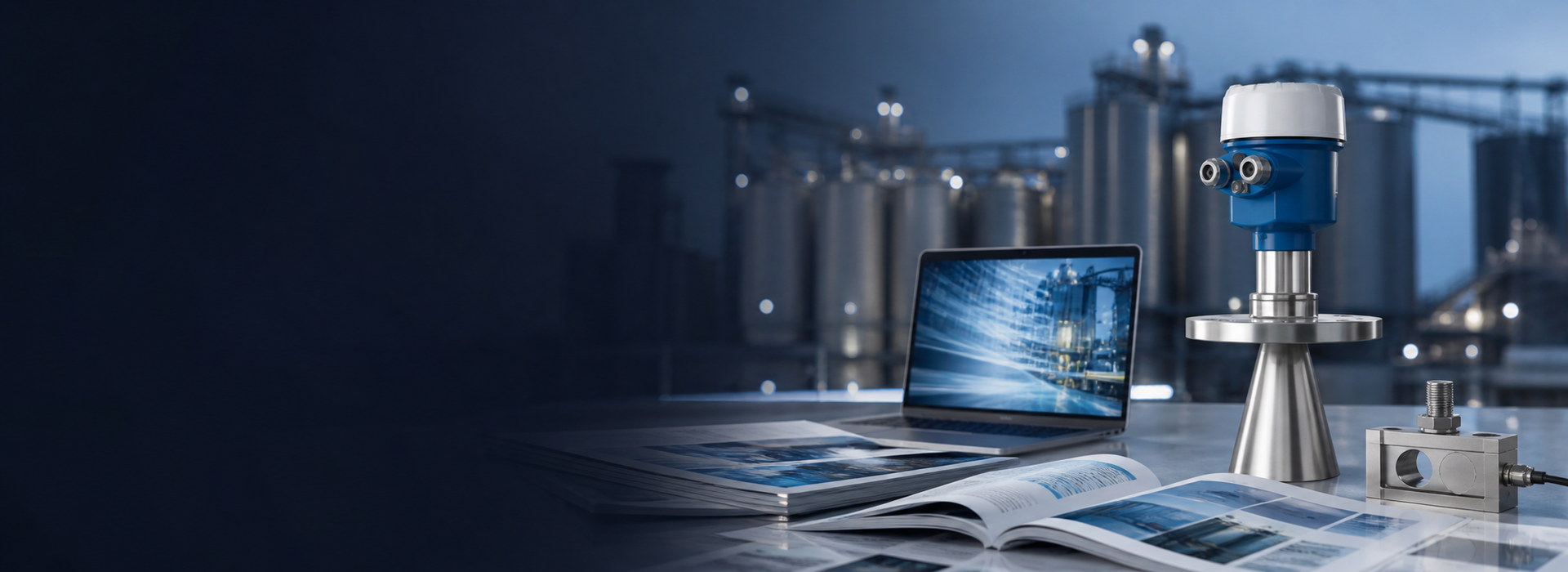
An FMCW radar level meter transmits a microwave signal whose frequency changes continuously during a controlled sweep. The received echo returns after a short delay. Comparing transmitted and received signals produces a beat frequency related to target distance. The instrument then selects the process-surface echo and converts distance into level.
From frequency sweep to measured distance
The electronics generate a known frequency ramp and transmit it through the antenna. A reflection from the product surface returns after a delay determined by propagation distance. Because the transmitted frequency has continued changing, the returning signal differs from the current transmitted signal. Signal processing uses that difference to estimate distance.
The displayed level is not the beat frequency itself. The instrument applies calibration, antenna reference information and echo processing to produce distance. It then uses the configured empty distance, zero point or vessel reference to calculate level, percentage, volume or another derived value.
Why the echo curve contains several targets
Microwaves can reflect from the nozzle, vessel wall, ladder, agitator, heating coil and product surface. Multiple reflections may also appear. An echo curve plots response against distance, allowing technicians to compare the expected product target with fixed interference and the instrument's selected echo.
A strong peak is not automatically the product. Fixed metalwork may return more energy than a low-dielectric liquid or dusty surface. Reliable tracking uses distance limits, signal behavior and process history. Installation geometry should remove avoidable interference before software suppression is considered.
Reference plane, empty distance and level conversion
Distance normally begins at a defined antenna reference plane. The empty-distance setting links that datum to the zero-level point. If a replacement antenna has a different reference plane, copying the old range can create an offset even when the measured distance is correct.
PLC scaling adds another conversion. A transmitter may output distance while the PLC expects level, or the 4–20 mA endpoints may be reversed. Commissioning must compare local distance, calculated level, analog current or digital register, raw PLC value and final engineering units at known references.
What process conditions do to the signal
Low dielectric reflection, foam, vapor, condensation, dust and antenna buildup can reduce or redistribute echo energy. Turbulence and moving piles change the target surface. FMCW processing can separate targets in distance, but it cannot restore a signal blocked by a solid deposit or make an unrepresentative mounting point representative.
Damping can smooth normal surface movement, but excessive filtering delays a real change and may hide short disturbances. Set response time from process dynamics and alarm requirements. Treat lost echo as a quality condition with a defined output and PLC action, not as a number to conceal.
Commissioning and troubleshooting evidence
Capture echo curves at empty or low level, normal level and the most difficult process state. Record reference distances, signal quality, selected echo, false-echo settings and output configuration. Photographs of the nozzle and internals help explain peaks that later appear after maintenance or a process change.
When a reading is wrong, first determine whether raw distance is wrong or only the converted level is wrong. A wrong distance points toward echo selection, geometry or process conditions. A correct distance with wrong level points toward reference settings, tank conversion, output mapping or PLC scaling.
Worked diagnostic example
Assume a radar shows 3.20 m distance locally while the PLC displays 70% level. An independent reference confirms the 3.20 m distance. Do not change echo tracking: inspect the configured empty distance, output variable and PLC endpoints. If the instrument instead jumps from 3.20 m to a fixed 1.10 m whenever an agitator starts, compare the echo curve with the agitator geometry and product signal.
The two faults require different evidence. The first is a conversion-chain problem; the second is a target-selection problem. Recording distance, selected echo, loop current or register value, raw PLC input and final display at the same timestamp prevents a team from masking one fault with settings intended for the other.
Engineering checklist
- Confirm the antenna reference plane and measured empty distance.
- Map fixed objects to echo-curve distances.
- Verify the selected product echo in several process states.
- Define damping and lost-echo behavior from process risk.
- Check 4–20 mA or digital-register mapping.
- Preserve baseline echo curves and configuration records.
Frequently asked questions
Does FMCW radar measure level directly?
It first estimates distance to a selected target, then converts that distance into level using configured vessel references.
Why can a stable display still be wrong?
The radar may be consistently tracking a fixed obstruction, or the distance may be converted with an incorrect empty distance or PLC scale.
Should every extra echo be suppressed?
No. Suppress only confirmed fixed interference and verify the full operating range so the true product echo remains available.
Need a project-specific review? Send the medium, vessel drawing, operating conditions, installation photographs, required outputs and acceptance criteria through our contact page. METRAVON can help define the measurement scope before quotation.
Related measurement solutions
26 GHz or guided-wave radar solutions · 80 GHz radar solutions