Chinese
 Spanish
 Russian
 Portuguese
 French
 German
 Indonesian
 Thai
Thai Vietnamese
 Arabic
 Italian
 Turkish
 Polish
 Japanese
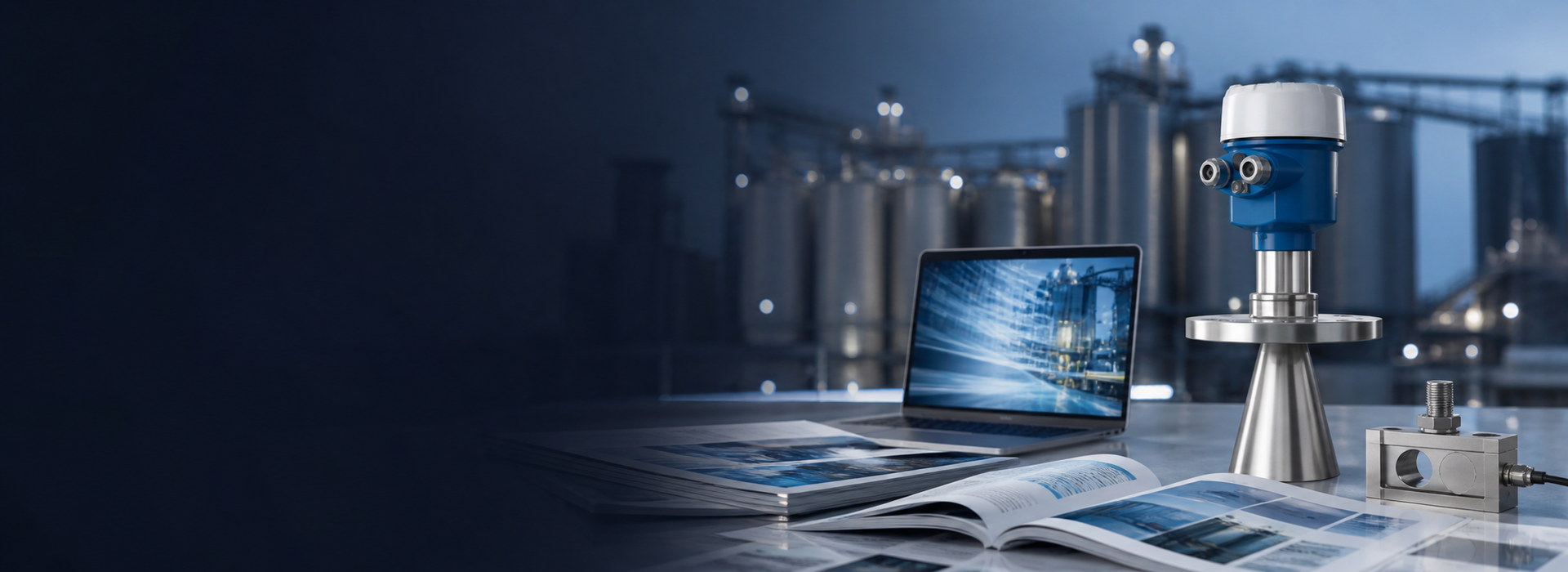
Radar and ultrasonic level sensors both measure distance without contacting the product, but their signals behave differently. Radar uses electromagnetic waves and is generally less affected by gas temperature, pressure and vapour composition; it still needs sufficient reflection, a suitable antenna position and control of false echoes. Ultrasonic instruments use sound in the gas space, so temperature gradients, steam, changing gas composition and dense foam can change or weaken the return. Selection should be based on the complete process envelope rather than a general claim that one technology is always better. Define vessel height, maximum level, nozzle, internals, agitation, filling stream, pressure, temperature, vapour, foam, condensation, dielectric behaviour and required accuracy. Compare the highest credible level with each sensor's blocking distance or dead zone, and decide how lost signal must appear in the control system.
Compare the measurement physics
Radar calculates distance from microwave travel time or frequency response. Product dielectric properties and antenna geometry influence reflection, although modern high-frequency radar can resolve narrow targets well.
Ultrasonic calculates distance from acoustic travel time. Temperature compensation helps near the transducer but cannot fully correct non-uniform thermal layers or a changing gas mixture along the path.
Evaluate vapour, foam and condensation
Steam and dense vapour often favour radar because microwave propagation is less dependent on the gas. Heavy antenna condensation can still attenuate energy or create near-field echoes.
Ultrasonic performance may decline in steam, mist or thermal stratification. Soft foam can absorb sound, while some wet foam reflects it; actual variability matters more than a simple yes-or-no foam statement.
Review geometry and mounting
For both technologies, draw the beam or acoustic cone, nozzle bore, maximum level and internal obstructions. Avoid fill streams and mount perpendicular to the representative surface.
Radar's narrower beam can help in tall or congested vessels. Ultrasonic may work well in open water tanks when the acoustic path is clear and the dead zone is respected.
Consider liquids and bulk solids
Radar is widely applied to liquids and powders, but solids create sloped, moving surfaces and dust. Check angle of repose, lowest dielectric condition and filling impact.
Ultrasonic can measure some solids but dust and irregular surfaces may weaken the echo. For wells or narrow sumps, hydrostatic measurement may be a simpler alternative.
Compare diagnostics and failure handling
Require access to echo curves, signal quality and fault history rather than relying only on the displayed level. Capture baseline diagnostics at low, middle and high conditions.
Define lost-echo timeout, output on fault, damping and quality status in the PLC. A held last value must not look like a valid stable measurement.
Assess lifecycle cost
Compare sensor, mounting, cable, surge protection, configuration, commissioning and cleaning access. A lower purchase price loses value if process changes cause repeated false readings.
Choose a technology with adequate margin, documented acceptance criteria and maintainable diagnostics. Keep independent overfill protection where the risk assessment requires it.
Engineering checklist
- Document all process extremes.
- Draw nozzle and internal geometry.
- Check dead zone at maximum level.
- Review foam, vapour and condensation.
- Specify lost-echo behaviour.
- Capture commissioning echo diagnostics.
Frequently asked questions
Is radar always better than ultrasonic?
No. Radar is often more robust in vapour and temperature variation, while ultrasonic can be economical in clear, vented applications.
Does foam affect both technologies equally?
No. Acoustic and microwave interactions differ, and foam type, thickness and moisture must be evaluated.
Can either transmitter replace a high-high switch?
Only when the protection design and risk assessment permit it; critical overfill often requires an independent device.
Need a project-specific review? Send process data, drawings, photographs and acceptance criteria through our contact page.
During a site trial, compare each device against the same physical datum and operating sequence. Do not tune one instrument under calm conditions and judge the other during filling. Preserve raw distance, echo and quality data so the result can be reviewed independently.