Chinese
 Spanish
 Russian
 Portuguese
 French
 German
 Indonesian
 Thai
Thai Vietnamese
 Arabic
 Italian
 Turkish
 Polish
 Japanese
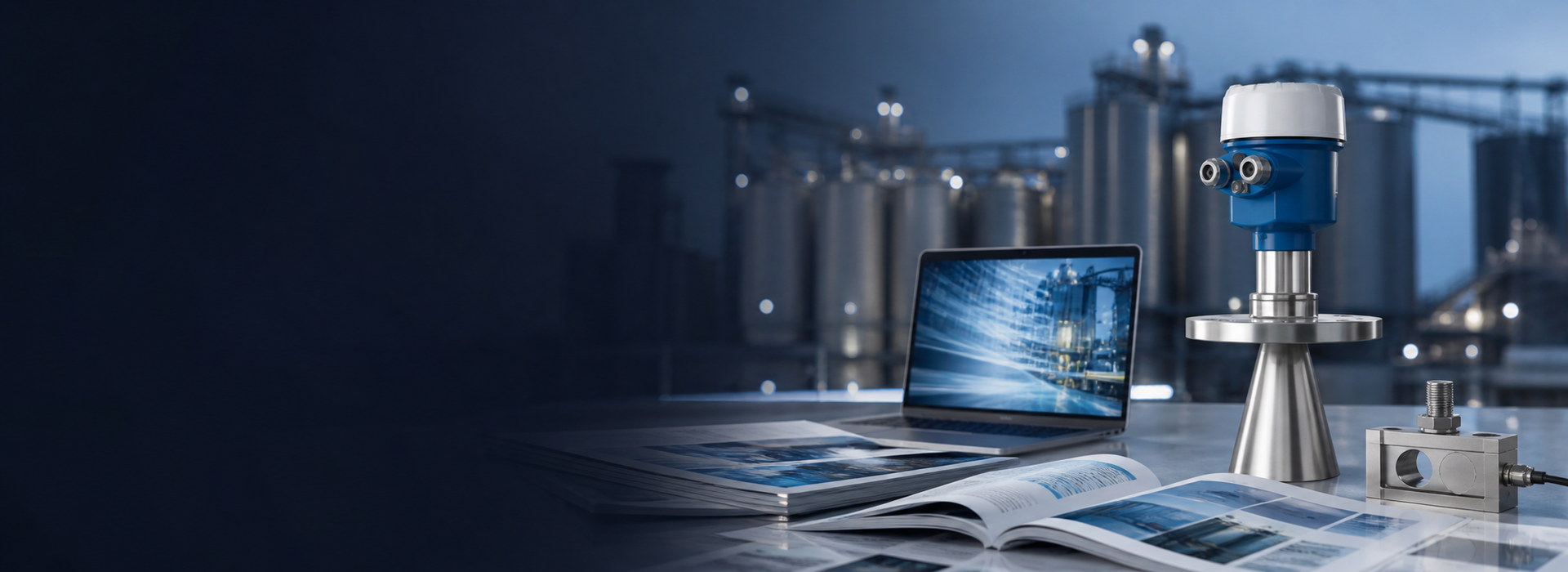
Grain silo level measurement must deal with an uneven surface, changing bulk density, dust and material movement. Filling forms a cone under the inlet; discharge creates a funnel above the outlet; aeration and settling change the profile after flow stops. A roof-mounted radar measures distance to one surface region, so inventory accuracy depends on where the beam lands and how level is converted to volume and mass. Begin with silo geometry, grain types, moisture, filling and discharge arrangements, then separate continuous inventory measurement from independent high-level protection.
Describe grain and operating variability
List grain types, bulk-density and moisture ranges, particle size, dust level and temperature. Include fumigation, aeration and seasonal storage conditions.
Record filling and discharge rates, inlet position, multiple outlets and expected settling. These conditions alter surface shape and the relationship between one measured distance and total mass.
Survey silo geometry
Measure cylindrical and cone dimensions, roof, nozzle, outlet and the radar reference plane. Mark ladders, braces, aeration pipes and other fixed reflectors.
Choose a mounting point away from the fill stream and wall buildup. Aim at a surface area that remains observable across the working range.
Select sensor and beam path
Compare radar frequency, beam angle, antenna, range, dielectric sensitivity and nozzle compatibility. Verify temperature, dust classification and enclosure requirements.
Use echo curves to separate grain surface from fixed structures. Do not suppress a changing process echo because it resembles an obstruction during one condition.
Convert level to useful inventory
Apply the correct silo geometry and a controlled datum. Account for fill cone, discharge funnel and dead stock when estimating volume.
Use current bulk density when converting volume to mass. State inventory uncertainty separately from the radar’s distance accuracy so commercial decisions are not based on false precision.
Manage faults and overfill risk
Define lost-echo timeout, stale-value indication and alarm delays from real filling rates. Flag implausible rate of change and communication loss.
Install an independent high-level switch where the consequence requires it. Test conveying shutdown, alarm annunciation and operator response through the final action.
Validate over complete cycles
Compare readings with delivery weights, withdrawals or surveyed levels during filling, rest and discharge. Record grain type and operating state with each comparison.
Trend persistent bias before adjusting calibration. Revalidate after grain, inlet, outlet, geometry, sensor position or volume-table changes.
Account for grain safety and material movement
Coordinate sensor installation with combustible-dust classification, grounding, aeration and fumigation procedures. Verify that the antenna and cable entries do not introduce an ignition or leakage path.
Document angle of repose, material in transit after conveyor stop and expected freeboard. Alarm settings should allow for continued inflow while remaining high enough to avoid nuisance trips from the temporary filling cone. Confirm the assumptions with operators for each grain and conveying route before final setpoint approval, then retain the signed basis with the alarm record, proof-test result and verified conveyor stopping time.
Engineering checklist
- Document grain and moisture ranges.
- Map fill cone and discharge funnel.
- Select mounting and beam path together.
- Separate distance, volume and mass uncertainty.
- Provide independent overfill protection where needed.
- Validate through full storage cycles.
Frequently asked questions
Can one radar measure total grain mass?
It measures distance at one area; geometry, surface profile and bulk density are also needed to estimate mass.
Why does inventory change after filling stops?
Grain settles and the surface redistributes, changing the measured point and bulk density.
Is dust a problem for radar?
Radar often performs well, but dense dust, weak dielectric response, buildup and geometry still affect signal margin.
Need a project-specific review? Send process data, drawings, photographs and acceptance criteria through our contact page.