Chinese
 Spanish
 Russian
 Portuguese
 French
 German
 Indonesian
 Thai
Thai Vietnamese
 Arabic
 Italian
 Turkish
 Polish
 Japanese
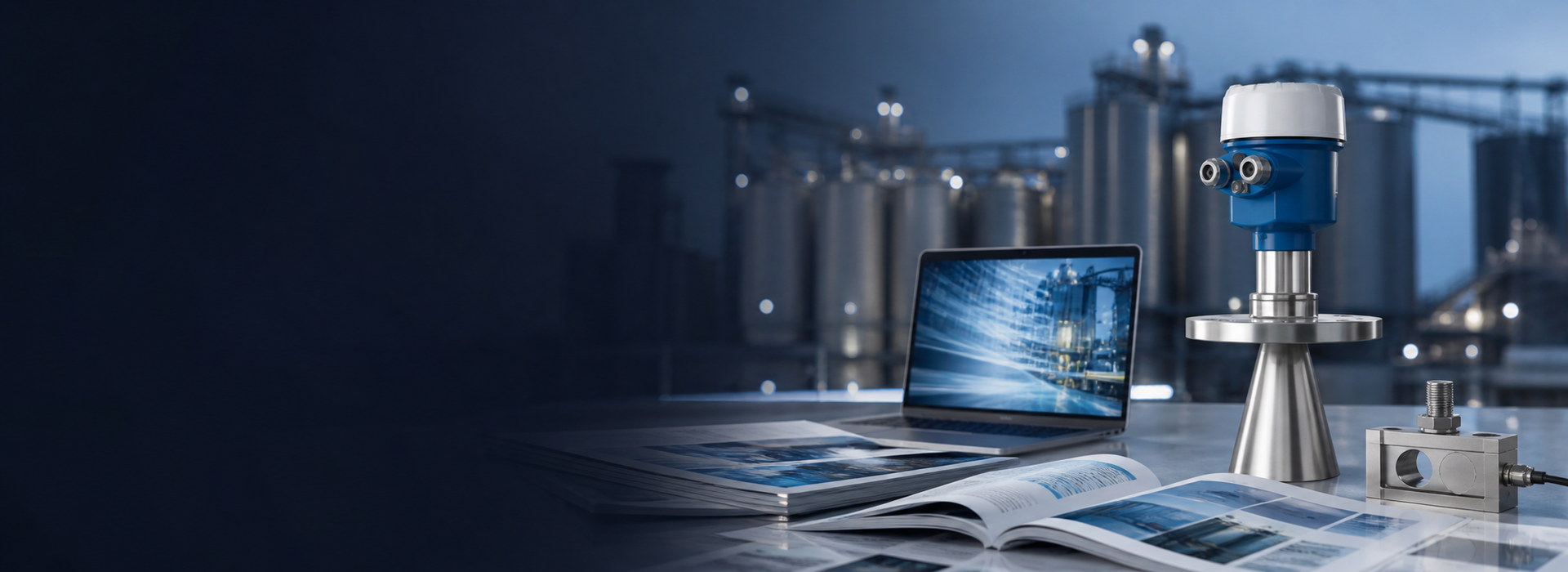
Cement silos combine low-dielectric powder, dense filling dust, wall buildup and steep surface profiles. Pneumatic filling can create a strong moving plume, while discharge forms a cone or rathole that a roof-mounted radar does not see uniformly. Radar is attractive because it has no contact with the material, but success depends on antenna choice, beam path, nozzle, signal margin and configuration. The measurement objective must be clear: continuous trend, approximate inventory, delivery control or high-level protection. A continuous radar reading should not automatically replace an independent overfill switch where loss of containment or filter damage has serious consequences.
Define cement and operating conditions
Record cement types, additives, bulk-density range, moisture, temperature and filling method. Note whether multiple products share the silo and whether cleaning is performed.
Provide fill and discharge rates, maximum dust duration, aeration, vibration and pressure excursions. These determine response time, echo loss and alarm delay requirements.
Map the silo and surface
Measure height, diameter, roof, cone, nozzle and outlet. Mark fill pipes, filters, ladders, braces and known buildup zones.
Predict filling and discharge surface angles and choose a beam target that remains representative. Do not mount in the direct fill stream or aim at a permanent structure.
Select antenna and installation
Compare radar frequency, beam angle, sensitivity, antenna size, process temperature and dust protection. Verify nozzle diameter, length and any weld or reducer interference.
Provide safe access and mechanical protection. Purge arrangements should be justified and must not disturb hazardous-dust controls or create ongoing maintenance dependence.
Configure echo processing
Capture empty-silo structural echoes before product loading when possible, then collect curves during filling and stable conditions. Apply false-echo suppression only to confirmed fixed targets.
Set tracking, damping and lost-echo behavior from actual material rates. Identify frozen or stale values clearly in the control and inventory system.
Separate inventory uncertainty from distance accuracy
Convert level to volume using the correct silo geometry, then account for surface profile and bulk-density variation when estimating mass. Sensor accuracy alone does not define inventory accuracy.
Compare deliveries and withdrawals with weigh data over complete cycles. Investigate systematic imbalance before changing calibration.
Commission alarms and protection
Verify distance, level, volume and PLC scaling at known points. Test high alarms, filling permissives and communication-fault response through the final equipment.
Use an independent high-high switch when required by risk. Record echo curves, settings, alarm tests and inspection intervals for future comparison.
Coordinate filling operations and alarm response
Set operator actions for high, high-high, rapid-rise and lost-signal conditions before commissioning. Confirm conveying stop time, material in transit and the remaining freeboard after a shutdown command.
Run a documented response drill without creating an overfill. Verify that filter, diverter, conveying and control teams receive a clear alarm and that restart requires confirmation of the actual silo condition. Record the response time and remaining capacity for each conveying route under normal throughput and maximum credible delivery rate.
Engineering checklist
- Define inventory and protection duties.
- Map fill and discharge profiles.
- Keep the beam clear of filling and structures.
- Validate echoes in several operating states.
- Account for geometry and bulk density.
- Proof-test overfill actions independently.
Frequently asked questions
Can radar measure through cement dust?
Often yes, but dense dust, weak dielectric response, buildup and geometry must be included in signal-margin review.
Why does indicated inventory differ from deliveries?
Surface shape, bulk density, wall buildup and volume conversion contribute uncertainty beyond the distance reading.
Is one radar enough for overfill protection?
Use an independent high-high device when the hazard analysis requires a separate protection layer.
Need a project-specific review? Send process data, drawings, photographs and acceptance criteria through our contact page.