Chinese
 Spanish
 Russian
 Portuguese
 French
 German
 Indonesian
 Thai
Thai Vietnamese
 Arabic
 Italian
 Turkish
 Polish
 Japanese
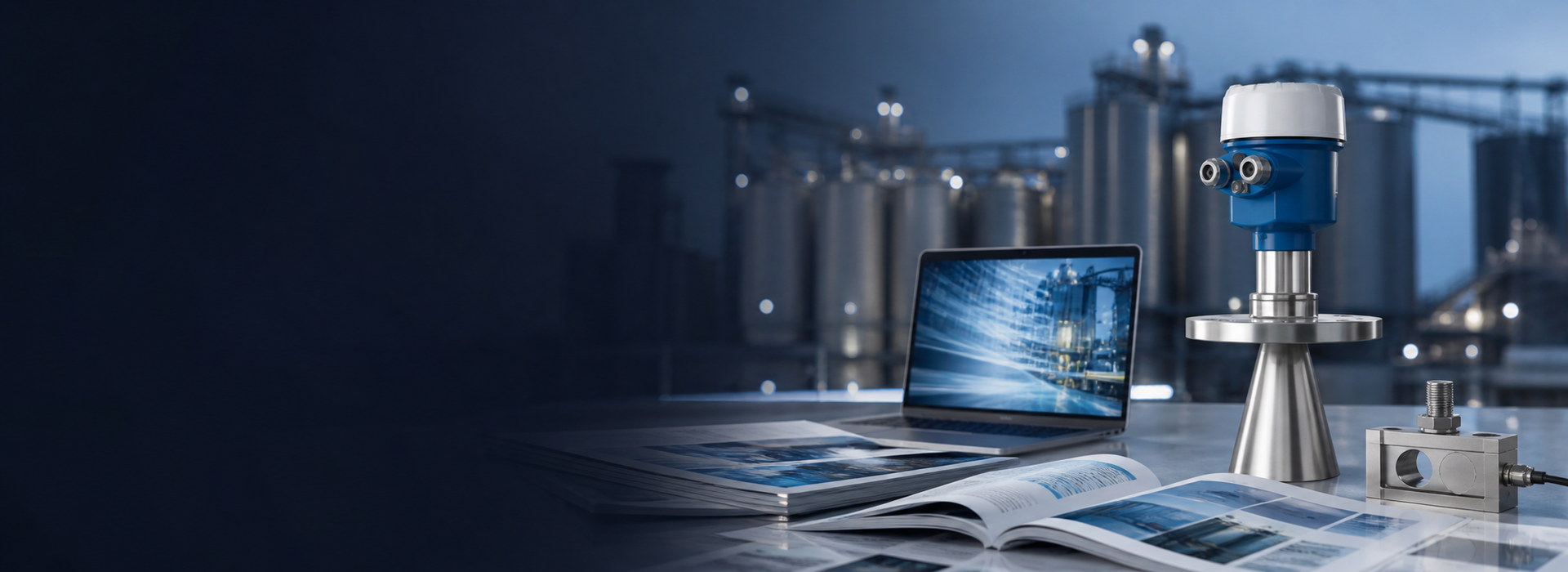
An ultrasonic level sensor sends an acoustic pulse and calculates distance from echo travel time. It provides non-contact measurement without wetted probes, but performance depends on the atmosphere between transducer and surface. Define range, tank geometry, nozzle, temperature, pressure, vapour composition, foam, turbulence, condensation, vacuum, fill stream and required accuracy. Ultrasonic technology can be effective for open water and many vented tanks; radar or hydrostatic measurement may be more robust where vapour, pressure or foam causes an uncertain acoustic path.
Define range and dead zone
Measure from the transducer reference face to empty and highest level. Keep the maximum surface outside the blocking or dead zone, including overfill and foam. Confirm usable range under the weakest expected echo, not just the advertised maximum. Leave margin for temperature, turbulence and mounting tolerance.
Account for sound velocity
Distance calculation depends on sound speed, which changes with temperature and gas composition. Integrated temperature compensation corrects local air temperature but may not represent a strong gradient. Solvent vapour, steam or stratified gas can introduce error. Vacuum prevents normal acoustic propagation and is generally unsuitable.
Assess foam and turbulence
Light open foam may return from liquid, while dense foam can absorb sound or create a false surface. Agitation and falling liquid scatter the echo. Test representative conditions or choose a technology with a more reliable physical basis. Excessive damping may stabilize the display while hiding rapid genuine level change.
Design the mounting
Mount perpendicular to the expected surface with a clear acoustic cone. Avoid narrow nozzles, ladders, pipes, agitators and fill streams. Follow minimum nozzle diameter and length. A stilling tube requires suitable diameter, smooth joints and venting, and contamination inside the tube becomes a maintenance concern.
Configure echoes and outputs
Set reference plane, empty distance, span, output direction and fault current. Review the echo profile before applying false-echo suppression. Confirm 4–20 mA or digital scaling at the PLC. A lost echo should produce an explicit bad-quality state rather than freezing the last value as apparently valid.
Commission across conditions
Verify readings at known low, middle and high levels where safe. Capture echo strength during filling, pumping and agitation, and inspect condensation after temperature changes. Test high-level alarms and communications separately. Retain baseline echo plots and parameters so future degradation can be compared objectively.
Engineering checklist
- Define the task and operating limits.
- Verify mechanical, electrical and environmental fit.
- Specify accuracy, safety and fault response.
- Test the complete installed system.
- Retain baseline and maintenance records.
Frequently asked questions
Does ultrasonic work through foam?
It depends on foam density and stability; representative testing or another technology may be needed.
Can it be installed in a vacuum vessel?
Generally no, because sound requires a gas path.
Why does level drift with weather?
Air-temperature gradients, wind, condensation or changing vapour can alter the acoustic path.
Maintenance should inspect the transducer face, mounting angle, nozzle and nearby obstructions before retuning. Trend echo strength, lost-echo events and temperature alongside level. After a process, vessel or firmware change, repeat the baseline checks. Parameter changes should remain controlled because aggressive suppression can make an unsafe false reading look stable.
Need a project-specific review? Send process data and drawings through our contact page.
For open channels and outdoor basins, review wind, rain, ice, direct sunlight and moving structures. A protective hood must not obstruct the acoustic path or trap condensation. If the measurement feeds flow calculation, survey the sensor datum and primary-device dimensions because level error is amplified by the flow equation. Validate totalized flow against an independent method where required and retain both the geometric survey and sensor configuration with the commissioning record.