


 Chinese
 Spanish
 Russian
 Portuguese
 French
 German
 Indonesian
 Thai
 Vietnamese
 Arabic
 Italian
 Turkish
 Polish
 Japanese


Cement silo level measurement has to remain useful during pneumatic filling, dusty conditions and discharge, not just when the vessel is empty and cool. A radar must be selected for the actual material and temperature at its installation point. METRAVON MV-RD21S and MV-RD21G provide different bulk-solids configurations to assess; neither frequency nor maximum range alone establishes suitability for the silo.
Separate the dust problem from the temperature problem
Airborne dust, a layer on the antenna and a hot process connection are different conditions. Airborne dust can affect the received signal during filling. Deposits can obstruct the antenna after filling has stopped. Heat can exceed the limits of the antenna, seal, electronics or cable even when the radar still reports a plausible value.
Describe each condition separately in the enquiry. Include the material, particle behaviour, moisture, filling method, duration of dusty operation and whether deposits harden after exposure to condensation. Record normal and upset temperatures at the connection and around the electronics; an average material temperature is not enough to approve the instrument assembly.
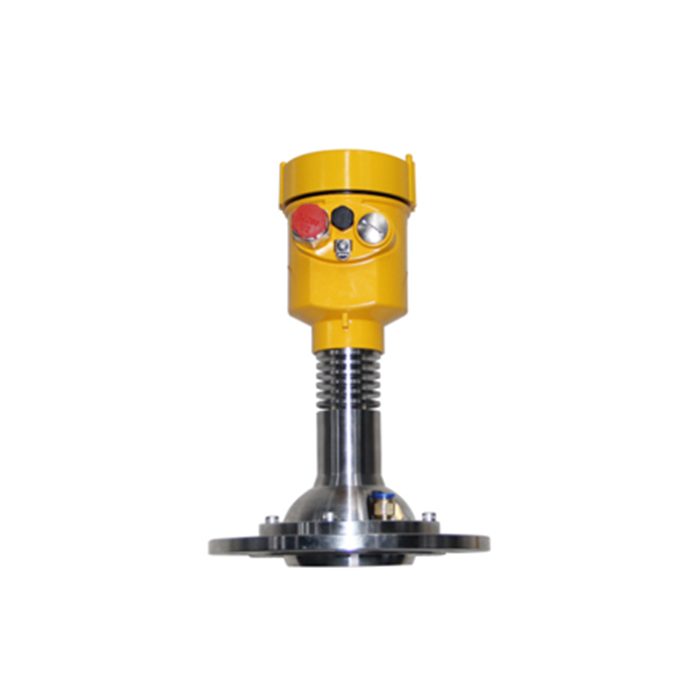
Cement silo level measurement: compare the actual configurations
The MV-RD21S is a PE-lens bulk-solids configuration with a process-temperature reference up to 80 deg C. The MV-RD21G uses a PTFE-lens high-temperature assembly with a documented process reference up to 200 deg C. These values identify different product configurations; they are not blanket approvals for every combination of pressure, temperature and mounting.
Match the selected antenna, process connection, seal, range and electrical version to the offered unit. For a heated installation, the heat-dissipating section must remain effective. Enclosing it in silo insulation or a tightly fitted protective cover can change the thermal conditions. Obtain the installation requirements before completing the insulation or weather protection design.
Do not substitute a liquid-service radar merely because its temperature rating appears suitable. The antenna arrangement, material surface and application documentation must support the intended bulk-solid service. Likewise, a long-range version does not guarantee a usable return from every powder under the heaviest filling dust.
| Condition | Information needed | Selection or acceptance check |
|---|---|---|
| Hot connection | Normal and peak temperatures, duration, nozzle and insulation details. | Confirm the assembled process rating and the separate limits at the electronics and cable entries. |
| Filling dust | Delivery method, filling rate, material behaviour and normal venting conditions. | Observe echo tracking during the representative filling cycle rather than relying on an empty-silo test. |
| Antenna deposits | Moisture, condensation, coating after filling and safe access for inspection. | Review the antenna arrangement and any approved cleaning provision; do not assume the sensor cleans itself. |
| Uneven surface | Inlet and outlet positions, expected cones or funnels, and internal structures. | Assess whether the measured surface position represents the intended inventory or alarm duty. |
| Overfill risk | Shutdown delay, material remaining in transport and the required protective action. | Define the alarm location and test the entire response, including any independently required point detector. |
Inspect the roof opening and the complete beam path
Measure the nozzle's clear bore and length, including linings, adaptors and projections. Check whether the antenna is recessed behind an edge that can collect material or produce a fixed echo. The vessel drawing should show fill pipes, reinforcement, ladders and other objects between the antenna and the lowest material surface.
A narrow beam can help avoid structures, but its footprint grows with distance. The roof location should be selected against the entire working range, not only the area immediately beneath the flange. The apparent level may change differently during filling and emptying as the pile develops around the inlet or outlet.
Keep the instrument out of direct filling impact and provide safe access for inspection. An installation that requires an improvised roof manoeuvre whenever the antenna needs cleaning is not a practical maintenance arrangement. Verify support stiffness and how vibration reaches the assembly, especially around pneumatic conveying equipment.
Decide how buildup will be handled
Where deposits are expected, establish an inspection baseline after commissioning. Compare the antenna condition and echo quality after representative operating cycles. This helps distinguish a progressively coated lens from a fixed obstruction or a change in material behaviour.
If purging is proposed, confirm that the selected assembly supports it and that the process permits the air supply and flow. Define the air quality and operating requirements using the approved configuration. Do not drill an improvised purge connection, or assume that purge equipment is included because another model has it.
A persistent loss of echo should trigger an investigation of deposits, mounting, process conditions and signal quality before more aggressive false-echo masking is applied. Suppressing a real material echo can make the reading look stable while it no longer follows the surface. Retain the original settings and diagnostic records so a change can be assessed and reversed if necessary.
Keep the point alarm and inventory conversion explicit
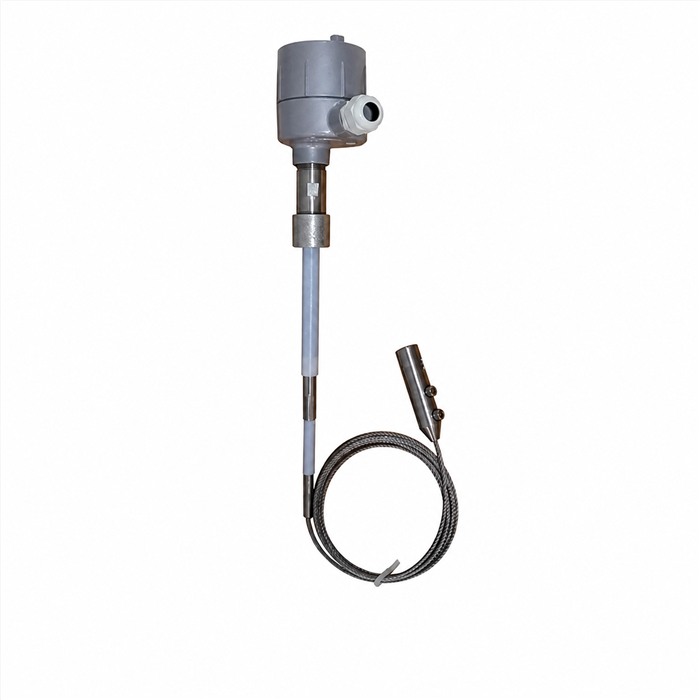
The MV-SP601 RF admittance switch is a candidate for a separate point-detection duty when its probe, process limits and output are appropriate. Its coating-rejection principle does not establish unlimited tolerance of hardened deposits. For hot powder, confirm the offered probe assembly's temperature rating independently of the radar rating.
Any conversion to tonnes also needs a separate review. Pneumatically filled powder can change bulk density as it settles, while cones, wall deposits and discharge funnels affect volume interpretation. Preserve the measured distance and conversion settings. The inventory monitoring guide compares level-derived estimates with vessel weighing.
Accept performance during filling and discharge
Before filling, check the measurement reference, configured span and response to known fixed structures. Then observe a representative filling cycle, including the dustiest operating phase and the approach to the high-level region. Check that the selected echo follows material rather than remaining on an internal feature.
Repeat observations during discharge and after the first relevant thermal cycle. Compare the displayed level, receiving PLC or logger value and an independent reference where one can be obtained safely. Record process conditions with each comparison; a cold, settled measurement and a hot filling measurement are not equivalent test conditions.
Test loss of echo, power and communications using an approved procedure. Define how operators distinguish bad or stale data from a valid low level. Where a protective function is required, its response and independence must be established by the site's control and safety assessment, not inferred from a generic product description.
Questions about dusty or heated silos
Q1. Should every cement silo use the high-temperature model?
No. Select it when the measured process conditions require that assembly. An ambient-temperature installation may have a different configuration need, while a hot installation also requires checks of seals, insulation and electronics exposure. Using the highest listed temperature is not a substitute for documenting the installation.
Q2. Can a radar be accepted from a successful empty test?
An empty test can establish reference distance and fixed echoes, but it does not reproduce filling dust, surface changes or deposits. Include operating trials at the conditions under which the level value will be used for control or delivery decisions.
Q3. Does an occasional stable reading prove that the antenna is clean enough?
No. Review echo quality and consistency over the operating cycle, together with the physical condition found during safe inspection. A remaining signal margin at one level may not be sufficient at another distance or during a dusty delivery.
Q4. What details are required before ordering?
Supply the silo cross-section and roof layout, material description, full distance range, temperature-pressure envelope, dust and coating conditions, available cleaning arrangements and required output. State whether the measurement is for delivery planning, inventory or a protective action, and identify the proposed acceptance reference.
Summary
For a dusty or heated powder silo, select the complete radar assembly and verify it during the difficult parts of the process. Keep temperature limits, deposit management, point alarms and stock conversion as distinct decisions. Request a METRAVON silo measurement review with the roof drawing and actual operating conditions, not only silo height.
